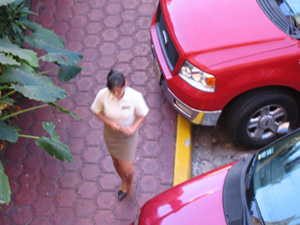
See how this young woman dresses in a blouse and skirt. And enjoys it!
When Americans work dead-end McJobs, they let the whole world know that they’re not happy with their jobs. They will serve you your food, process your order, or ring you out, but you know for a fact that they hate their job. In fact, if it weren’t for you the customer, user, or consumer, actually requiring their services, they could be sleeping in until noon everyday. Unfortunately, these are the very same people we most often encounter in our daily lives. I’m not saying all American workers have this bad attitude, but we encounter far more of them than necessary.
In Mexico, there is a totally different attitude toward work in a country where fifty-million people live on less than one dollar per day. Mexicans truly appreciate any and every job that they hold. Even when I was in Burger King or McDonald’s in Mexico (because my sons refused to eat the Mexican food my family cooked up for us), every single employee wore their uniform proudly and they took their job seriously. The service was so much better in Mexico because they did their job as well as they were supposed to do it. And they didn’t treat the customer as a mortal enemy to be hated the moment he or she entered the restaurant. The customer was always respected, nay, revered. Even the guy who washed my car in the parking lot when we went to the show in Celaya. He was so respectful when he offered to wash my car for thirty pesos that I paid him in advance because I trusted him and I just knew that I would come back and my car would be washed. I absolutely trusted him. When I returned I was very happy with how clean my car was.
If you go to el Zócalo in Mexico City, you may see all kinds of Mexicans. You really can’t say you’ve been to Mexico City unless you’ve visited el Zócalo In Mexico City. So every time I go to Mexico City, I end up in the Zocalo at least once.
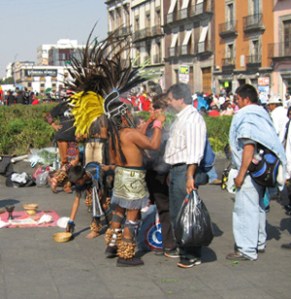
I really love this public square because many Mexicans feel compelled to visit it. El Zócalo is the center of Mexican life. You’ll also see many foreign tourists. Cathedrals, the presidential palace, and colonial buildings surrounding the Zocalo. If you look down in front of the cathedrals, you will see some glass inlaid into the sidewalk revealing the remains of Aztec pyramids below, which the Spaniards razed to construct the cathedral under orders of Hernán Cortés. As a reminder of Mexico’s past, Aztec dancers are ever present near el Zócalo dancing for the public. They will also perform a spiritual cleansing for you. They will cleanse you of any bad spirits that are hindering your happiness and wellbeing. Whenever you see the Aztec dancers, they are always cleansing someone with at least several others waiting in line for their turn.
I told my cousin that I probably needed a good cleansing, and she said I should get one. She confessed that she was once cleansed when life wasn’t treating her well and it improved her life for the better. She insisted that I should be cleansed. I would become a much better person. Well, I didn’t really believe a cleansing would really help me, so I passed. But now I wonder.
I had some unusual table conversations while I was in Mexico. I guess I learned a lot about Mexicans in my previous three visits to Mexico. I always felt that I could speak honestly about anything whenever my relatives asked me personal questions. And everyone else was also very honest in these conversations. But not in such a way as to hear more information than I wanted to hear.
One of the most unusual conversations turned from gossip about a woman’s breast implants to an impromptu questionnaire about breast implant preferences. Someone mentioned a certain woman who had unusually large breasts. Someone else who knew her said that she had had breast implants, but that she didn’t like them because they hurt her whenever someone touched them.
Suddenly, my cousin asked me if I liked breast implants. I felt uncomfortable answering this in mixed company, especially since I was asked by a female cousin. Well, I paused to think awhile, but my cousin’s husband immediately volunteered his opinion and said that he preferred natural breasts. He wouldn’t like breasts with implants if he couldn’t touch them and massage them during sex. The females also stated that they liked to have their breasts touched, so they would never get breast implants. All the while, I was surprised that I was participating in such a conversation in Mexico.
Driving on the streets of México City requires excellent driving skills, a good memory to remember all the major street names, great intestinal fortitude, and at least a couple of loose screws in the brain housing group. Because, who, in their right mind, would want to drive someplace where the drivers view the rules of the road as mere suggestions to be ignored whenever possible? I mean, besides me. Red lights mean stop if you think you’ll get into accident. Otherwise, don’t stop too long or the drivers behind you will start beeping at you to make you drive through the red light. Amazingly, you don’t see very many traffic accidents in Mexico City considering the congestion.
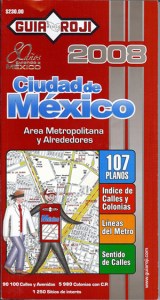
I felt embarrassed that I needed a map to get around México City. Until I found out that anyone who drives all over the city also has a map, like the one above by Roji. It’s a geographically large city, so there are way too many streets to memorize all their names. In fact, many Mexicans know the routes to various places such as their workplace and the homes of family members. But ask them to give you directions to a place they travel to daily, and they’ll be hard pressed to be able to give you accurate directions. Mainly because the don’t know the street names of all the streets on which they drive. My cousin drove me from her house to our aunt’s house. As we were driving, I took out my little notebook with everyone’s address. I asked my cousin the name of the street on which she was driving. She didn’t know its name. Or the names of half the streets we took.
When I drove to the house of another cousin, I followed the directions I was given. They were easy enough to follow. When I arrived at my cousin’s house, I got there way too early and I didn’t feel like waiting around for a few hours for her to get back. So I looked at my Roji and tried to drive to my aunt’s house following a new route that I plotted out, against the advice of my cousin. How hard could it be? Besides, I have been lost in Mexico City many times before. I started to miss driving on my own and getting lost on my own and then trying to find my way to my destination. The other thing about driving in Mexico City is that the street signs are so small, posted on the sides of buildings, making them difficult to locate so that they are rarely helpful. And sometimes when you do find them, they’re covered with graffiti and therefore unreadable.
Anyway, I’m driving to my aunt’s house, but the main street that I wanted to take is a one-way street in the opposite direction of my destination. So I figure I’ll take a parallel side street. However, the streets do not follow a regular grid system because Mexico is such an old city. So all side streets radiate out from the main strip of any given colonia, or neighborhood. Well, if I wanted to drive in a more or less parallel course to the main street, I had to zigzag my way from a couple of blocks away. It was easy to lose my sense of direction because very few streets ran in straight lines. Luckily, I thought to use the GPS feature of my iPhone and I could tell I was more or less on course.
Well, this was quite an adventure! And even though I swear I’ll never drive the streets of México City again (mainly when I’m completely lost while driving), I now miss that roller coaster ride of emotions ranging from fear to sheer terror while driving. I can’t wait to drive back to México City!
A long time ago, my cousin Gary from México came to visit me in Chicago with his friend Gustavo, also from México. It was a cold, snowy February day. Being the considerate host that I am (most of the time), I asked to take their coats. They said they wanted to keep them on. We talked for a while and finally they took off their coats because they got hot. I took their coats and hung them up in the closet. I asked them why they kept their coats on and they said that in México most houses didn’t have heating, so everyone keeps their coat on to stay warm. The weather is much more temperate in Mexico than in Chicago where we have extreme cold in the winter and extreme heat and humidity in the summer and so our homes have heating and air conditioning.
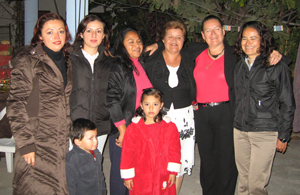
When I was in Mexico, not one home I visited had heating or air conditioning because they don’t really need it. In the winter, the temperatures drop, but everyone sleeps under blankets and when they are awake they wear coats or jackets in the house if they feel cold. Of course, everyone worries that I’m cold because I don’t wear a jacket along with everyone else. In fact, I wore short-sleeved shirts. People got cold watching me walk around sans jacket or sweater. When I look at some of the pictures I’ve taken, I see people wearing winter coats even though I recall the temperature hovering around sixty degrees. On the plus side, Mexicans have two less utility expenses since they don’t have or need heating nor air conditioning. I wish I could do without heating and air conditioning in Chicago!



 Chicago USA