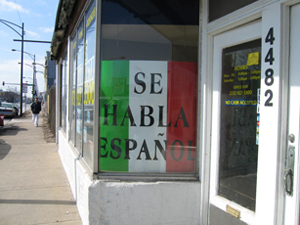
Bilingual


Chicago, Illinois, USA

I was born in Perth Amboy, New Jersey, but my first language is Spanish. We moved to the Pilsen neighborhood in Chicago when I was about two years old. We only spoke Spanish at home. All our visitors spoke Spanish. As I recall, even my childhood playmates spoke Spanish. When we went to mass at our neighborhood church, the priest said mass in Spanish. I believe everyone around me always spoke Spanish until I started school. When I watched television, it was in English. Occasionally, I would go shopping with my parents where I heard languages other than Spanish. However, the only language I understood was Spanish.

Since I grew up in the neighborhood called the Back of the Yards, I heard many different foreign languages along with English. When I played outside with the other children, I never understood what they said if they spoke a language other than Spanish. Although I often heard English, I did not learn to speak any English until I entered Kindergarten. It was the sudden immersion method since I had never spoken more than a few words of English at a time. Suddenly, for hours at a time, I only heard English, and the teacher expected me to respond in English. We learned nursery rhymes and songs that used archaic English words. When I attempted to use some of the new English words that I learned from the nursery rhymes or songs outside of school, other children would laugh at me. For example, I was ridiculed when I called a female classmate a lassie. I learned “lassie” from the song, “Have you ever seen a lassie go this way and that way?”

I attended a Lithuanian Catholic grade school called Holy Cross Grade School in the Back of the Yards neighborhood. All of the priests and most of the nuns spoke Lithuanian and English. We were always conscious of the fact that our neighborhood was the setting for the Lithuanian family in the novel The Jungle by Upton Sinclair. During school hours, the nuns stressed the importance of learning English and we were not allowed to speak our native tongue whether it was Spanish, Polish, or Lithuanian. We had to master English if we were to function in a Catholic and American society.

What helped me learn English was the constant repetition of songs and prayers. Rote memorization was the norm. I improved my English vocabulary by writing down important words several times. This constant repetition helped me learn English. Every morning we went to church to attend mass in Latin before school. We prayed a “Hail Mary” before class in the morning. In the afternoon, we prayed the “Our Father” and the recited the “Pledge of Allegiance” before class. I often did not understand the lessons taught at school. When the teachers instructed the students to complete a task, I was usually the last one to comply because I didn’t understand the command in English and would belatedly obey it by watching what the other students did. Sometimes, my classmates made fun of me because I was slow to follow the instructions. Occasionally, the teacher would correct my English and students would make fun of me after class.

At home, my parents insisted that I speak English so that they could also learn English. The more English I spoke, the more Spanish I forgot. In the end, my parents realized how difficult it was to learn English, so they never really learned it well enough to become fluent. We ended up speaking these bilingual conversations where I spoke English to my parents and they spoke Spanish to me. Of course, certain terms were not translated from their original language. We often spoke in a mixture of English and Spanish: Spanglish. Once I knew how to speak English well enough to get by, I became the official family translator at age eight; I had to translate whenever we went out, and we needed directions or my parents had to conduct some sort of business. I was always self-conscious about the way in which I spoke English because of my Spanish accent.

When I was in the fourth grade, I felt embarrassed by the way I spoke English. I wanted to improve my fluency, so I read books to feel more comfortable with English. When I got my first library card, I spent a lot of time at the library reading books. I also borrowed a lot of books to read at home. I really loved the joke books because I learned the multiple meanings of many words. For example, “What did the ocean say to the beach? Nothing, it just waved.” These jokes and riddles helped realize that words had multiple meanings. This helped me to increase my English vocabulary while I also learned to enjoy the humor of the English language.

Unfortunately, I still had trouble comprehending the classroom lessons in the fourth grade. When we went to Mexico for two months during that school year, I had lost the little English fluency I had. In Mexico, I realized that I did not speak Spanish as effortlessly as my relatives in Mexico. When I played with my cousins, they made fun of my speaking that was part English, part Spanish. When I returned to Chicago, I realized that my classmates still made fun of my English. I did not speak either language very well. I also learned that I would fail the fourth grade because I missed two months of school due to our extended Mexican vacation. Since the teacher said that I failed in part because of my problems with English, I have always felt self-conscious about my English.

As I grew older, I wanted to be bilingual in English and Spanish and speak both languages fluently, like a native speaker. I often tried to read, write, and speak English and Spanish whenever possible. When I was in the Marine Corps, I studied English grammar books extensively. I read in Spanish whenever I came across something written in Spanish. However, it was not until I attended the University of Illinois Chicago that I felt that I really learned English and Spanish. To this day, I feel that I speak English with a Spanish accent and Spanish with an English accent.
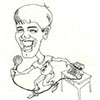
caricature of author at end of post
DDR

Irma Serrano


Irma Serrano at the People’s Theater, Back of the Yards, Chicago, Illinois

I never understood why my mother went to Mexico when Irma Serrano came to Back of the Yards to perform at the People’s Theater. She absolutely loved Irma Serrano. My mother had all her records. My mother saw all her movies. Yet, my mother went to Mexico the summer of 1970 when Irma Serrano came to People’s Theater.

But my mother had a plan! While she was away in Mexico, I would go for my mother to see Irma Serrano in concert! I was only fourteen at the time, so I was a little nervous when my mother explained her plan to me. I would see Irma Serrano in concert and then tell my mother all about the concert when she returned from Mexico. My mother thought her idea was absolutely brilliant. I, on the other hand, had mixed feelings. Because of my mother, I, too, loved Irma Serrano as a singer and an actress. I just couldn’t let my friends know this dirty little secret about me. What if my friends saw me going to the People’s Theater when I went to see Irma Serrano? What would I tell them? What if they wanted to tag along? That was my dilemma of the summer of 1970.

My mother arranged everything. She bought another camera just for the concert because she always took her camera to take pictures in Mexico. I was to take pictures of Irma performing on stage. I was to take pictures of every outfit she wore. She changed a few times during her performance, so I made sure I took pictures of every outfit. I must admit that this was fun, especially since Irma seemed to welcome the additional attention of an adolescent male admirer. My mother also wrote a letter to Irma that I was supposed to hand deliver to Irma Serrano personally. Those were my mother’s orders! My mother wanted me to go backstage after the performance to talk to Irma and take more pictures of her.

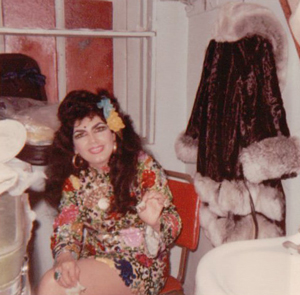
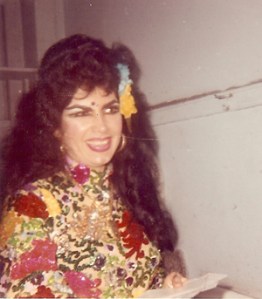
Irma Serrano in the dressing room.

“But how am I supposed to go backstage?” I asked my mother. “Just tell them that you’re delivering a letter to Irma Serrano from Carmen Rodriguez! They’ll let you in then!” I was always painfully shy, but now I was truly afraid to follow through with my mother’s plan. She wanted me to meet someone who was really a successful star and really, really famous. I was scared to approach Irma after the show. But I was even more afraid of how my mother would punish me if I didn’t take pictures of Irma and deliver my mother’s letter backstage.

I must admit that I thoroughly enjoyed the concert! Of course, that was also because none of my friends saw me going to the People’s Theater that afternoon. Luckily, the concert was on a Sunday afternoon when most of my friends spent the day visiting relatives. I recognized every song Irma sang because my mother always played them at home on her 8-track player. The only time I didn’t like listening to my mother’s Mexican music was on Saturday mornings. She played her music starting at sunrise. If I told her to turn it down a little, she would yell at me for being lazy and staying in bed. I would put the pillow over my head and the music didn’t sound so loud that way.

Since I was at the Irma Serrano concert of my own free will, according to my mother (under duress, if you asked me), I attempted to enjoy myself as much as possible. The audience consisted of less than about a hundred people, but they were all really into Irma. Even me! It was a really good concert! And since the audience was so small, it was also very intimate.

After the concert, I was able to get backstage by mentioning my mother’s name. I seriously doubted that would work, but I was amazed that I got to meet Irma Serrano in person. I told her that Carmen Rodriguez had written her a letter and I then handed her the letter. She smiled as she took the letter and said, “So you’re Carmen’s son? She told me about you.” I don’t know if Irma really knew my mother, but she knew how to treat fans appreciatively.  I asked Irma if I could take more pictures of her, and she consented. I was thrilled to be backstage with Irma Serrano all by myself!

So that was my closest encounter with a very famous star!

DDR

Parque Marquette


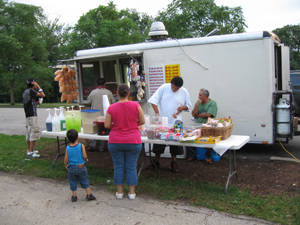
Taste of México, Marquette Park, Chicago, Illinois

My oldest son found a frog at the forest preserves and decided to keep it. He bought an aquarium, but soon the house smelled of stagnant water. He really didn’t clean the aquarium regularly or properly. Then he got bored of having a frog. He thought of releasing the frog in our backyard, but I told him it would die there and that would be inhumane. I suggested he take the frog to the Marquette Park lagoon where it would at least stand a chance to survive. A week passed and the frog was still our roommate and the aquarium water was still polluting the air we breathed. Yesterday, we both were home at the same time, with free time at the same time–something that rarely happens with our busy schedules (even though I’m on summer vacation now!).

So, I said, “Let’s take the frog to Marquette Park now.” Amazingly, he agreed. However, he didn’t want to touch the frog because of the putrid smell. He brought the aquarium down from his bedroom and put it on the front porch. He almost threw as he set the tank down. So, I was the one who took the frog out of the smelly tank and put it into a five-gallon bucket to take to Marquette Park.

I’ve been going to Marquette Park since the 1960s. My parents always loved taking us to parks or beaches whenever possible. When my mother got her driver’s license, she ventured further away from our house. Once she took us to Brookfield Zoo! But first she had to build up her courage. So she took us to Marquette Park. She had heard that it was a nice park. She drove us there in her 1964 Chevy Impala convertible. I remember driving on Marquette Road to get to Marquette Park. My mother was amazed by the houses we saw there. When we drove back home on Marquette Road, my mother said, “Some day we will live on Marquette Road!”

Eventually, we did live at 2509 W. Marquette Road! Many Lithuanians lived in Marquette Park. There were very few Mexicans in the neighborhood back in the early 1970s. But that didn’t stop my mother from moving in. I missed my old friends at Back of the Yards, but Marquette Park was a much bigger and better park than Davis Square Park. Marquette Park had a lagoon for fishing, sailing, RC boats. There were plenty of activities at the field house where I eventually joined the Mar Par Chessmen. Years later, I joined the Marquette Park Track Club that was coached by Jack Bolton. There were soccer and baseball leagues. I went there for a wrestling match when I was in the eighth grade. I got to know Marquette Park very well. There were very few Mexicans at the park then.

So, imagine my surprise when I returned with my sons to Marquette Park to release the frog (I bet you thought I forgot all about the frog!).  Over the past few years the neighborhood has been changing. African-Americans started moving in. Now, Mexicans are moving in, too. Whenever I drive through the neighborhood, I see more store signs in Spanish. Since I don’t spend all that much time there, I wasn’t sure what to expect when I arrived at the park. Marquette Park was filled with mostly Mexicans. Several soccer–actually, fútbol–games were in progress. Unlike the 1970s, all the players were Mexican. Ditto when I drove past the concrete basketball courts. I was also surprised by the Mexican food vendor in the picture above. They sold the usual Mexican food items: elotes, tacos, gorditas, raspados. My son was hungry, so he bought a couple of tacos de carne asada and an elote in a cup. I didn’t even know you could buy elote in a cup! I always buy it on a stick! As Dios intended. But, I’ve also seen pizza in a cup. So why not elote in a cup? And I’m not even going bring up walking tacos here.

Anyway, we placed the frog (See! I still remember that this post was about the frog!) on the grassy shore of the lagoon and the frog immediately jumped into the water. Live long and prosper!

DDR

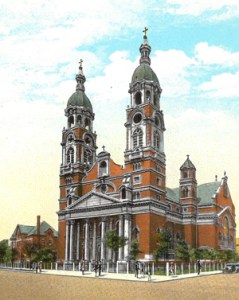
Holy Cross Church


Holy Cross Church, Back of the Yards, Chicago, Illinois

I went to Holy Cross Church today after an absence of about thirty-plus years. I wasn’t sure what to expect. I knew things would be different, but I didn’t quite expect to see so many familiar sights.

Well, to begin with, the church was founded by Lithuanians in Back of the Yards In the early 1900s and they finally built their church in 1913. When I attended Holy Cross in the 1960s, most of the parishioners were Lithuanian. Mexicans were just starting to move into the neighborhood in larger numbers. Mexicans had been moving to Chicago since about the time of the Mexican Revolution around 1910, but they started moving into Back of the Yards in large numbers in the 1930s.  By the time I attended Holy Cross, there were many Mexican parishioners. However, Mexicans also had their own church, Immaculate Heart of Mary, about a half-mile away from Holy Cross.

On Sundays, we usually went to mass at Holy Cross Church, but sometimes our family went to the mass at Immaculate Heart of Mary because the priests said the mass in Spanish. I enjoyed hearing mass in Spanish, so I never complained. Apparently, too many Mexican parishioners from Holy Cross started attending mass at Immaculate Heart of Mary on Sundays. Well, the priests and nuns from Holy Cross didn’t like this at all. Suddenly, we were required to attend Sunday mass at Holy Cross Church. We had to sit with our class and the nuns took attendance. If we didn’t come to Sunday mass at Holy Cross, we would have to bring a note from our parents explaining where we were. This was directed at the Mexican students only. But everyone understood the rule. There was no racism involved. If you belonged to a parish and enjoyed the benefits of their Catholic education, you must attend their mass.

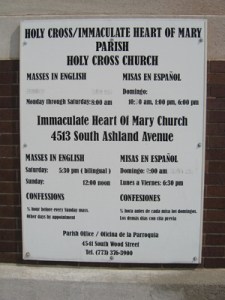
Imagine my surprise when I went to Holy Cross Church today and I observed that at least 99% of the people in mass were Mexican, all except the priest who I’m guessing was African and spoke fluent Spanish. The mass was said in Spanish and the children’s choir sang in Spanish to marimba music. I really didn’t expect to see any of my former teachers or classmates, and I didn’t. Well, it turns out that Holy Cross Church and Immaculate Heart of Mary Church have merged since most of the neighborhood is now Mexican.

The new Holy Cross.

I was wondering what the priests and nuns of my school days would say if they saw the church today. Well, at least the church is still alive and well. The Polish parish of Sacred Heart no longer exists. I walked there before mass and was surprised that most of the buildings were demolished, and a Chicago public school stood in its place. Holy Cross School no longer exists, but the parish rents out the school building to the Chicago Public Schools. C’est la vie.

DDR


Happy Father’s Day!


Happy Father’s Day!

I would especially like to thank my father Diego for being my father. He’s holding my baby brother Joey in the picture and I’m standing next to him. Seated are my brothers Danny, Rick, my sister Delia, and my brother Jerry. My mother isn’t in the picture because she was the photographer. She loved taking pictures of the family!

I can honestly say that the happiest days of my life were when I was a boy living with my family before my parents got divorced. Both my parents were always there for me, although we did have a few misunderstandings. My father taught me some carpentry and how to use tools. I would always help him fix his cars because he was a mechanic at the Curtis Candy factory. He was proud to be a mechanic. My father respected anyone who was a good carpenter or mechanic by calling them maestro. Thanks to my father, I’m now able to perform many fix-it projects around the house.

As a father myself, I often think of all the things my father did with us and I try to do some of the same things. Sometimes, just being with his children was enough satisfaction and joy for my father, especially after my parents divorced. Even if we’re not doing anything together, I’ll often sit in the same room with my sons just to be with them. Occasionally, we’ll start an unexpected entertaining conversation.

My father always asked me for suggestions for trips we could make, and no matter how crazy I thought the idea was, he would take us on the trip. He never made any excuses for not going. So, now I follow my sons’ suggestions. One time, my oldest son was writing a report on Mount Rushmore, and we all became interested in the report. My son suggested that we go to Mount Rushmore, and we went the following June. Every time I go on vacation with my sons, I always think of my father.

DDR