Bilingual


Chicago, Illinois, USA

I was born in Perth Amboy, New Jersey, but my first language is Spanish. We moved to the Pilsen neighborhood in Chicago when I was about two years old. We only spoke Spanish at home. All our visitors spoke Spanish. As I recall, even my childhood playmates spoke Spanish. When we went to mass at our neighborhood church, the priest said mass in Spanish. I believe everyone around me always spoke Spanish until I started school. When I watched television, it was in English. Occasionally, I would go shopping with my parents where I heard languages other than Spanish. However, the only language I understood was Spanish.

Since I grew up in the neighborhood called the Back of the Yards, I heard many different foreign languages along with English. When I played outside with the other children, I never understood what they said if they spoke a language other than Spanish. Although I often heard English, I did not learn to speak any English until I entered Kindergarten. It was the sudden immersion method since I had never spoken more than a few words of English at a time. Suddenly, for hours at a time, I only heard English, and the teacher expected me to respond in English. We learned nursery rhymes and songs that used archaic English words. When I attempted to use some of the new English words that I learned from the nursery rhymes or songs outside of school, other children would laugh at me. For example, I was ridiculed when I called a female classmate a lassie. I learned “lassie” from the song, “Have you ever seen a lassie go this way and that way?”

I attended a Lithuanian Catholic grade school called Holy Cross Grade School in the Back of the Yards neighborhood. All of the priests and most of the nuns spoke Lithuanian and English. We were always conscious of the fact that our neighborhood was the setting for the Lithuanian family in the novel The Jungle by Upton Sinclair. During school hours, the nuns stressed the importance of learning English and we were not allowed to speak our native tongue whether it was Spanish, Polish, or Lithuanian. We had to master English if we were to function in a Catholic and American society.

What helped me learn English was the constant repetition of songs and prayers. Rote memorization was the norm. I improved my English vocabulary by writing down important words several times. This constant repetition helped me learn English. Every morning we went to church to attend mass in Latin before school. We prayed a “Hail Mary” before class in the morning. In the afternoon, we prayed the “Our Father” and the recited the “Pledge of Allegiance” before class. I often did not understand the lessons taught at school. When the teachers instructed the students to complete a task, I was usually the last one to comply because I didn’t understand the command in English and would belatedly obey it by watching what the other students did. Sometimes, my classmates made fun of me because I was slow to follow the instructions. Occasionally, the teacher would correct my English and students would make fun of me after class.

At home, my parents insisted that I speak English so that they could also learn English. The more English I spoke, the more Spanish I forgot. In the end, my parents realized how difficult it was to learn English, so they never really learned it well enough to become fluent. We ended up speaking these bilingual conversations where I spoke English to my parents and they spoke Spanish to me. Of course, certain terms were not translated from their original language. We often spoke in a mixture of English and Spanish: Spanglish. Once I knew how to speak English well enough to get by, I became the official family translator at age eight; I had to translate whenever we went out, and we needed directions or my parents had to conduct some sort of business. I was always self-conscious about the way in which I spoke English because of my Spanish accent.

When I was in the fourth grade, I felt embarrassed by the way I spoke English. I wanted to improve my fluency, so I read books to feel more comfortable with English. When I got my first library card, I spent a lot of time at the library reading books. I also borrowed a lot of books to read at home. I really loved the joke books because I learned the multiple meanings of many words. For example, “What did the ocean say to the beach? Nothing, it just waved.” These jokes and riddles helped realize that words had multiple meanings. This helped me to increase my English vocabulary while I also learned to enjoy the humor of the English language.

Unfortunately, I still had trouble comprehending the classroom lessons in the fourth grade. When we went to Mexico for two months during that school year, I had lost the little English fluency I had. In Mexico, I realized that I did not speak Spanish as effortlessly as my relatives in Mexico. When I played with my cousins, they made fun of my speaking that was part English, part Spanish. When I returned to Chicago, I realized that my classmates still made fun of my English. I did not speak either language very well. I also learned that I would fail the fourth grade because I missed two months of school due to our extended Mexican vacation. Since the teacher said that I failed in part because of my problems with English, I have always felt self-conscious about my English.

As I grew older, I wanted to be bilingual in English and Spanish and speak both languages fluently, like a native speaker. I often tried to read, write, and speak English and Spanish whenever possible. When I was in the Marine Corps, I studied English grammar books extensively. I read in Spanish whenever I came across something written in Spanish. However, it was not until I attended the University of Illinois Chicago that I felt that I really learned English and Spanish. To this day, I feel that I speak English with a Spanish accent and Spanish with an English accent.
caricature of author at end of post
DDR

Sirius XM in México


Photo by Bruno Ticianelli on Pexels.com

Before I drove to México earlier this month, I searched online to see if I would be able to listen to Sirius XM in México. I guess few people with satellite radio travel to México and then post whether Sirius XM will work in México because I found exactly zero results. Well, I am now posting that I went to México, and I was able to listen to Sirius XM in México while I drove all the way to México City. There were some bad reception areas, but overall, the quality was incredibly good. This certainly made my driving experience much more enjoyable. So, now you know, in case you ever want to drive to México City and want to listen to Sirius XM down México way.

Treadmill


Photo by Anastasia Shuraeva on Pexels.com

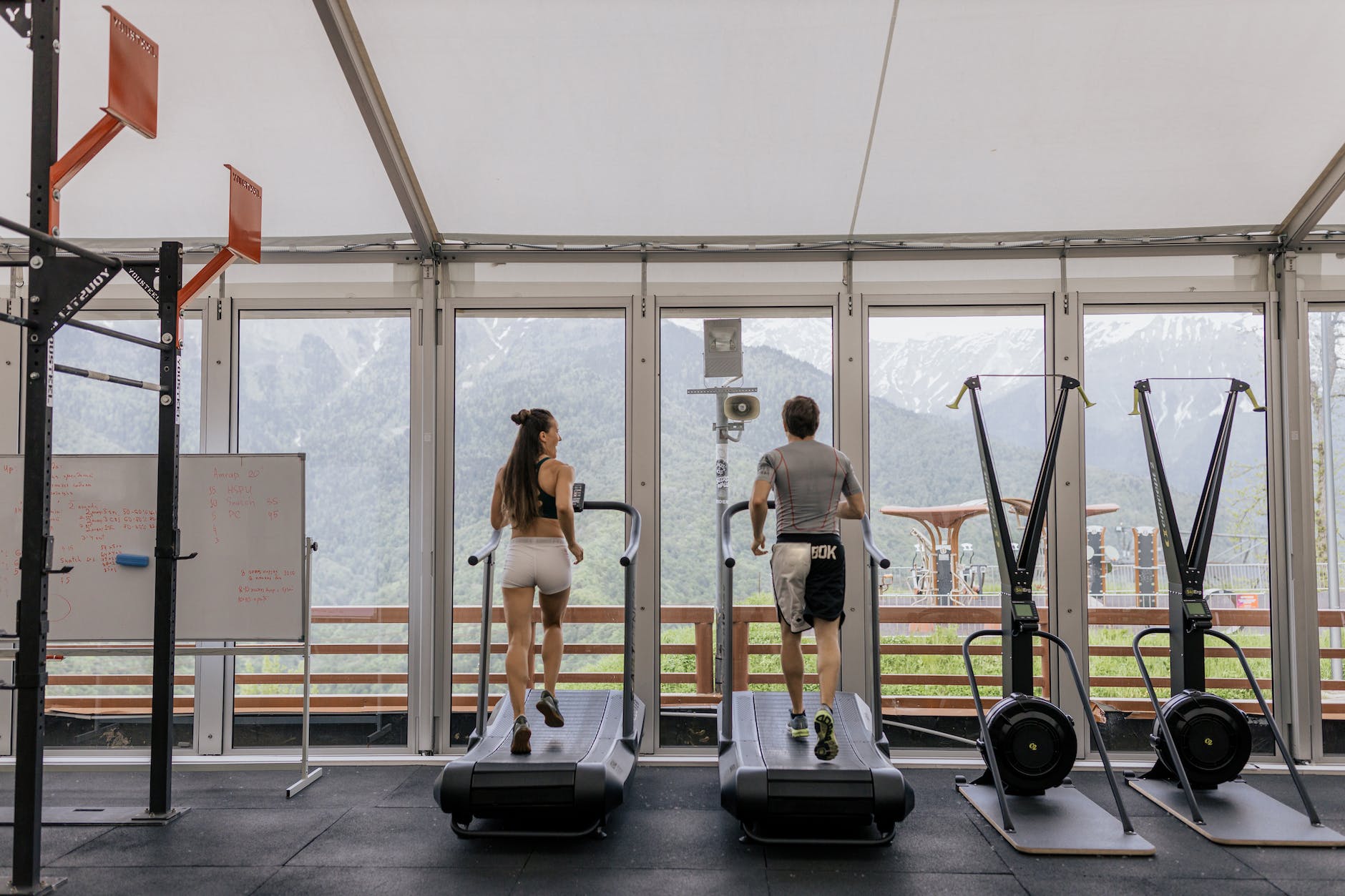
One thing I hate more than running laps is running on a treadmill. I had always been curious about treadmills and stationary bicycles. For the longest time, I thought I would be interested in riding a stationary bike during the winter when I didn’t want to run in the snow and ice. It would be nice, I thought, to get an aerobic workout without braving extreme winter weather. I often thought about buying a stationary bicycle until I heard about treadmills. Then, I wondered what it would be like to run on a treadmill indoors instead of running through the snow, slush, and ice on a wintry day. I suppose I could have joined a health club instead of buying a stationary bicycle or a treadmill, but somehow, I thought I would use the stationary bicycle or treadmill if I owned one.

The more I ran outdoors, the less I thought about buying either apparatus. I hate the repetitiveness of running laps because I keep seeing the same scenery repetitively. However, running and cycling in one place would be even worse because of the lack of change of scenery. But I never actually ran or cycled in one place.

A few years back when I was in México, my cousin suggested that I go to the health club with her. I have never been a fan of health clubs, but I was curious to see what a health club in México was like, so I went with her. Well, it didn’t look much different than a health club in Illinois or California. Anyway, I decided to run on the treadmill just to finally see what it’s like to run a treadmill. I had not run for about a month prior because of constant pain in my right foot, so I wasn’t sure how fast or how long I could run, but I was running alongside my cousin Jaqueline. She was happy that she didn’t have to miss her workout on account of my visit. I told her I could handle running even though I had not run recently.

So, I felt a little pressure to show her that I was a real runner. I set a goal of running for thirty minutes, which I was confident I could complete. We were able to watch TV while we ran. It had never occurred to me before to watch TV while I ran. I don’t even listen to music when I run.

Well, running on a treadmill did not seem like real running to me. I jumped in the air and the belt beneath me moved my foot back. So, I was running without going anywhere. It seemed absurd to me. I sped up the belt slowly, but it still didn’t feel like real running. My cousin was enjoying her workout. She kept asking me how I liked it and I would just say it was great and smile back at her. Then I thought of increasing the incline that is supposed to simulate hills. Well, running on a steeply inclined treadmill is nothing like running hills. All I had to do was raise my foot a little higher and the belt would move it backwards. When I run up a hill, I can feel my legs carrying my entire body weight up the hill, not so with the treadmill.

Well, I managed to run for thirty minutes comfortably, but I didn’t feel like I really exerted myself very much. The pain in my right foot didn’t bother me at all. After that, I lost all desire to buy a treadmill. I’ll just stick to running on the road and running hills without watching TV or listening to music. Well, I must run now.

Hills


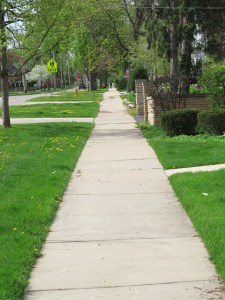
This picture doesn’t truly capture the grade of this hill in Glen Ellyn.

Illinois is a rather flat state. When I ran races in California, the race entry form would describe the race course as either flat or hilly. And by hilly that usually meant some steep incline. I once ran a seven-mile race that was uphill for the first half of the course. When I returned to Chicago and started running races here, some race courses were described as hilly. In California, these types of hills are called “flat” by some race directors and “gently rolling hills” by others.

When I started running cross country in Donaldson, Indiana, we never ran any hills because the terrain is relatively flat there, too. Occasionally, there were some slight inclines, but there were no real hills per se. In Chicago, there are no hills either. When I ran with the Marquette Park Track Club, coach Jack Bolton would have us doing “hill work” by running up the sled hill in Marquette Park or running to the “Nabisco Hill” near the Nabisco cookie factory. They weren’t real hills, but that was the best way to train for the “hilly” races in Illinois.

In México City, they have mountains, not hills. I once went running with my cousin through the mountains. We ran for about an hour, but I was surprised that I could keep up with him. I think he was trying to run me into the ground.  Afterwards, he told me that since I was from Chicago, he didn’t think I could handle the hills or the altitude, México City having the elevation of 8000 feet.

So now that I’m running in “flat” Illinois again, I found some “hills” in Glen Ellyn that for my area of Illinois are “hilly”. Of course, I’m not as young as I was when I ran in California or México, nor am I in top form physically anymore. However, I’ve been running these hills for the last year or so trying to get back in shape. I think back to some of the hilly California races I ran and these hills I’m running now don’t seem so steep now.

A few weeks ago, I was running up this Glen Ellyn hill, seen in the picture above, and struggling to keep running at the same pace. This hill on Prospect Avenue goes up for about a half mile. I’ve seen other runners stop running and start walking up this hill. I always continue running up the hill. It’s funny how I only remember running uphill, but not running downhill. Anyway, I’m running up this hill, when suddenly I hear footsteps behind me. I could tell it was another runner by the pace of the footsteps. A female runner passes me up and I say, “Good morning” to her. I make it a point to greet all runners I meet in order to share in the camaraderie of running. She runs a few steps past me and turns back to look at me. She tells me in a firm voice, “Attack the hill!” So, I attack the hill and pull up alongside her. I’m pushing myself harder than I would have had I been all alone. I’m struggling to keep up with her, but I actually feel good that she came along and pushed me to run faster. Her running form is smooth, but she’s huffing and puffing with each step up that hill. I, on the other hand, am not huffing and puffing, but you could tell from my form that I’m struggling to get up that hill. When we get to the top of the hill, we part ways and I shout out to her, “Thanks for the motivation!”

I guess I enjoy the challenge of running up hills.

DDR

Happy Mother’s Day!


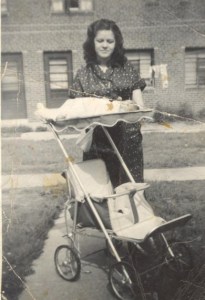
My mother Carmen and I, Perth Amboy, New Jersey, 1956.

Happy Mother’s Day to every mothers everywhere! Yesterday and today!

Yesterday, no , today is Mother’s Day in the U.S., but yesterday was Mother’s Day in México because Mother’s Day is always celebrated on May 10th in México. I was born on May 9th, so my mother would usually tell me how she had hoped I would have been born on Mexican Mother’s Day, May 10th. When I was a boy, she usually told me this either on my birthday or on May 10th, or more often than not, on both days. She also told me how she was hoping for a girl during her entire pregnancy. I would have been Debbie, but I turned out to be a boy.

Unfortunately, my mother is no longer around for us to spend the day with her. She always wanted to have grandchildren from me, but my children weren’t born until long after she passed away. So my oldest son only knew his maternal grandmother until he was almost two years old because she, unfortunately, passed away from ovarian cancer, but he never met his paternal grandmother, my mother. And my twins never met either grandmother at all. I feel that my sons were deprived of some wonderful experiences by not having had grandmothers in their childhood.

The happiest days of my childhood were the days when my parents were still married and my grandmother and tía Matilde were living with us in Chicago. My mother was always so happy having her mother in the house. Everyone needs a mother. And to have a mother and grandmother in your life is to be doubly blessed!

Happy Mother’s Day!

DDR