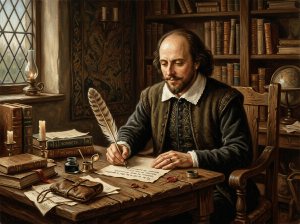
William Shakespeare writes with a quill amid books, candles, and theatrical manuscripts.
Alighieri Dante (1265-1321) Francesco Petrarca (1304-1374) Ludovico Ariosto (1474-1533) Toraquato Tasso (1544-1595)
Sir Thomas Wyatt the Elder (1503-1542) Herny Howard, Earl of Surrey ( 1517-154 7) Sir Philip Sidney (1554-1586) Thomas Lodge (1558-1625)
Samuel Daniel (1562?-1619) Herny Constable (1562-1613) Barnaby Barnes (1569?-1609) Michael Drayton (1563-1631)
Edmund Spenser (1552-1599) William Shakespeare ( 1564-1616)
–David Diego Rodriguez (1956-2056?)
(Translated, from the Spanish, after the sonnets of Joan Brossa and Nicanor Parra, by the author and David Diego Rodriguez, and Published according to the True Original! Copies.)
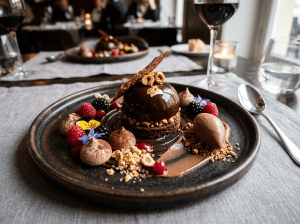
An elegant chocolate dessert garnished with fresh berries and edible flowers
I love desserts! Who doesn’t? I always look forward to every dessert. Never have I skipped a dessert. I live by the words of Erma Bombeck: “Seize the moment. Remember all those women on the Titanic who waved off the dessert cart.”
Desserts are wonderful because they don’t even require that you to eat a meal first. For example, the ice cream truck comes rolling down your block. Do you run into the house and eat a complete meal so you can eat ice cream? Of course not! You skip the meal and run straight for the ice cream. And the ice cream truck has so many varieties.
When I attended Divine Heart Seminary in Donaldson, Indiana, the students ate at assigned tables family style. Each table consisted of students from each grade. We would pass the serving dishes and take our own food. All the students ate the same food. Desserts were very modest. Occasionally, we would get apple pie. But we always had ice cream for dessert! And what variety! We could choose vanilla or chocolate! Each table received two one-gallon cartons of ice cream: one chocolate, one vanilla. I always chose the plain vanilla ice cream. But I chose vanilla creatively. Let me explain.
We were allowed to keep our personal condiments on our assigned table. I kept a container of Nestle’s strawberry powdered mix that I would add to my white milk. I was the only one drinking strawberry flavored milk. Other students would ask where I had gotten the strawberry milk, and I would tell them I had added Nestle’s strawberry powder. They were excited at first sight, but lost interest when I offered them the strawberry powder for them to mix it into their own milk. I enjoyed drinking the strawberry milk.
Later, I brought a jar of orange Tang, the drink of astronauts, to the table. The Tang instructions said to add two tablespoons of Tang to a glass of water, which I did dutifully at first. Then I had the brilliant idea of adding Tang to my white milk! I loved drinking that orange milk! Again, other students asked me where I got the orange milk, and I explained that I mixed orange Tang into my milk. Once I explained how I made my concoction, everyone lost interest. Maybe it was too much work for them. Or maybe they thought I was cuckoo.
For the first few months of my freshman year, I alternated between strawberry milk and orange milk. Aah! But I felt a need to expand my culinary enjoyment. After one supper, as the ice cream was being passed around the table, I had another brilliant idea! Why not eat strawberry ice cream? Or orange sherbert ice cream?
So, I added extra strawberry powder to the remaining strawberry milk in my glass. I then added the strawberry milk to the vanilla ice cream. And, voila! Strawberry ice cream! It tasted like real strawberry ice cream. Students at my table asked where I had gotten the strawberry ice cream. I explained my simple process and offered them my strawberry mix. Again, no one took me up on my offer.
Ditto for the orange sherbert ice cream! Sure, it didn’t taste exactly like orange sherbert ice cream, but I did enjoy the variety of vanilla, strawberry, and orange sherbert ice cream. And my classmates were always surprised that I had a variety of milks and ice creams.
Driving. An activity that has always fascinated me. An activity without which I would not have reached this point in my life. Driving to work, to school, on vacations. I can’t imagine my life without ever owning a car. I owe my success and happy life to car ownership.
There is no way I could have worked full-time and attended college full-time without a car. Without a car, my commute from home to work to school to home would have taken all day on public transportation. I graduated because I was able to manage my time well since I owned a car.
Growing up, my father was the only driver in our household. My mother finally got her driver’s license when I was in the seventh grade. So, everything I learned about driving, I learned from my father. Including bad driving habits. But my father loved driving! He could turn a short trip to the grocery into a two-mile cruise. But not if my mother was onboard.
Our family car was always a used car that constantly needed repairs, which my father loved because he was a mechanic and carpenter by trade. My father never bought a new car until I was in the eighth grade. He bought a lime green 1971 Ford Maverick two-door sedan. He loved that car! That’s when he decided we should go camping to Tippecanoe River State Park in Indiana.
On Sunday morning before going to mass, my father and I would pop the hood of the car and inspect the engine. My father always inspected the engine before every drive. And he always made some mechanical adjustments. Then we would wash the car before driving to church. I really thought that driving a car was a very complicated affair due to my father’s preparations. I also believe these preparations deterred my mother from getting her driver’s license sooner.
When I bought my first car, it was a brand new 1975 Pontiac Firebird. I didn’t want to do all the mechanical work that a used car involved. I was still in high school and working full-time in the Peter Pan peanut butter factory on the midnight shift. I needed a car to drive home from work at 7:00 A.M., shower, and go to school by 8:30. There was no way I could accomplish this using public transportation on the south side of Chicago.
I was the first one of my friends to own a new car. My other friends drove their family car. They always wanted to try driving my car, but I always refused to give them the keys. They were reckless behind the wheel. But not any more so than me. When we were young every one of us wanted to be the driver on our road trips. No matter whose car we drove in, we all fought for the keys to be the driver.
Flashforward a couple of decades, and now we’re arguing over whose turn it is to drive. No one volunteers to drive anymore. And my friends and I no longer go on long road trips. I go on my road trips alone. I actually enjoy driving alone without all the bickering and deciding where to go when we had no definite destination in mind anyway.
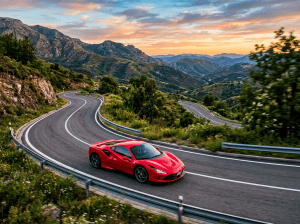
Nowadays, I prefer to drive alone. I imagine my car as an escape pod from my mundane life in Chicago. I have driven to California, Rhode Island, Mexico City, and many other places in between. I no longer dream of having an expensive sporty car. My vehicle needs to transport me to my destinations comfortably, with decent gas mileage, and uninterrupted satellite radio.
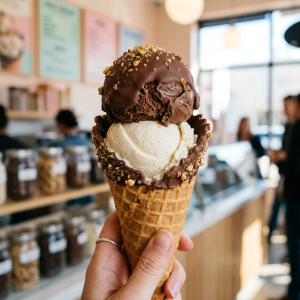
A richly topped chocolate and vanilla ice cream cone stands out in a bright, welcoming café.
Ice cream! I love ice cream! However, ice cream is contraband in my home. My wife doesn’t allow ice cream in the house. If she eats it and gains weight, it’s my fault. I, unfortunately, posted a video of me feeding ice cream to our dog Earl and my wife saw it. Now, she fat shames Earl. So, ice cream is no longer allowed in our home.
Since I was driving alone, I was eating ice cream on my road trip to visit my brother in Prescott, Arizona. I was enjoying two scoops of black cherry on a waffle cone while sitting on the bench outside the ice cream shop. A woman sat next to me on the bench, also enjoying her delicious ice cream. She confessed to me that she was enjoying savoring the ice cream away from her dog and her husband. I had found an accomplice! Partners in ice cream!
So, I also confessed. I told her how I had a secret stash of ice cream at home. Well, one night, about 2:00 A.M., I couldn’t sleep. So, I decided to self-medicate with ice cream. As I went to the fridge, I realized my dog Earl had followed me to the fridge. I knew better than to let Earl have any ice cream. So, I locked myself in the bathroom to eat my ice cream. I could hear Earl scratching at the door and whimpering for ice cream. But I knew better than to let Earl have any ice cream. Suddenly, I heard pounding on the door and my wife yelling, “Are you watching porn in there?” I was afraid to get in trouble, so I said, “Yes! I’m watching porn! It’s called, ‘Double Dip Delight!'”
Even though Adrian and I lost touch after our eighth-grade graduation, I often remembered him whenever I went to the Museum of Science and Industry, the Chicago Loop, or walked past the Prudential Building. Because I fondly remembered him from time to time, I mentioned him in one of my blog entries, which is why I’m here today. His daughter Victoria searched for Adrian’s name on the internet and landed on one of my blog posts that mentioned Adrian Stanislovaitis. So, here I am. Thank you for giving me the opportunity to have one last encounter with Adrian and his loving family and friends.
Labas! I learned the Lithuanian greeting of “Labas!” from my Lithuanian friends in Chicago. I attended a Lithuanian church and school in Chicago’s Back of the Yards neighborhood, from kindergarten through eighth grade when I graduated.
I met Adrian at Holy Cross Grade School in the fourth grade. We were classmates from the fourth grade through the eighth grade. Unfortunately, our eighth-grade graduation in June of 1971 was the last time we saw each other.
We spent a lot of time together even though Adrian and his brother Renatas lived more than one mile away from the school. Most of the Holy Cross students lived only a few blocks away from the school. I lived two blocks away at 4405 S. Wood Street.
We spent a lot of time together during those years. We were also altar boys together. We had a lot in common. However, I was the oldest of six children, and I had never done much without at least one of my parents taking me somewhere. That all changed when I met Adrian. He was like the wiser older brother to me. Since he lived so far from the school, he was very independent and knew his way around Chicago.
In grade school, we had school days off for federal holidays like Columbus Day, George Washington’s Birthday, and Abraham Lincoln’s Birthday. When we were in the fifth grade, Adrian suggested that we go to downtown Chicago on our day off. I wondered who would take us there since our parents were working. Adrian said that we would take the bus downtown by ourselves! I had never heard of such a thing! Going downtown without an adult?! We were only twelve years old at the time.
Adrian met me at my house, and we took the Number 9 Ashland-Archer bus downtown. We went to the gift shops and ate at a restaurant downtown. The most memorable event for me involved going to the top of the Prudential Building downtown. We were truly impressed because it was the tallest building in Chicago at the time. Every time I go downtown and see the Prudential Building, I recall going up there with Adrian. Adrian always had great activity suggestions for us!
Once, we went to the Museum of Science and Industry by bus. He had all the logistics figured out. Since it was a school holiday, we had the day off from school. I said I couldn’t go because I had to watch my three younger brothers. Adrian said we could all go together. Since he lived on 55th and Wood Street, right off of Garfield Boulevard, he would walk to the corner of Ashland Avenue and Garfield Boulevard. My brothers and I would take the Ashland bus to Garfield Boulevard where we would transfer buses. We met Adrian on the corner and boarded the Garfield bus that took us directly to the museum. We spent the whole day there. And we spent all our money there, except for just enough bus fare for my brothers and me to be to take the Garfield bus to Wood Street where Adrian lived. And my brothers and I walked eleven blocks on Wood Street to get home. My brothers and I fondly remember that trip.
One day, Adrian was telling me how he saw a very funny movie over the weekend. He told me that on Friday and Saturday nights they showed comedies late at night. He told me I had to see The Marx Brothers in Duck Soup. He described the funny parts to me, and I was hooked. I would stay up late on weekends watching comedies. Duck Soup is still my favorite Marx Brothers movie.
Once when Adrian was at my house, my father took us to visit my uncle in Pilsen. My uncle was frying tortillas and baloney when we arrived. I was kind of embarrassed that Adrian had to see my father and uncle frying and eating baloney tacos. I couldn’t stand the smell of them. I only ate one bite of my baloney taco and said I didn’t like it. My father and uncle said they were really good. I told Adrian that he shouldn’t have any. But my father convinced him to try one. I was so embarrassed by my father and uncle offering a baloney taco to Adrian. But Adrian said the baloney taco was really good! In fact, he ate two more!
Adrian loved his planes, trains, and automobiles. When planes flew overhead, he would tell me everything he knew about the plane. He was able to identify every plane we saw and state the manufacturer of the plane and the model. I asked him why he knew so much about planes. He said that he would be a pilot someday. When I visited his house, he pulled out his Jane’s airplane books and showed me why he could recognize every plane in the sky.
I also learned about model trains from Adrian. Because of him, I started collecting N-gauge trains. Adrian also knew a lot about cars. If a car drove by us, he could tell me the year, make, and model of the car. He could identify a car just by looking at its taillights. He also like to build model cars. He got me to enter a hobby store contest for building car models.