English only, please


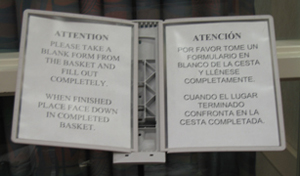
A poorly translated sign at Mercy Hospital.

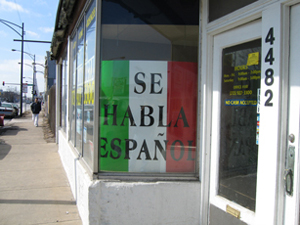
We have so many foreign words in English that it’s quite pointless to insist on “English Only” or that English be made the official language. For one thing, what do we do about all the Spanish geographical names of the American southwest? There are too many names to translate to English.

And the reason they have Spanish names is because the Spaniards gave them Spanish names when the American southwest was still part of the Spanish colony called Nueva España (New Spain). Just think of the California cities called San Diego, Los Angeles, San Francisco, and Sacramento. There is a place in California (named in Spanish by the Spaniards) called La Brea Tar Pits. In Spanish La Brea means tar pits. So if we translate the name into English, we get The Tarpits Tarpits! We could do that for all the cities with Spanish names. San Diego will become Saint James, San Francisco, Saint Francis, and Sacramento, Sacrament! Perhaps this would be an impossible task, but we will eventually translate all those Spanish names into English! Dammit!

And speaking of redundant, I am reminded of the song, “Surfin’ USA” by the Beach Boys. There is a line in the song that says, “You’d see ’em wearin’ their baggies / Huarachi sandals, too.” In Spanish, “huaraches” means sandals, so these surfers are wearing sandals sandals! And then there’s Carlos Santana with, “Yo no tengo a nadie that I can depend on.” Hey, Carlos. English only!

In “Vertigo” by U2, the song begins with some “counting” in Spanish: “Uno, dos tres, catorce.” Either Bono doesn’t know Spanish or he just doesn’t know how to count. One of my students told me that these numbers really are a tribute to U2’s producer who produced albums number 1, 2, 3, and 14. And this reminds me of the song “Woolly, Bully,” by Sam The Sham and The Pharaohs that begins, “One, two, tres, cuatro.” He counts in both English and Spanish, but at least he gets the numbers in the correct order!
DDR

The story of the Spanish “O”


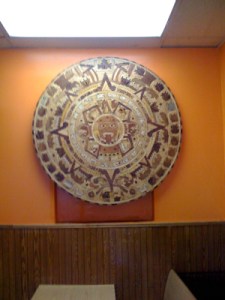
Aztec calendar = O

The letter “O” is an amazing letter in Spanish! “O” makes Spanish, Spanish. In my Spanish class, I demand that all my students to speak Spanish whenever possible.

Once there was a commotion in the classroom and I asked what had happened. When a student told me that his book fell, I asked him to tell me in Spanish. He then said, “El book-O fell-O.”

Merriam Webster’s Collegiate Dictionary even lists “el cheapo” as an entry! That’s the stereotype of the Spanish language: that all the words end in “O.” Do you understand? No problemo! (In Spanish it’s really “problema.”)

How about all those snacks derived from corn tortillas? They all end in “o” with an “s” to make it plural. Fritos, Doritos, Tostitos, Nachos, Chipitos, Crujitos, etc.

However, there are some English words that become Spanish when you add “o.” For example, insect becomes insecto, car becomes carro, Alfred becomes Alfredo, Robert becomes Roberto, but David remains David and under no circumstances does it become Davido. Nothing annoys me more than to be called Davido! False becomes falso, traffic becomes tráfico, and video, well, it stays the same, video. 

But be careful with cool. Don’t say coolo! Adding an “o” to cool will make it culo in Spanish, which requires much care when saying it because it’s a swear word referring to part of the body in the nether region known as the buttocks. ¿Comprendo? [sic]

DDR

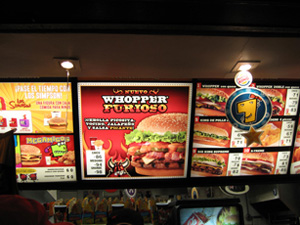
Spanish in Burger King


Burger King in Mexico City

Last night, I was in Burger King with my sons. A Mexican family was standing behind me in line. I joked around with the cashier who took my order. We spoke in fluent colloquial English, and I have a Chicago south side accent.

The father of the Mexican family then ordered his food in broken English. Later, while I was waiting for my order, the father spoke to me in Spanish about his son who had just learned to walk the week before. I was surprised! I’m always surprised when total strangers speak to me in Spanish! I told a non-Mexican friend about this, and she said, “But you don’t even look Mexican!” But to another Mexican I do!

As a boy, my father would take us to Burger King a lot. We would order our food and I dreaded waiting to hear my father’s order. After completing the order, my father would always ask, “Do you have hot peppers?” When the cashier would say no, my father would say, “That’s okay. I brought my own!” He would then pull out a jar of jalapeño peppers from his pocket.

My father had hundreds of ways of embarrassing me in public.

DDR

Appearances are deceiving


Chicago, Illinois

I am always amazed when a stranger approaches me and immediately speaks to me in Spanish! When I was in Arizona, I was pumping gas, and someone asked me for help with the gas pump in Spanish. My sons were surprised that this person knew that I spoke Spanish.

This happened again in the mall in Phoenix. A woman approached me to sell me a nail product by greeting me and introducing herself in Spanish. We spoke Spanish during the entire demonstration. My friend was surprised not only that she addressed me in Spanish, but also that I spoke Spanish so well. (I do teach college Spanish!) My non-Hispanic friends are shocked to learn that I know Spanish. I suppose that’s the only way I’ll shock anyone.

DDR

Language barrier


Back of the Yards, Chicago, Illinois.

When I was growing up, my parents always spoke Spanish at home. Once I began attending school, I was supposed to speak English at home. This way my parents would be forced to learn to speak English. This was a promising idea in theory, but the reality resulted in bilingual conversations in which I would speak English and my parents would speak Spanish. To this day, I still speak to my father in English; whenever I speak to him in Spanish, he doesn’t understand me.

When I was a boy, my mother sent me to the store to buy pork chops. She specifically told me to buy pork chops, but she told me in Spanish. As I’m walking to the store, I realize that I don’t remember how to say pork chops in English. I kept trying to remember as I walked to the store.

Luckily, there were two customers ahead of me. That gave me more time to think about what I had to buy. Unfortunately, I couldn’t remember the English name for pork chops. The best I could produce was “pig chops.” But I was too embarrassed to ask for “pig chops” because I knew that wasn’t the right term. So, I walked home empty-handed, and my mother asked me why I didn’t buy the pork chops. When I told her what happened, she said that I should have asked for “pig chops.” She didn’t know how to say pork chops in English, either.

That night, we ate chicken.

DDR