El Gallo de Oro


El Gallo de Oro, 2952 W. 63rd Street, Chicago, Illinois

When I lived at 3006 W. 64th Street, I always used to eat at this great Mexican restaurant that was exactly one block away. El Gallo de Oro, 2952 W. 63rd Street, 773.737.8101, has been there since at least 1981 when I moved back to Marquette Park after being honorably discharged from the Marines.

This Mexican restaurant serves real Mexican food cooked by real Mexicans to other Mexicans who patronize the restaurant. That’s how you can tell if a Mexican restaurant is really good: by how many Mexicans eat there. I remember once going to Milwaukee and my girlfriend suggested that we eat at a Mexican restaurant, either La Perla or La Fuente, but she didn’t know which one was better. We ate at the one where all the Mexicans ate! And it was great Mexican food! So, are you wondering which restaurant was better? Well, I honestly can’t remember because I drank a few too many bottles of Negra Modelo. Anyway, El Gallo de Oro has great Mexican food, and I say this after having come back from having eaten Mexican food in many Mexican restaurants and Mexican homes in Mexico. Well, lately, I’ve been going to different Mexican restaurants in the Chicagoland area, or Chicagolandia as I like to call it since we have so many Spanish speakers here, and I’ve been ordering the enchiladas de pollo. Today, I tasted the enchiladas at El Gallo de Oro, and they were ¡sabrosísimas! This is a great Mexican restaurant.

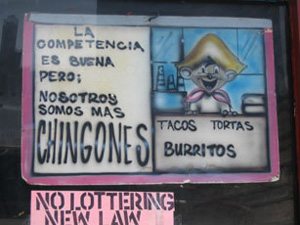
When I still lived in the neighborhood, I ate there several times a week. Of course, everything I needed in the neighborhood was within a two-block radius. The cleaners, the gas station, the locksmith, the used bookstore, my barber Aldo of Italy, and of course, El Gallo de Oro. I went to the locksmith exactly once, but it was nice to know that he was always available even though I dreaded the day that I would actually need him. Aldo of Italy cut my hair once a month before I ate at El Gallo de Oro. Aldo always loved speaking to me in Spanish while he cut my hair until I fell asleep. Anyway, again, I loved the attitude of the Mexican cooks at El Gallo de Oro. They were typical Mexicans who loved to brag about their food and service. I especially loved their sign in the window: “La competencia es buena, pero nosotros somos … ¡más chingones!” In English, “The competition is good, but we are … ” Okay, I’m not sure how to translate the last two words, but you could tell who was Mexican and who wasn’t by how they reacted to the sign. Of course, at that time the FCC let a lot of profanity get aired on all the Mexican radio stations. So the sign remained in the front window for many years until about two years ago. I rather miss that sign. That’s the thing about Mexicans. They have chutzpah!

One time, I told my father, brothers, and sister that I had a special surprise for them for our Thanksgiving dinner that year. They were so curious that I caved in to all their questions and told them my surprise beforehand. “We are eating Thanksgiving dinner at … ” and I paused for dramatic effect … “El Gallo de Oro!” “But we want turkey,” my sister shouted. “Yo quiero guajolote,” said my father. “Un momento,” I said. “El Gallo de Oro is serving turkey burritos on Thanksgiving Day!” After a little grumbling, they finally agreed to my Thanksgiving dinner plans! Everyone got to eat turkey, I got to eat at El Gallo de Oro, and my father got to eat so many jalapeño peppers that sweat poured from his forehead profusely and he had to keep asking for more and more water. Well, El Gallo de Oro managed to satisfy yet another finicky Mexican family–again!

DDR

Mexican jokes


My business card in 1986

When I was growing up, in an age before everyone tried to be politically correct, everyone told ethnic jokes. They were always insulting and mean-spirited to whatever group was targeted. Sure, some people were offended by these jokes, which only led to them being the target of more ethnic jokes. However, these jokes also brought a lot of joy and laughter among friends. For example, I worked in a peanut butter factory, named Derby Foods, with various ethnic groups who lived in the Back of the Yards neighborhood. In general, we all got along very well. Shirley, one of my Polish coworkers, loved to hear any kind of joke because she loved to laugh. Her real name was Ursula, but she preferred to be called Shirley. Anyway, she especially loved to hear Polish jokes. She always insisted that I tell her any new Polish joke that I heard. And when I didn’t learn any new jokes, she insisted that I retell her the old ones. Whenever I told her Mexican jokes, she told me she liked the Polish ones better. In this age of political correctness, I will not tell any Polish jokes lest I offend anyone. But I suppose it would be okay if I told some of the Mexican jokes that I still remember. I’m not doing this to propagate any negative stereotypes about Mexicans, but merely as a scientific exercise to preserve our humorous past. Now, I’m not saying that these jokes are funny anymore, but once upon a time, people laughed at these jokes. Some of them are quite dated. Okay, you have been forewarned!

  1. Why can’t Mexicans be fireman? They don’t know the difference between José and Hose B.
  2. Mexican weather report: Chili today. Hot tamale.
  3. Why do Mexicans wear pointy shoes? To kill cockroaches in the corner.
  4. What is the name of the Mexican telephone company? Taco Bell.
  5. Why don’t Mexicans have barbecues? The beans keep falling through the grille.
  6. How can you tell if you’re at a Mexican birthday party? There are more adults than children.
  7. What do you call a Mexican basketball game? Juan on Juan.
  8. What do you get when you cross a Mexican with an octopus? I don’t know, but boy can it pick lettuce!
  9. Why doesn’t Mexico have an Olympic team? Because every Mexican who can run, jump, or swim is already in the U.S.
  10. What do you call a Mexican in a BMW? A valet.

Upon further reflection, I retract the above listed jokes because they are in extremely bad taste. With apologies to Ursula, I mean, Shirley!

DDR

Matilde


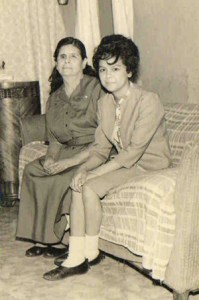
Mi abuelita y tía Matilde

My tía Matilde came to Chicago as part of the package deal when my abuelita came for eye surgery. Tía Matilde also needed surgery, so she came from México to have surgery on her ears. I’m not sure what exactly was wrong with her ears, but she was otherwise healthy.

My aunt was very young when she came, and she liked living in Chicago. She loved listening to pop music on the radio and she bought all the records by her favorite singer, Rick Nelson. She went wild when listening to his music.

What I remember most about my tía Matilde was how she did laundry. We, my parents, my three brothers, my abuelita, my tía Matilde, and me, all lived in a small four-room apartment. We had a washer and dryer in the kitchen next to the sink. When my parents were at work, tía Matilde would do all the laundry in the house, every handkerchief and sock. She would search everywhere in the apartment for dirty clothes. She found dirty clothes where I would never even think of looking. She just had to make sure that every last item of dirty clothing was clean when she was done doing the laundry. And so, when all the dirty clothes were in the washer, and there was a little room in the tub for more clothes, she would start taking off her clothes right at the washer and start putting them in the washer. She would be standing in the kitchen wearing nothing but her bra and panties, proud of the fact that all the dirty clothes in the house were now washed, obviously oblivious to my presence.

Back then, we always seemed to be either at home or at Cook County Hospital taking either my abuelita or tía Matilde to the doctors there. Anyway, my tía Matilde, who would undress at the washer, was very shy with the doctors when they asked her to disrobe. The day of her surgery, she refused to undress and refused to put on the hospital gown because it had no back to it.

I still remember her telling this story when she returned from her surgery. She absolutely refused to undress for the nurses and doctors. She thought she had won her battle, but after the surgery, she woke up in her hospital bed and immediately realized that she was completely naked! Whenever she told this story, she always sounded so shocked that this could have happened to her despite her precautions. She didn’t even remember when or why she lost consciousness. She always wondered who managed to see her naked. She would blush every time she told the story.  She was truly traumatized by this experience!

She eventually went back to México with my abuelita.

DDR

Despedida mexicana


Why are these tequila bottles so blurry?

There are good-byes. And then there are Mexican good-byes. By this, I mean that most people say good-bye and then they leave. Mexicans, on the other hand, say good-bye and think of many reasons for staying un poquito más. Such as telling the story they just remembered on the way out, upon touching the doorknob. Or, because they haven’t seen each other in such a long time, since like last week. I, too, of course am guilty of these long, extended good-byes. Perhaps, I didn’t say everything that I wanted because I couldn’t get a word in edgewise or the stories told were so good that I didn’t want to interrupt them.

While I was in Mexico, every good-bye was a despedida mexicana, but one long good-bye especially comes to mind. I was staying at my cousin’s house and we were going to visit her sister, also my cousin. My cousin, her husband, my aunt, and I went to my other cousin’s house. We would leave about three o’clock in the afternoon in order to avoid the afternoon rush hour traffic. I agreed because Mexico City’s normal traffic is horrendous and traumatic, even if you’re just a passenger, let alone driving during rush hour. So we visit my cousin, we eat at a restaurant called California, we go back to the house of the cousin we just visited, look at some old family pictures, and talk and talk and talk over old times since the last time I went to Mexico, which was twenty-nine years earlier. By the way, we started up the conversation right where we left off the last time I was there as if I had just left a few days before.

At 3:00 p.m. sharp, my cousin announces that we’re leaving immediately in order to avoid the rush-hour traffic. My cousin’s husband says that we can’t leave his house without first drinking some tequila together. That would reflect poorly on their hospitality. Besides, how could I go to Mexico and not drink tequila?

As the guest of honor, he served me tequila in his very own special tequila shot glass that was wrapped in specially treated tan leather with his name embossed on the leather. How could I say no to this shot of tequila? So we all had a shot of tequila as we were standing to leave. Sure enough, we all start talking about when my cousin came to visit Chicago in 1979. As luck would have it, I was in California in the Marines at the time. So we all sit down to hear about her trip to Chicago and how she almost saw snow because the weatherman predicted a snowstorm, but then there was only a light dusting of snow.

Of course, this called for another shot of tequila! Which no one refused, including me because I always try to be polite and eat and drink everything that is served to me. (You’d be surprised at how polite I can be when food or tequila is involved!) Then it occurs to our host that if you drink tequila you should drink it properly. So he serves us another shot of tequila, but this time he passes around a bowl of lime slices and a salt shaker. That’s how Mexicans really drink tequila! You squeeze some lime juice on the side of your fist, shake some salt on the lime juice, you drink the tequila shot in one gulp, and then lick the lime juice and salt afterwards. Well, we down a few more tequila shots the proper Mexican way and then our host said he had to go to work to take care of some business, but when he returned, he would bring back some food for supper.

The tequila had long ago been consumed and we were left to our own devices to entertain ourselves. Actually, for Mexicans like my aunt, my cousins, and I, we merely entertain ourselves by talking about what we did in the past since the last time we saw each other. In fact, I spent most of my trip just sitting around talking to my relatives bringing myself up to date on their lives. Well, it’s after six p.m. and our host still hasn’t returned. His wife calls him on his cell phone and it turns out that he’s stuck in rush-hour traffic. When he finally returns, he returns empty-handed. We’re all extremely famished by this time. So we all pile into two minivans and go to their favorite restaurant in town. We eat supper and spend a couple of hours talking over our food. By the way, we’re still saying good-bye since three p.m.! We eventually return to my cousin’s house about 9:30 p.m.! However, we did manage to avoid Mexico City’s infamous rush-hour traffic! I have to admit that it was my longest good-bye ever, even by Mexican standards. But it was also one of the most entertaining.

Okay, let me just blurt this out and be off. ¡Adiós!

DDR

Olivia Maciel


Sombra en plata por Olivia Maciel

Olivia Maciel is a poet who was born in Mexico City, but has lived in Chicago a long time. She has written several collections of poetry over the years. She writes poetry in Spanish, but her books include an English translation on the facing page. I recently read two of her collections: Sombra en plata [Shadow in Silver], Chicago, Swan Isle Press, 2005, and Luna de cal [Limestone Moon], Chicago, Black Swan Press, 2000. All her books are available for purchase on Amazon.com.

I first met Olivia in one of my graduate classes at UIC. We took several classes together while earning our master’s degrees. She graduated from the University of Chicago with a Ph.D. When Octavio Paz died, she published an article about her reactions to his death that appeared in the Chicago Tribune. We occasionally bump into each other at UIC because we are both Spanish lecturers there. I really enjoy talking to her because she’s so creative. Sometimes, she begins writing poems as we speak. She says that I inspire her when we talk. I asked her if she would hire me as her muse.

DDR