So I today I bought four new tires for my upcoming trip to Mexico. The two rear tires barely had any tread left and one front tire kept leaking air.
Last July, I kind of panicked when I saw my tire pressure warning light turn on. I was on a road with no shoulders in Mexico and I was afraid I would have to change the tire there. Rather than repeat that scenario, I bought four new tires. And maybe it’s my imagination, but the car seems to handle better now. It’s stops faster now and it corners much, much better now.
That’s very important for driving Mexican roads that are on cliffs with no guard rails. Of course, this could just be an illusion. I remember how whenever I got new gym shoes as a boy, I always felt the I could run faster, jump higher, and okay, I can’t think of a third thing that I could do everything better and faster with my new gym shoes, but you get the idea. So, I feel safer driving my car now that I have four new tires.
I often listened to my father and uncles tell stories about what life was like in Celaya, Guanajuato. I always enjoyed listening to these stories even after multiple retellings. In fact, I loved the way the stories improved with each retelling. The more details that someone forgot about a certain incident was an opportunity to invent new and more interesting facts. My grandfather had a furniture shop in Celaya called “Mueblería El Carmen.” The shop was called El Carmen because it was right across the street from La Catedral El Carmen. I can’t remember what exactly the name means, perhaps no one told me in the first place. The curious thing about this cathedral is that there are three other cathedrals within walking distance of each other. This was, after all, a Spanish colonial city. And all of my family in Celaya is very, very Catholic. That’s my father’s side of the family because my mother’s side of the family lives in Mexico City and even though they’re Catholic, they don’t really go to church much.
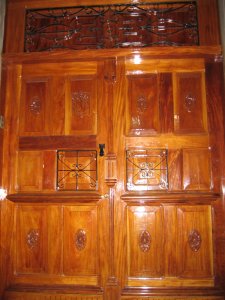
Anyway, my father and uncles told stories about how they had a baseball team sponsored by the Mueblería El Carmen. All the team members were brothers. Yes, there were nine brothers, enough for a baseball team! And couple more to sit on the bench! I loved hearing about the furniture shop. In Celaya, people would go to the shop and describe what kind of furniture they wanted–bedroom set, dining room table, etc.–and my grandfather or my uncles would draw up the design for the customer’s approval. Then, they would proceed to make it from scratch. Their business was very successful. So successful that it’s still in business in Celaya to this day. In fact, when we were walking back to my Uncle Eutimio’s house from Christmas mass, my cousins proudly pointed at a door of a building and told me they had made that door. I immediately stopped to take a picture of the door. They were so proud that I was taking a picture of their handiwork.
Doors by the Rodríguez Family
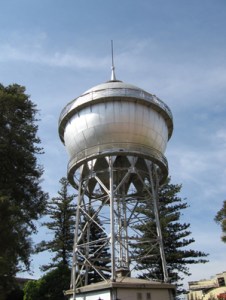
Anyway, (again, but my last anyway–for this post, anyway), my favorite story was the one about what people in Celaya tell someone who tells them something they don’t want to hear. So, if someone comes up to you in Celaya and you want them to go away before they finish saying whatever it is they want to say but you don’t want to hear, you simply say, “Sepa la bola.” And they should take the hint and go away. So now you probably want a translation to English, right? Well, this phrase doesn’t translate easily into English. I titled this post “Go fly a kite,” but now that I think of it, that phrase doesn’t even come close to the meaning of “Sepa la bola.” But I’m not going to go back and change it now. Maybe, I should have titled this post, “Go tell it to the Marines.” Yes, that’s it! Eureka! I have found the equivalent phrase in English without even having sat in a bathtub filled to the brim with water. But “Sepa la bola” literally means, “Let the ball know” or “Go tell it to the ball.” In this case, the ball is the water tower in Celaya, pictured above. Perhaps this isn’t the funniest or most interesting story that my father or uncles ever told me, but something about “Sepa la bola” is just downright fascinating. Whenever I see my uncles here in Chicago, sometimes out of the blue, I say, “Sepa la bola.” And they never fail to laugh.
I started reading the blog Stuff White People Like about two months after it started up. I think I read about it on the Internet somewhere and I checked it out. I really enjoyed reading it and found myself laughing out loud many times.
Then, one day, I thought, “I could write for this blog.” So, I contacted Christian Lander and asked him if he accepted freelance submissions. He said that he would, but that he had just signed a book deal and they didn’t want a lot of other new writers now. I understood perfectly. But for some strange reason, I had really, really wanted to write one post for the Stuff White People Like. I tossed around several ideas in my head during my idle moments–of which I seem to have more and more with each passing day. But I never actually wrote anything down, as I am wont to do.
Soon the blog announced the forthcoming publication of the Stuff White People Like book and there was much excitement in the blog’s comments. I commented that I wouldn’t buy the book since I had already read all the posts and comments on the Internet for free. As it turned out, the book version had several new never-before-read entries. However, I still refused to buy the book and ended up reading it for free at the Borders bookstore in two visits!
Before the book’s release, Lander announced that there would be a contest for the best post written for Stuff White People Like. The prize? A free copy of the book. I immediately sprang at the opportunity to write for this blog. There were hundreds of entries. Since there were so many good entries, the first prize was expanded to the top five best entries. In addition to the free book, the winners would also receive a subscription to The Onion. Well, the first winner was announced and there were scores of complaints about the quality of the entry. Commentators complained that it wasn’t written in the same style, that it wasn’t funny, etc. With each winning entry announced, the complaints grew more vocal. Soon, readers started posting their own submissions in the comments. Okay, so did I! And since I wrote it, I’m posting it here for the sake of posterity! 🙂
The dream job for the English major.
English Major
When choosing a college major, white people often choose the tried and true English major rather than the last resort of Undeclared. When asked why, they will give the convincingly believable reason that an English major will help them get accepted into law or med school. Worst case scenario is that they can always go to grad school for that arts degree and work at the local coffee shop and be the most intelligent, misunderstood barista there. Being misunderstood adds to the mystique of the English major.
Whenever a college student announces that he or she is an English major, be sure to state, “But you already know English!” This will reaffirm his or her belief that no understands the value of a great liberal arts program. When speaking to an English major, whether a current student or a proud graduate, always comment on how well they speak English and how flawless their grammar is. Also mention the decline of the English language since the Elizabethan Era. Many English majors have learned some very funny jokes while enduring long, boring seminars on Chaucer and the Romance of the Rose. They will even share these jokes with you if you let your guard down. English majors are proud of the fact that they are English speakers.
When engaging in a conversation with an English major, be sure to nod in agreement but never interrupt. There is no need to start an argument with an English major. Oftentimes, he or she will start one without your assistance. For example, the conversation may suddenly turn to The Wasteland, and without your aid, he or she will begin arguing whether T.S. Eliot was American or British. Be sure not to get involved in the argument. You will not win. If you would like to change the subject of the argument, simply mention how you always felt that the Nobel Committee screwed James Joyce.
In order to gain the confidence and friendship of an English major, be sure to ask about his or her writing: “What are you working on now?” But don’t expect an answer immediately. In fact, don’t expect to learn any details about anything he or she has ever written. He or she will tell about how difficult it is to write. Be sure to ask to read a recent work. Of course, the reply will be, “I haven’t let anyone read it yet. Very few people will understand all the literary allusions.” Give them a consoling look and say, “It must be hard to write with all the long hours you put in at the coffee shop.”
If you ever start to offend a Mexican, they will reply with a remark like, “¡No manches!” In other words, don’t smear my good name.
Well, I was at the Ford City Mall the other day with my sons when I saw this T-shirt stand right there in the middle where you can’t miss it. I immediately saw the t-shirt with the map of Mexico. Underneath the map it read, “United States of Mexico.”
The girl working at the stand immediately approached me and handed me a card saying that they had a website. I responded half in English, half in Spanish without really thinking. I assumed that she wasn’t even Mexican because Mexicans, or any Spanish speaker in Chicagolandia, are always happy to meet someone else who speaks Spanish. So, I gathered that she wasn’t a Spanish speaker, or perhaps not even Hispanic. And here she was selling these Mexican-themed T-shirts to–well, actually, to no one!
The whole time we were in the mall, I was the only one to approach the stand and read the t-shirts. I didn’t even bother to ask the price of the T-shirts. As I read these T-shirts, I was offended. I like to think of myself as very open-minded and I have a high tolerance for political incorrectness and profanity, but I wondered what kind of Mexican would buy a T-shirt that read, “got mica?” and “as seen on immigration”? Maybe I’m missing something here! They seemed more offensive than funny.
If they’re going to be that politically incorrect, they might as well should have named their business, “¡No manches, güey!” Why did they stop short? Don’t get me wrong. I’m not overly sensitive. In fact, I always smile when I see someone wearing a T-shirt that says, “I’m not late. I’m running on Mexican time!”
My favorite Mexican t-shirt.
Look closely at the T-shirt above. I was looking to buy T-shirts as souvenirs from Mexico, but they mostly sold stuff from the U.S.A. Talk about American cultural imperialism! It’s such a good parody of the actual Corona shirt that my cousin and I almost didn’t notice it. I suppose this t-shirt will only be funny for people who speak Spanish and know Mexicans.







 Chicago USA