One thing I love about teaching Spanish at UIC is the food! Students will use any excuse to bring food to the classroom. Spanish students learned to bring food in high school, and they keep right on bringing it in college. I love it! If I could, I would design a Spanish course dedicated solely to comida de la cocina hispana.
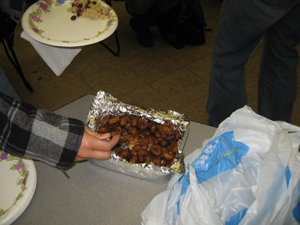
My Spanish 104 class had to do oral presentations last week and some students found a way to prepare a dish that would highlight their proyectos. Of course, I never complain! I usually teach in the morning and most students are very hungry when they come to class. Okay, I’m hungry, too. So, the food is always a very welcome visual aid for the student presenting. I’m looking forward to the next set of proyectos!
I love sticking it to the man. I mean, who doesn’t? It’s an American pastime. We all stick it the man whenever possible.
So who is the man? Well, if you want me to tell who the man is, I will be honest and say I don’t know who the man is. You asked the wrong person. But I have my theories. I can’t describe the man to you because he has never formally introduced himself to me. However, I have a sneaking suspicion that the man is behind all those rules and regulations that we must obey every day. And to top it all off, the man may be either male or female. Yes, the man is a cross dresser. If you look around, you will observe that the man is all around us. In fact, sometimes I feel as if the man has gotten inside of me. To counter the man, I have formulated my own rules and regulations for sticking it to the man. How do I stick it to The Man? Let me count the ways!
First, always call the man, the man. In lowercase letters. You must diss him in every way possible and that begins by not dignifying the man by using uppercase letters to write the man! Don’t even put the man in quotes! My only lament is that our only options for writing are only uppercase and lowercase fonts. I’ve been working on new font to write the man. I call it the undercase font. Or, perhaps I should call it the negativecase font. But I’m afraid such a font would be invisible to my readers, and no one would know to whom I was sticking it. Another interesting possibility would be the man, with the strike-through font. Nah, that just not good enough for sticking it to the man! I think I’ll just stick to sticking it to the man.
The second thing, never tell the man that you are sticking it the man. Sometimes, the man doesn’t even know that he’s the man! If he denies that he’s the man, well, then that certainly means he’s the man. You just can’t take any chances. Just assume anyone who wants to order you around is the man.
So I stick it to the man whenever possible. When I cross the street, I don’t walk completely within the crosswalk lines, obviously put there by the man. I always get at least three footsteps outside the crosswalk zone, even if it’s only measurable in millimeters. You know how they taught you in driver’s ed that all forward motion must cease. Well, I never come to a complete stop at stop signs. I only appear to stop, but my car keeps creeping forward. I get free smells at all restaurants–not just Jimmy John’s. I bite the hand that feeds me, especially if it belongs to the man. I would like to tell you more ways that I stick it to the man, but I don’t want the man to know all my strategies and ploys. That’s my way of sticking it to the man!
When translating “you” into Spanish, be careful! “You” is the second person singular subject pronoun. Quick! What is the plural of you? I hope you didn’t say “y’all” or “you guys”! In English, the plural of “you” is “you!” I occasionally have this argument with students who don’t seem to believe me because I’m a Spanish speaker. But it’s true. The second person plural subject pronoun in English is “you.”
Often my students will insist that the plural of “you” is “y’all” or “you guys.” Or, get ready for this, the even more emphatic “all y’all” or “youse guys.”* So how do I convince my students that the plural of you is you? I quote President John F. Kennedy: “And so my fellow Americans: ask not what your country can do for you–ask what you can do for your country.” “See!” I tell my students. “He addressed himself to ‘my fellow Americans’ and then he spoke to them calling them ‘you’!” They usually stop disagreeing at this point, but I’m convinced that I haven’t fully convinced them. I think they resent being corrected by a native Spanish speaker.
But back to the Spanish lesson about translating “you” into Spanish. Since you is both singular and plural–And for you students of Spanish, oh, yes! It’s also formal and familiar! –you can translate “you” into Spanish as: tú, vos, usted, vosotros, vosotras, ustedes. Remember that tú, vos, vosotros, and vosotras are always familiar. Do not use them to talk to someone you just met or don’t know very well. Use usted and ustedes for more formal situations ¡Ojo! In Latin América, ustedes is used as the familiar second person plural subject pronoun instead of vosotros and vosotras.
So there you have it. I’m addressing myself to all of my readers. And by that I mean all three of you!
DDR
* I won’t even mention that the plural of “you” is “yin” in the state of Virginia!
When teaching Spanish, I always learn something new from my students, or rather mis estudiantes. Sometimes I don’t notice things that are part of our Mexican culture because they are just part of everyday life. For example, we don’t always notice daylight because it’s always there (in the daytime, of course) and we just take it for granted. In my Spanish classes, I just happen to take Spanish for granted. In fact, I’m rarely aware of which language I’m speaking. So, when I’m supposed to be speaking English, I’m speaking Spanish, and vice versa.
So, today, we had a little bit of free class time, so I decided to show a movie that was filmed in Spanish. Students just love watching movies in class. Rather than conversing in Spanish or doing more exercises. Well, I like to show movies in Spanish because this way they can learn something about Hispanic culture that they can’t learn from a textbook. A student had mentioned the Mexican movie Y tú mamá también earlier in the semester. In the culture section of our textbook Sueña, Gael García Bernal is profiled and specifically mentions Y tú mamá también in his film credits. I thought this would be a good movie to teach students a little about Mexican culture and Mexican expressions, otherwise known as mexicanismos. Afterwards, the student who had originally mentioned the movie told me she thought the movie was a little racy. I must admit that it is. I saw it at the show when it first came out. I was in a theater full of Mexicans at the Ford City Theaters, and they were all shouting “¡Huy!” at some of the scenes at the end of the movie.
It seems that no matter what movie I show in class, a few students always comment about something in the movie that was offensive to them. All good movies will offend at least some of my students. Most of the other students love seeing the movie regardless of the content, whether deemed offensive or not. I’ve shown movies from México, Spain, Guatemala, Argentina, and the U.S. (in Spanish). They always address some controversial topic such as sex, incest, murder, etc. and they usually have a tragic, depressing ending. But they are always good movies. The advantage of showing these movies is that I know none of my students saw them in their high school Spanish class. No sane high school teacher would dare show such risqué films without taking a chance of getting disciplined and/or fired. I teach at a university, so I have a little more liberty in film selection since all my students are older than eighteen.
Sometimes when students tell me they find a movie offensive because of too much violence or sex, I tell them that they may leave the class without penalty if they find the movie objectionable. No one ever leaves. In fact, they find the movie enthralling. So I just don’t understand why they complained in the first place. Perhaps, to clear their conscience. Besides, everyone loves Penelope Cruz movies, and she hasn’t made a movie without any offensive topics. My favorite movie with her is the one where she plays a pregnant nun with AIDS.
On a couple of occasions, I offended some students unintentionally by playing Lotería. This is a board game like Bingo that I have been playing since I was a little boy. Every student gets a board with pictures of people and things such as La dama, El soldado, La rana, etc. There is a deck of cards with these same pictures. So, I shuffle the cards and call out the names. If your board has the picture that I called out, you mark the picture with an uncooked pinto bean (provided by me, since students don’t happen to walk around carrying pinto beans with them, but I do). When you cover all the pictures with pinto beans, YOU WIN! And you shout ¡Lotería! at the top of your lungs and I give you a little prize like a packet of chiclets or something else that’s Mexican. This is a child’s game that you would think would not offend anyone. Well, if you thought that, you would be wrong!
Once, actually, this happened several times, when I called, La sirena, a female student shrieked and said that the mermaid had exposed breasts. She was genuinely offended by the nudity. I didn’t know what to say. So, I looked at the card of La sirena and sure enough she had exposed breasts! I’ve been playing Lotería my whole life and I never even noticed her exposed breasts. To me she was just a mermaid. A cartoon mermaid. All I ever saw was her long hair and her fish tail. I mean, if I saw a real mermaid in person, I wouldn’t be caught staring at her breasts!
Why didn’t I see La sirena‘s breasts before? I’m not sure. Probably because I always saw my mother breast-feeding my younger brothers. And in public, too! I remember my mother taking my brothers and me to the park to play in the playground and she would breast-feed my baby brother right there on the park bench. And she wasn’t alone, either! There were always at least two or three other mothers breast-feeding, too. Maybe I just view breasts differently from everyone else. Breasts were just part of my Mexican culture while growing up and I just never noticed them on La sirena or in movies until students point them out to me! ¡Ay! ¡Ay! ¡Ay!
T-shirts with messages always attract my attention, especially if they have an intriguing message. So how does a clothing item that was originally an undergarment come to demand so much attention? Well, I’ll tell you. No one seems to know. If you wear a T-shirt with text, I will read it. If the message is partially obscured by a sweater or jacket, I will ask you to let me read it. If for some reason your message truly intrigues me, I will ask you to let me take a picture of your t-shirt. I hate it when I ask the wearer of a particularly mysterious message to explain the significance of the message and they don’t know. How can they not know? Well, usually the T-shirt was a gift. Well, I wouldn’t wear a t-shirt to disseminate a message that I didn’t understand. Yet, many people do. I just don’t get it!







 Chicago USA