


Why does bottled water have an expiration date? Will the H2O spoil? Will it ferment and become wine? I was just wondering. I guess common sense doesn’t alway factor into capitalism.

Why does bottled water have an expiration date? Will the H2O spoil? Will it ferment and become wine? I was just wondering. I guess common sense doesn’t alway factor into capitalism.
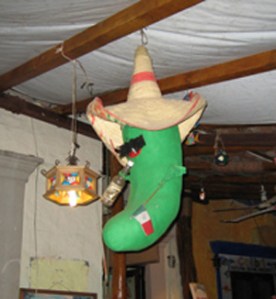
I am proud to say that I am a Mexican!
Go ahead and ask me why! Okay, okay, I’ll tell you. I read in the newspaper that the Milwaukee Brewers have added a new sausage to their sausage race for the 7th inning stretch. In addition to the hot dog, bratwurst, Italian sausage, and Polish sausage, Chorizo (a Mexican sausage), wearing a Mariachi hat, will also race. Milwaukee also had a “Cerveceros” (Spanish for Brewers) day on Saturday, July 29, 2006.
Now that I think of it, one of my cousins moved from Mexico to Milwaukee. But not because of the Cerveceros.

I have been called a lot of bad names and racial slurs in my lifetime, but the most hurtful insults come from people who are supposed to be close to me, who are supposed to be my friends. I believe I have been called all the ethnic slurs for Mexicans, Hispanics, and Latinos. However, I was surprised that when I went to Mexico, I was called a gringo by my own family. That really hurt. I have even been called a racist by my cousins in Mexico.
I had spent most of my life thinking that I was a Mexican living in the U.S. of A. Most people in the U.S. often reminded me that I was a Mexican–either nicely or with an ethnic slur. But stranger’s comments don’t bother me as much as an insult from a loved one. However, when my cousins called me gringo, I was shocked and insulted. They were associating me with America, the very group from which I felt alienated at home. With an insult like that, I felt like I didn’t belong in either place. I still feel like an outsider to this day. I’m not sure where I belong. No matter where I go, I always feel like an outsider.

Sometimes, I like to plan ahead. So even if it’s cool enough to wear a jacket when I leave the house and I know the temperature will warm up later, I will leave the house without a jacket. I just don’t want to carry the jacket when I stop wearing it once the temperature warms up. I consider myself practical in that sense.
Well, over the years, people have directed comments at me like, “You Latinos don’t have to wear a jacket when it’s cold because you’re hot blooded.” On the other hand, if I wear a jacket when it’s cool out, I hear, “You Latinos can’t take the cold.” In the winter when the temperatures are sub-freezing in Chicago, I don’t bundle up as much as everyone else. I can take the cold because I have acclimated myself to the weather having lived in Chicago my entire life. So, everyone around me will be bundled up and afraid to go out into the cold, but I’m already heading out the door before I zip up my winter coat.
I guess it’s because I’m a hot-blooded Latino.

The other day I was walking around the Arizona Mills shopping mall in Phoenix and noticed that a teenager with black hair, brown eyes, and a perpetual tan was wearing a T-shirt that said, “I’m Mexican,” on the front. On the back the shirt said, “I’m Mexican / I’m not Latino / I’m not Hispanic.” I wasn’t surprised to see such a message since I have always felt the same way. I mean, what am I supposed to call myself? As a teenager, I was even more confused. In grade school, I told everyone that I was Mexican. Then in high school, another Mexican told me about that I was a Chicano. Back then, all the older Mexicans like my parents, aunts, and uncles all thought that Chicanos all belonged to gangs. So, I stuck to being Mexican. But now that I’m more mature, I still don’t know what or who I am. No matter what I call myself, someone within earshot will disagree. Lately, I’ve been telling everyone that I’m Mexican. And I’ll keep telling everyone that I’m Mexican until I figure out my identity–whatever it is!
 Chicago USA