The other day I was walking around the Arizona Mills shopping mall in Phoenix and noticed that a teenager with black hair, brown eyes, and a perpetual tan was wearing a T-shirt that said, “I’m Mexican,” on the front. On the back the shirt said, “I’m Mexican / I’m not Latino / I’m not Hispanic.” I wasn’t surprised to see such a message since I have always felt the same way. I mean, what am I supposed to call myself? As a teenager, I was even more confused. In grade school, I told everyone that I was Mexican. Then in high school, another Mexican told me about that I was a Chicano. Back then, all the older Mexicans like my parents, aunts, and uncles all thought that Chicanos all belonged to gangs. So, I stuck to being Mexican. But now that I’m more mature, I still don’t know what or who I am. No matter what I call myself, someone within earshot will disagree. Lately, I’ve been telling everyone that I’m Mexican. And I’ll keep telling everyone that I’m Mexican until I figure out my identity–whatever it is!
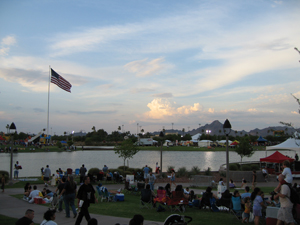
Last night I went to a Fourth of July celebration in Phoenix, Arizona. Most of the spectators were of Mexican descent. There were also a few whites and Native Americans, but most of the people were minorities in this sea of humanity. There were several stages where a variety of current music was played. We sat by a stage that featured two bands that covered American Pop songs. As I listened to the bands, I read a newspaper in Spanish, La Voz. No one criticized me for reading a Spanish-language newspaper. I loved the bands, even the one that covered Metallica. The crowd applauded all the bands equally. People were even dancing in front of the stage, although there was no mosh pit. Some spectators were singing along with many songs. This was truly an American event, despite the ethnic appearance of the spectators. Thousands of Americans came out to celebrate America’s birthday. I brought my sons to this celebration to instill the importance of patriotism to the USA. You could feel American pride throughout the crowd. We were all proud to be Americans!
I wasn’t sure what to expect when I went to see the movie Nacho Libre with my sons. This movie was filmed entirely in Mexico with all-Mexican cast, with the notable exception of Jack Black. Perhaps, I should translate his name to Juanito Moreno.
The movie is set in Mexico, but all the characters speak English with a Mexican accent. I guess that was the director’s way of letting the audience know that the movie was set in Mexico. The accents weren’t very convincing, particularly because the scenery was actually Mexican.
Did this movie offend you? Some characters speak Spanish and there are no English subtitles! Whatever happened to English only? Where is the public outcry? Well, there was none. I wasn’t the least bit offended. In fact, I was happy that Mexico could be represented in American cinema without any controversy.
This was such a fun movie to watch. I laughed so hard at some scenes and then wondered why I wasn’t offended. I noticed that the other people in the theater who were laughing were also of Mexican descent. The movie brought back some memories of Mexico. The movie accurately portrays Mexico as I remember it when I visited my family there as a boy. The movie represents Mexico in its stark reality without any social critique, as does Robert Rodriguez’s El Mariachi.
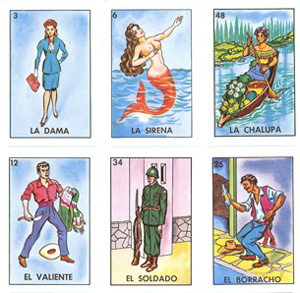
Lotería is a fun game to play just as it is, but Lotería needs to be updated to Lotería 2.0.
I’ve played lotería in both Mexico and the U.S. We need some new cards that reflect the influence of both Mexican and American culture to the game. There is nothing wrong with the cards now in use, but how about adding some new ones? I recommend: El Vato, La Gabacha, El Mariachi, La Abuelita, El Pachuco, La Malinche, El Macho, La Llorona, La Mamacita, El Maricón, La Jamona, El Cholo, and El Güero.
And then when you fill up your card, you have to shout, “¡Lotería 2.0!” That should liven things up a little. Do you have any other suggestions for other cards?
What do you call someone of Hispanic descent? I am truly confused about what to call myself. I have heard a lot of terms, good and bad, to describe Spanish speakers or people from Spanish-speaking countries, for example, Latino, Hispanic, Latin-American, Mexican American, and on the negative side, beaner, spic, and wetback.
But what should I call myself? What term should I use to describe myself? None of the terms seem adequate. Latino, Hispanic, and Latin-American are too all-encompassing and include a lot of Spanish-speaking nations, but they don’t describe any of my individual characteristics. And let’s not forget that I have been born and raised in the United States of America as an American citizen.
When I think back to my childhood, I used to tell everyone, “I’m Mexican.” When I was a student at the Lithuanian Catholic grade school Holy Cross, the nuns would ask me what nationality I was and I would answer, “I’m Mexican.” Sometimes when visitors came to class, the nuns would tell the visitor, “This is David. He’s a nice Mexican boy.” Now that I look back, that seems to be the best term to use today in our politically correct times.
Let me explain. If I say that I am a Mexican American, that seems redundant. I was born in the USA to parents who emigrated from Mexico, and I speak fluent English. My parents were born in Mexico and were citizens of Mexico. My mother eventually became a naturalized U.S. citizen. If you asked my parents what they were, they would reply, “Somos mexicanos” in Spanish. So, when I say, “I’m Mexican” in English, without a Mexican accent–okay, perhaps a bit of a south side accent–, I imply that I am an American citizen of Mexican descent. If I were a Mexican national living in the USA, living and working here, legally or otherwise, I would say, “Soy mexicano,” perhaps even because I couldn’t speak English.
So, I say to you, “I am a Mexican,” in English, without a Mexican accent, but with a south side Chicago accent. Do you hear me? ¡I am a MEXICAN!




 Chicago USA