Back of the Yards


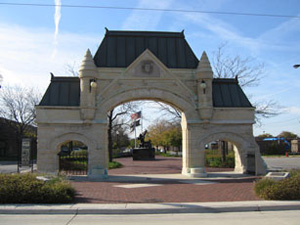
Entry to the Union Stock Yards

After we moved from Pilsen, our family moved to Back of the Yards where my tío Simón and tía Maricela lived. They lived at 4546 S. Marshfield and we moved to 4545 S. Hermitage. Back of the Yards was named thusly because it was literally located behind the International Union Stockyards if you headed southwest from downtown.

They were made famous, or infamous depending on your point of view, in Upton Sinclair’s novel The Jungle. In grade school, the Lithuanian nuns always mentioned the novel proudly because the protagonist was Lithuanian. They always talked about the man who drowned in the unpaved street and when I finally read the novel I convinced myself that I had deduced exactly where he drowned. The Stockyards where ever-present in our consciousness because many of our parents worked there in one of the meat-packing plants, we had to drive past them to go downtown or to the lakefront, or mainly, because of the pungent odors produced by a fertilizer company ironically named Darling and Co. The stench produced in the fertilizer-making process was inevitable if the wind blew in the direction of our neighborhood–even if we were indoors. My friend Patrick McDonnell used to take me there to play because it was the ideal playground for boys with over-active imaginations. But we had to look out for security guards, Patrick told me, and run if we saw them in order to avoid getting shot by their pepper guns. Luckily, we never saw any. One day Patrick told me where there was a swimming hole and we went swimming there. It was dirty, smelly water, but Patrick talked me into jumping in. The next day when I told one of our neighbors where I had gone swimming, he laughed uproariously. He finally told me we swam in the pool that they used to wash the pigs before they were slaughtered! Well, we never swam there again.

Our neighborhood was typical of any Chicago neighborhood in that there was a surplus of neighborhood bars. There was at least one bar on every corner. But there were some corners that actually had two or three bars. And usually there was at least one or two bars in the middle of the block. The whole theory behind having so many bars was that if the man of house went out to tipple a few beers, everyone would know where to find him. Every payday, I had to make the rounds of the bars within a two-block radius to find my father before he spent too much of his salary before he got home. Later, I got the brilliant idea of taking my shoeshine box with me when I looked for my father in the bars. I would first go to the bars where I absolutely knew my father would not be and ask for him. Some of bar patrons whom I thought were surely upright citizens would see my shoeshine box and then ask me for a shoeshine. I made some pretty good spending money this way. One day, my father didn’t recognize me because I didn’t get to him in time and he paid me for a shoeshine. And he gave me a generous tip, which I dutifully gave to my mother when we returned home.

The neighborhood served as a port of entry for many ethnic groups. When we moved there in the 1960s, the Mexicans were just starting to move in, but there were plenty of us to go around. I had friends who were Lithuanian, Polish, German, Irish, Italian, and of course, Mexican. I remember going to many a friend’s house and not hearing any of their parents speaking very much English. In my neighborhood, there were three parishes within four blocks of my house. I attended Holy Cross Church because they also had a grade school. There was also Sacred Heart of Joseph that was the Polish parish also with its own school. Immaculate Heart of Mary was the Mexican parish, but they didn’t have their own school, which is why we attended Holy Cross. The main reason I attended Holy Cross School was because it was the closest Catholic school in the neighborhood. In fact, we lived right across the street from the school.

I remember my first day at Kindergarten. My tía Maricela and her daughters Lourdes and Jane came for my mother and me and we all walked to school together. After school, I went out to the schoolyard with my cousin Jane who was in my class. We saw her mother, but my mother wasn’t there for me and I started crying. How would I get home, I wondered, even though I only lived across the street. My tía Maricela told me not to cry. My mother showed up a few minutes later. She said that she had forgotten all about picking me up and I started crying again. The next morning, my mother woke me up to go to school. I was surprised. I said, “I have to go again?” I didn’t realize that Kindergarten would get so involved. But I agreed to go only if my mother remembered to pick me up this time.

Back then, no one sent their children to a Chicago public school if they could afford to send them to a private school. Holy Cross had Lithuanian nuns and they were very strict, but it was an education that lasted me a lifetime. I remember we had to go to mass everyday before we went to school. Back then the masses were still in Latin, but I liked the old masses better. Of course, I rarely go to mass now, but I haven’t forgotten what it is to be Catholic. I still feel guilty if I even think of committing a sin. Anyway, some of the Holy Cross students, namely the Mexicans, began attending mass at Immaculate Heart of Mary because the priest said the mass in Spanish. Well, this didn’t go over well with our Lithuanian nuns. They insisted that we attend mass at Holy Cross and started taking attendance at mass by keeping track of the envelopes that we gave during the offering at mass. We had to sit with our class at the 9:00 a.m. mass. Attendance was mandatory! Unless we could bring documentation that we were hospitalized or that something more serious had occurred to us. Because of this new rule, I often went to mass twice on Sundays. My mother would send me off to mass at Holy Cross and when I returned home, we would all pile into the car, go to Immaculate Heart for the Spanish mass, and then do our Sunday visits.

Our neighborhood was very territorial. Everyone knew where everyone belonged. Territorial transgressions where sometimes retaliated with physical violence. I remember once during our school lunch, my brother and I went to the candy store that was more or less between Holy Cross School and Sacred Heart School. My brother left the store before me. When I went out, I noticed my brother was crying. It so happened that two students from Sacred Heart had beat him up. As the older brother, it was my moral obligation to defend my little brother. So I chased the two kids and I started punching them and telling them never to hit my brother again. Just then, a nun from Sacred Heart grabs me by the collar because I’m a stranger in a strange land. They take my brother and me to their principal’s office. One phone call to my school and my brother and I are in really big trouble so I try to be polite to the nuns. Luckily, I didn’t accidentally punch the nun who grabbed me. All we got was a lecture! But not a very good one. The principal, also a nun, said my brother and I reminded her of Cain and Abel. I couldn’t help it, but I absolutely had to correct her. I told her, “Cain killed his brother. I was defending my brother!” The principal told me not to talk back and she released us.
DDR

Marquette Park Track Club


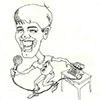
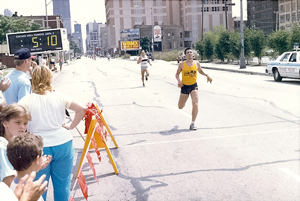
Proudly wearing the Marquette Park Track Club colors of black and gold!

When I returned to Chicago after three years in the Marine Corps, I moved back to Marquette Park. I lived at 3006 W. 64th Street for six years before I moved to Bridgeport. I loved living so close to the park because then I could go running every day. While in the Marines, I began running seriously after I ran a marathon in California. I thought that if I trained well enough, I could become a good runner. I joined the Marquette Park Track Club after running the Roy Bricker Memorial 5 Mile Race where I placed third in my age group. Roy Bricker was the best runner that the club ever produced. All thanks to Coach Jack Bolton whom all his runners adored. The club would meet every weeknight at 5:30 p.m. rain or shine, snow, or sleet. Jack never missed a practice.

Jack Bolton came from Ireland many years before, but he never lost his Irish brogue. We all loved it. Some of the runners imitated him lovingly. He was a world-class miler back in Ireland and when he came to the U.S. he coached high school teams in Chicago. He always had great runners running for him.

When I first joined the club in 1981, all the practices began with six laps (one mile) on the cinder track at Marquette Park. Jack would lead the pack, and everyone had to stay behind him. This was a group warmup. Jack’s philosophy for this warmup was twofold. 1. Runners learned to run in a pack and 2. Runners learned to run at someone else’s pace, as sometimes happens in a race. In later years, Jack’s ankles gave out on him, and he didn’t run the warmup with the club anymore.

Jack especially loved working with younger runners. He was known for the female runners that came out of his club system. In fact, some high school girls would join Jack’s club in order to develop as runners and qualify for running scholarships at the universities of their choice. Most girls achieved their goal. Of course, many boys also received running scholarships, too.

What everyone loved about Jack was his eternal optimism. He always believed that one of his runners would win the race outright, no matter how overwhelming the odds. I once entered a race and learned at the starting line that Jack had predicted that I would win. I wanted to live up to his expectations, but I had a difficult day and faded halfway through the race. But Jack was always touting some up-and-coming runners from his club. He was usually right, too.

Click here to read an article that I wrote about Jack Bolton for the CARA Finish Line the January/February edition of 1985:

http://davidrodriguez.us/docs/bolton.html 

DDR

Azteca Tacos


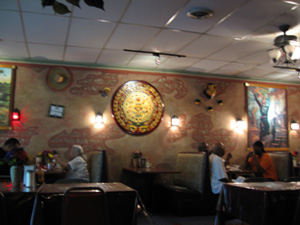
The ambience makes up for the sinking seats.

My favorite all-time Mexican restaurant is Azteca Tacos in Pilsen, 1836 S. Blue Island Avenue, Chicago, IL 60608, 312.733.0219

I’ve eaten there many times over many years. I was still in high school the very first time I ate there. My father and I went to the Fiesta del Sol when it was still on Blue Island Avenue. Rather than eating at one of the vendors from the fiesta, we went to Azteca Tacos and ordered our food through the window with wrought iron grating as we stood on the sidewalk.

It was kind of like eating at a restaurant in México. Authentic Mexican food is served by authentic Mexicans. The food is so delicious–¡Riquísima!–and they serve you large portions. It’s like being in México. Street merchants walk in to sell you everything from chiclets to blankets. Once an elderly man came in with a boom box and a book with a list of songs in Spanish. I picked two songs that I recognized and he sang them for us. I paid him $10 and he left the restaurant with a smile.

I like going there with my friends because it’s a nice place to hang out for a few drinks. Granted, it doesn’t look like a luxury restaurant, the seats in the booths are worn down a little, and the bathrooms remind me of México, but the food and the ambience make up for everything else. You have to go there at least once in your lifetime!

DDR

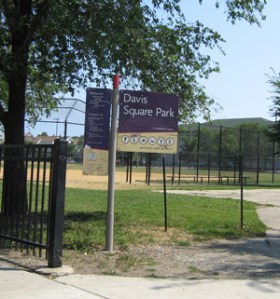
Davis Square Park


Back of the Yards, Chicago, Illinois

When I was growing up, I spent a lot of time in Davis Square Park in the Back of the Yards neighborhood. The park is located between Marshfield Avenue and Hermitage Avenue, 44th and 45th Streets. There are larger parks in the city, but when I was five, the park was huge.

My mother always took my brothers and me there to play whenever it was nice out. Basically, if it wasn’t raining, my mother would take us to the park to play no matter how cold it was. I loved going down the slide, which was the biggest slide I had ever seen! All the kids said it was the world’s biggest slide and I believed them. Come on, I was only five years old at the time. One day, I fell of the top of the slide because one of the kids told me to slide down one of the supporting poles instead of sliding down the slide.

When I was too afraid to go down the pole, he demonstrated how I should go down by doing it himself. Well, my legs didn’t wrap around the pole exactly right and I fell for what seemed an eternity and landed on my right arm. I cried because I was in so much pain! My mother came running over to see what had happened to me. She took my brothers and me home immediately. She massaged my shoulder, but I kept crying.

She called a friend of hers who immediately came over. She looked at my arm and shoulder, and then boiled some herbs on the stove. She then rubbed this pungent concoction on my shoulder and arm that made me gag and massaged me forcefully. I remember crying even more while she did this. Actually, I remember feeling much worse after her “cure.”

Davis Square Park had a field house where we would go after school in the fall to play floor hockey and in the winter to play basketball. In the winter, they would hose down the baseball fields so we could play ice hockey. Every day after school, I would play hockey all afternoon and evening long. I just loved playing hockey. I would have been a great hockey player if it weren’t for my one weakness: I couldn’t skate very well! However, I was fearless. I turned out to be a very good goalie. As long as I was standing in front of the net, I could block slapshots with my stick or chest, and I could catch the puck and give it to one of my teammates. My team usually won because hardly anyone ever scored on me.

The park had a swimming pool where we spent as much time as possible, although that was extremely limited because of their schedule. For reasons unbeknownst to us, the schedule alternated between a boy’s day and a girl’s day when we could go swim without an adult. In the afternoon and evening, families could go swimming together. I could never go because you needed an adult to take you. My mother never took us because she refused to wear a bathing suit. In fact, I never saw her go in the water when we went to the beach.

Our time at Davis Square Park just flew by. When it was time to go home, my brothers and I wanted to stay. It seemed like it wasn’t until we were really having fun that my mother would decide we had to go home. But we had to go home, my mother told us, because they let lions loose at the park at night. She told us this every time it was time to go home.

At first, we went home without questioning her. Then, I started thinking about the logistics and safety of maintaining lions at Davis Square Park. But my mother always had an answer for every question I posed. “Where do they keep the lions?” “In the basement of the fieldhouse.” “How do they let them out?” “Through the steel plates that cover the basement windows.” “How come the lions don’t run away if there’s no fence all the way around the park?” “Because the love the park.” “What’ll happen if I don’t go home with you?” “Fine! Stay! But don’t come home crying to me when the lions eat you!” “Wait for me!”

I met Mayor Richard J. Daley at Davis Square Park for the first time. Our neighborhood had a slight gang problem, so Da Mayor decided to start up his own rival gang called the Centurions. In theory, the Centurions would provide an alternative to street gangs. All my friends and I joined even though we never even thought of joining a gang in the first place. But we had a lot of fun! We played all kinds of organized sports and sometimes we even won a trophy. I really loved it when they would load us up on a school bus and take us the White Sox games for free!

DDR

Just a snowstorm?


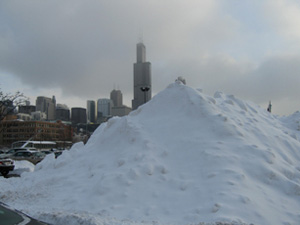
UIC Parking Lot

Snow was falling as I drove to school today. In all of my Spanish classes today, some students asked me if the exam might be canceled tomorrow because of the snow. Of course, there would be class tomorrow! This is Chicago!

This one particular student was sure that if it kept on snowing, I wouldn’t be able to get to campus and give the exam. However, in Chicago, a snowstorm is not merely a meteorological event. Every snowstorm, and other major climate changes, are political events of major consequences in Chicago.

You can trace this back to the snowstorm of 1979 that was improperly handled by Mayor Michael Bilandic. A few heads did roll after the snowstorm, including Bilandic’s. (I’m sure a few heads also rolled after the Chicago Fire in 1871.)

Luckily, I was living in sunny, southern California at the time. I know that even if we get three feet of snow tonight, I will be able to drive from my house in Beverly on the south side to UIC near downtown. Chicago will not be slowed down by such an insignificant snowstorm as that! Every time meteorologists predict even the remotest possibility of snow, city workers are on standby all over the city and even salting the streets before even the first snowflake has formed. Sometimes, there is more salt on the streets and sidewalks than snow. Yes, my dear students, I will be at UIC on time tomorrow morning to give you your exam. I love Chicago, the city that works (especially at Chicago overtime rates).

DDR