Okay, as a true Chicagoan and Chicago Bears fan, I cannot contain myself anymore and I must have my say about the outcome of today’s Super Bowl. My sons asked me who I wanted to win the Super Bowl. The New England Patriots, I said without even hesitating. They were amazed because they wanted the New York Giants to win. But that’s understandable because they don’t know Chicago History.
I’ll never forget the horrendous disaster that occurred on December 2, 1985–a disaster in Chicago History that ranks right up there with the 1812 Fort Dearborn Massacre, the 1871 Chicago Fire, and the 1992 Chicago Flood! Yes, I’m talking about the Chicago Bears loss to the Miami Dolphins in what would have been the perfect romp to Super Bowl XX. Yes, the Chicago Bears won the Super Bowl, but their record was slightly diminished. Their nearly perfect season was reduced to a mere 18-1 record by the Dolphins who held the record of 17-0 for the most wins in a season. Okay, so that’s why I want the New England Patriots to win tonight’s Super Bowl and go on to a perfect record of 19-0. Just so they can beat Miami’s perfect season of 1972.
Only then will I feel vindicated over that Bears’ loss to Miami, oh, so long ago, even though the wounds are still fresh in my heart! Go, Patriots!
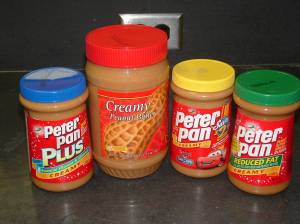
I worked at Derby Foods, Inc., 3327 W. 47th Place, Chicago, IL 60632, for twelve years. I started working on the midnight shift two days before my eighteenth birthday, but Jessie who hired me told me to tell everyone I was eighteen so the factory wouldn’t get in trouble for violating federal child labor laws. The factory-made Peter Pan Peanut Butter and Derby Tamales. Occasionally, they put the generic “Giant” labels on the Peter Pan Peanut Butter jars that were shipped out east somewhere. Many people laughed when I told them I worked in a peanut butter factory. Now that I think back, it does sound kind of funny. Besides, how many people would admit to working in a peanut butter factory–I mean besides me. I worked there for twelve years in all, but not consecutively. I started on May 7, 1974, and worked continuously, not counting two layoffs, through May of 1978 when I went to Mexico on vacation for a month and didn’t come back to work on time from my vacation. I heard that I got fired, but I didn’t care. My mother was extremely upset because I had the dream job that she had always wanted. She couldn’t get it, so she did everything in her power for me to get it. When I returned from Mexico, I went to the unemployment office and filed a claim because I had heard that I was laid off again. Well, I started receiving unemployment insurance checks which led me to believe that I was laid off and not fired. I never actually talked directly to Jessie or anyone else from Derby Foods to find out what my actual job status was. On August 23, 1978, I enlisted into the United States Marine Corps, mainly because my unemployment benefits would soon end because I would be called back to work and I didn’t want to work at Derby Foods anymore. While I was in the Marines, my mother had talked to Jessie at Derby Foods about me getting my job back–the job I never even wanted in the first place! I soon received a letter from Derby Foods stating that I could have my job back when I was honorably discharged from the Marines. My mother called me up to congratulate me even before I received the letter, which I immediately threw away upon receiving it.
When I returned to Chicago in July of 1981 after being honorably discharged from the Marines, my mother wanted to know what I had done with the letter, so I could take it to Derby Foods and get my old job back. I told her that I couldn’t find it. I really didn’t want to work there anymore, but I didn’t want to go to college at that point in my life either. In September, my life savings from the Marine Corps had been spent in a mere two months. I didn’t have all that much money because I pretty much earned about minimum wage working for Uncle Sam. Well, I had found my own apartment near Marquette Park at 3006 W. 64th Street and I had to pay the rent somehow. My mother was upset that I wouldn’t live with her in her house, but she would go to my new apartment every day to clean, bring me used furniture, and unpack my things. I started working at Derby Foods again in September. As luck would have it, I didn’t lose any of my seniority or benefits while in the Marines because of federal laws. In fact, the fiscal year for the factory started on November 1, so I worked about three weeks and then I had to take a three-week vacation before the fiscal year ended or I would lose all that vacation time. I was kind of glad I went back to Derby Foods. Of course, before I took my vacation time, Jessie asked me if I was going to Mexico again. Everyone was worried that I wouldn’t return. I told them that I planned to stay home and read books for three whole weeks. This worried them even more because no one at Derby Foods ever read any books.
I met all kinds of people at Derby Foods, from different Chicago neighborhoods. When I first started working there, everyone treated me nicely because I was so young. They all told me to finish high school so I wouldn’t have to work there all my life like they did. It was very good advice, but I couldn’t work full-time and go to high school full-time. I told my mother that I wanted to graduate from high school, but I couldn’t study and go to work at the same time. I would get home at 7:30 a.m. from working the midnight shift and then I’d have to go to school. Most days I couldn’t stay awake in school. Eventually, I dropped out of school. But I did get my GED thanks to my first wife who was so embarrassed being married to a high school dropout. I’m glad she made me take the GED test or my life would have turned out so differently. Some of my co-workers at the factory told me they were disappointed that I didn’t graduate.
About 1982, I was laid off again for nine months. Everyone told me I should complain to Derby Foods because a certain Peter was still working and didn’t get laid off even though he had less seniority than me. Whoever made up the list of people to be laid off didn’t include my time in the Marines for my seniority, so it appeared that I had less time on the job than Peter. I actually didn’t mind being laid off for those nine months! I did a lot of reading and writing back then. My mother would call me up every day to tell me to call Derby Foods and tell them that I had more seniority than Peter. I told her that I liked being laid off. That I liked not working and getting paid for it. She just didn’t understand. I worked there until September of 1986 when the factory shifted its operations to Sylvester, Georgia, but didn’t take any employees with them. Like I would have moved to Georgia just to work for Derby Foods! Thus ended my illustrious career as a manual laborer at the peanut butter factory.
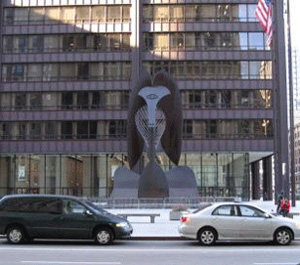
Picasso Sculpture, Daley Center, Chicago, Illinois
Today, I read the The Chicago Way by Tom McNamee in the Chicago Sun-Times in which he talks about jokes that work only in Chicago. Well, I would like to share some of those jokes with you, my fellow Chicagoans. He starts out with “Noel, Noel … So I took the bus.” I remember hearing a different version of this joke at Holy Cross School told by a nun: “Some Christmas carolers are under the El tracks downtown singing, “Noel, Noel …” Along comes a drunk and tells them, “Then take a bus!”
My friend Vito Vitkauskas wrote this Chicago joke that I used to use in my comedy routine: I once broke my arm in three places. Halsted, Lincoln, and Fullerton.
Ken Green, in today’s Sun-Times, wrote two funny haikus, or as he calls them, Chi-kus:
The CTA bus a very rare animal moves in packs of three
In my house we vote Even my uncle votes May he rest in peace
Here are some of the other jokes printed in the column:
How many Chicagoans does it take to park a car? Seven. One behind the wheel and six to rearrange the kitchen chairs.
Why is Chicago known as the city that works? Because whatever the problem–a parking ticket or a murder indictment–it can be fixed.
We all know why the chicken crossed the road, but why did the lady duck cross Walton Place? To get to the Drake.
I heard Mayor Daley has a plan to get crime off the streets. Yeah, he’s going to widen the sidewalks.
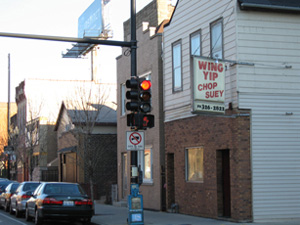
For the finest Chinese Food, you must go to Bridgeport on Chicago’s south side. Wing Yip Chop Suey, 537 W. 26th Street, 312.326.2822, is a cozy, family-owned Chinese carry-out restaurant. If you dine in, don’t expect a fancy ambiance. In fact, don’t even ask to use their public restroom. They don’t have one!
I have eaten at this Bridgeport establishment since the early 1980s, but I’m not sure what it was called back then because I don’t remember the restaurant ever having a sign outside with its name on it. This place doesn’t look like much from the outside–or the inside, now that I think of it–but the food is delicious and they serve generous portions for a more than reasonable price.
As you wait for your food, you may read the Chicago Tribune or Sun-Times that someone left behind after reading it. The carry-out customers are Bridgeport residents and people who work in the neighborhood. Everyone in Wing Yip is very friendly. People often meet other acquaintances, friends, or family members by surprise when they go there. But strangers greet each other, too. The loyal customers love this place so much that anyone who patronizes Wing Yip has something in common with all other customers who walk in. So it’s not that unusual for total strangers to greet each other and start up a conversation.
As a police officer, I used to like to eat lunch there because everyone respected the police there and I would meet other police officers whom I hadn’t seen in years. This is also a great police restaurant because the service is fast and cheap. I sometimes go out of my way just to eat there now that I’m a retired police officer. I like the fact that they know me by name because I’ve spent so much time in there over the years. If you go there, you just may see me sitting in the corner doing the crossword puzzle.
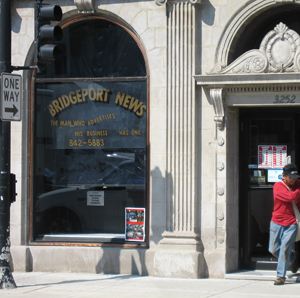
When I was in Holy Cross School, I had several paper routes and I really enjoyed delivering newspapers. My best friend in the fourth grade was Patrick McDonnell. One day he asked me to help him deliver newspapers on his paper route. One of his older brothers had the paper route, but when he got tired of delivering newspapers, he gave the paper route to his brother Patrick. In those days, it was almost impossible to get a paper route on your own. True to Chicago tradition, you even needed clout to get a paper route.
I helped Patrick deliver his newspaper, The Chicago American, for a few days. One day, he asked me if I knew who all the customers were. Of course, I did! “That’s good,” he said. “Because you can have the paper route!” He had gotten tired of delivering papers and couldn’t quit the paper route until he found a replacement.
Well, I was extremely happy to be his replacement because I loved delivering newspapers and I especially loved having some spending money. I’m not sure how long I had that paper route, but it was long enough to see the Chicago American become the Chicago Today. I loved reading the newspaper as I walked door to door delivering it. Then one day, the Chicago Today folded and I was out of a job. But it was fun while it lasted.
Months later, my friend Patrick asked me to help him with his paper route again. He had found another paper route and again he was tired of delivering newspapers on his bicycle. He immediately thought of me as his replacement. This route had many more customers than the other one and you needed to deliver the papers on a bicycle because this route covered our entire neighborhood. This paper route was the most memorable one for me. Paper route number 9! I really learned a lot about life while delivering newspapers on this route. And I also truly learned a lot about the Back of the Yards and its residents. On this route, I delivered the Chicago Daily News, the Chicago Zgoda, and the Chicagowski, the last two were newspapers published in Polish. I tried to read the Polish newspapers, but they seemed be written in a foreign language to me. And most of the Polish subscribers hardly knew English, but we always understood each other.
There were two facets to delivering newspapers. One was the actual delivery of the newspapers. Some subscribers wanted it delivered in a certain way. Folded without a rubber band, or with a rubber band. On the front porch, or on the back porch. Between the screen door and the door. There were considerate customers who didn’t mind if I just rode past on my bike and threw the paper on their front porch. And my aim was true, most of the time.
One day, as I was approaching a house next to the alley, I was about to throw the newspaper on the porch when suddenly a car sped out of the alley. I was shaken a little and when I released the newspaper, it broke the glass on the storm door. I was so scared that I kept riding and delivering papers. When I returned to the newspaper agency, the subscriber had already reported me to my boss, Ernest Pressman. I swear. That was his real name. She knew it was an accident and she only wanted me to pay for the broken window. I remember I had to pay about four dollars for a new window, roughly my weekly salary before tips.
Sometimes delivering the newspaper could be downright dangerous. One customer wanted the paper delivered in the rear hallway. What I didn’t know was that sometimes she kept her German Shepherd there. One day, I open the hallway door and saw the German Shepherd lounging at my hand that was attempting to drop the newspaper in the hallway. I quickly shoved the newspaper in his mouth and slammed the door shut. I was waiting for another reprimand from Mr. Pressman when I returned to the newspaper agency, but I was never reported for this.
The second facet was collecting the money for the subscriptions. Collecting money from some customers required an excellent memory, ruses, and stratagems. All this just to collect a measly fifty cents! I had to remember what day they got paid so I could go collect the money that day before they squandered it away on rent, food, utilities, and other such nonsense. And I also had to make sure I had enough change so they could pay, and I could give them change. They wouldn’t pay unless I gave them correct change.
One woman once asked me if I had change for a five. Of course, I did. So, then she upped it to ten dollars. I told her I had change for a ten, too. Then, she said for a twenty and I said yes. She then told me she had a fifty-dollar bill and I showed her that I had enough change. I was ready for her because she had tried this before. She then paid me in exact change and gave me a nickel for a tip.
I mean I got to know all of my customers very well. One woman told me to collect the money on Saturday morning at 8:00 a.m. and then wait for about ten to fifteen minutes until she opened the door. Not a problem, I told her. All I wanted to do was collect my money, and hopefully, a small tip. The reason she wanted me to knock on her door so early was that I was her Saturday-morning alarm clock. And she took so long to open the door because she went to the bathroom first. I always hoped she washed her hands.
I delivered the Daily News to a bar on the corner of 43rd Street and Wolcott. When the bartender paid for the subscription, he would tip me fifty cents and tell me to take a bag of Mrs. Vitner’s potato chips, any candy bar of my choice, and a pack of gum. One customer I never saw. She left me a note on her door in the rear hallway saying she would leave the money hidden in a crack in the wall. I was pleased by this arrangement because this mystery woman tipped well.
One little old Polish lady always wanted me to deliver both the Zgoda and Chicagowski directly into her hands. So, I had to get off my bike, go knock on her door, she would say something in Polish that I didn’t understand, I would say I was the paperboy, and then she would open the door. I did this every day! Actually, I didn’t mind doing it, either. Of course, she wasn’t a big tipper, either, even though she considered herself extremely generous. On the day I had to collect the money for the subscription, she would tell me to enter her apartment and lock the door behind me. She would give a crisp brand-new dollar bill to pay for her bill of ninety-nine cents. I would then give her her change of one cent, which she would give back to me immediately as my tip and insist that I put the penny in a different pocket because that penny was for me and not the newspaper agency. Most subscribers would tip a nickel or a dime and that was extremely generous in all reality. But I really loved going through this weekly ritual for my one-cent tip! Sometimes I had to run out of the apartment so she wouldn’t hear me when I couldn’t contain my laughter anymore. I really loved this little old Polish lady!
There was another little old Polish lady on paper route who received the Chicago Daily News, the Zgoda, and the Chicagowski. Her bill was about $1.50 per week. She wasn’t as demanding about her delivery, either. When I went to collect the money for her subscription, she would tip me 100%. I told her that $1.50 was way too much money for the tip, but she insisted. Well, being the polite Mexican boy that I was, I would pocket the money, in a different pocket, of course, so the Mr. Pressman wouldn’t get my tip. Sometimes, she would feel really guilty about the tip and slip me an extra nickel or dime before I walked out!