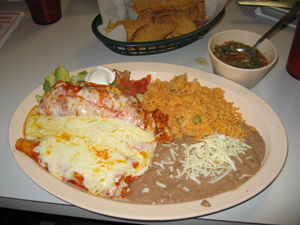
In Mexico, I was surprised when my cousin handed me a bag of potatoes and a potato peeler. She actually wanted me to peel potatoes! In the past, whenever I went to Mexico, I was never allowed in the kitchen while the women cooked. So I sat down at the kitchen table and actually peeled potatoes while my cousin and my aunt prepared the New Year’s Eve dinner. Amazingly, there were two other males in the kitchen helping with the cooking. Mexico is changing. I remember when I was a boy and my mother and aunts were making tamales, I got kicked out of the kitchen while they were preparing the tamales. Once my mother made tortillas and she let me roll one tortilla, but then she kicked me out of the kitchen. My abuelita never even let me try to cook anything when she lived with us in Chicago. Now that I think back, most Mexicanas always tried to discourage me from helping in the kitchen. But I think that it’s a conspiracy. Because then when you meet American girls, one of the first things they ask is, “What can you cook?” And if you ever go to their place for dinner, they test your culinary talents by making you help with the dinner. They’ll let you cook the entire meal if you’re able. But if you’re like me and grew up in a traditional Mexican family, you won’t be able to do much more than warm up tortillas! And they’ll settle for you washing the lettuce.
What I love about going to Mexico is all the attention I receive from my relatives who are genuinely happy to see me. They ask me many questions about my life, in particular, and life, in general, in America. The only problem with this is that they tend to ask me these questions while I’m eating. So I am always the last one done eating.
I’m a slow eater anyway, but answering questions slows me down even more. And they ask rather personal questions, too. But everyone is so honest when speaking that I feel compelled to answer their questions honestly. And no one judges anyone about each other’s behavior. At least not that I noticed.
So, how did I enjoy a good home-cooked Mexican meal with everyone insisting that I answer their questions? Well, I didn’t want to be rude, so I answered every question immediately. Of course, sometimes I answered with my mouth full of food because I was caught off guard by the timing of the questions. I guess I was being rude by talking with my mouth full just because I didn’t want to be rude!
See how this young woman dresses in a blouse and skirt. And enjoys it!
When Americans work dead-end McJobs, they let the whole world know that they’re not happy with their jobs. They will serve you your food, process your order, or ring you out, but you know for a fact that they hate their job. In fact, if it weren’t for you the customer, user, or consumer, actually requiring their services, they could be sleeping in until noon everyday. Unfortunately, these are the very same people we most often encounter in our daily lives. I’m not saying all American workers have this bad attitude, but we encounter far more of them than necessary.
In Mexico, there is a totally different attitude toward work in a country where fifty-million people live on less than one dollar per day. Mexicans truly appreciate any and every job that they hold. Even when I was in Burger King or McDonald’s in Mexico (because my sons refused to eat the Mexican food my family cooked up for us), every single employee wore their uniform proudly and they took their job seriously. The service was so much better in Mexico because they did their job as well as they were supposed to do it. And they didn’t treat the customer as a mortal enemy to be hated the moment he or she entered the restaurant. The customer was always respected, nay, revered. Even the guy who washed my car in the parking lot when we went to the show in Celaya. He was so respectful when he offered to wash my car for thirty pesos that I paid him in advance because I trusted him and I just knew that I would come back and my car would be washed. I absolutely trusted him. When I returned I was very happy with how clean my car was.
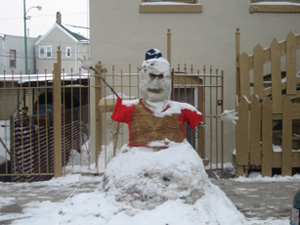
I’ve heard a lot of complaints this winter about how much snow we’ve had in Chicago this winter and last. People are also complaining about how cold it’s been lately. Most of these complainers are either too young or haven’t lived in Chicago for very long. These are the cold, bitter winters that I remember as a boy! No, I won’t exaggerate about how cold and snowy winters were in Chicago in the days of yore. I don’t have to. Just recall the weather since December and you’ll see how much snow we used to have and how cold it used to be. Once you get used to the weather, you can still enjoy living in Chicago. There are much colder places than Chicago.
When I was a boy, I spent a lot of time outside during the winter. I delivered newspapers, shoveled sidewalks for money, played ice hockey, and occasionally, played baseball in the snow. We liked to do things that would make adults shake their heads at us. Like staying outside in the cold. The one thing I did learn–although accidentally–was to dress in layers. We didn’t have very much money for proper winter clothing such as down coats, wool socks or sweaters, or insulated gloves. One day, while ice skating at Davis Square Park across the street, I got cold, so I went home and put on some more pants and socks and shirts, eventually experimenting until I learned the correct number of layers to wear. I would wear two or three T-shirts, three or four pairs of pants, and four or five pairs of socks, depending on the temperature. When everyone else went into the park fieldhouse to warm up, I continued skating outside. I never got cold again once I learned to dress for the weather.
And I also taught my brothers how to dress properly for winter. One extremely cold, snowy winter, our school, Holy Cross School, had a fundraiser for which we had to sell Christmas cards door to door. There had been snow on the ground since Thanksgiving Day. Even though the sidewalks were shoveled, there was snow piled up everywhere where no one walked or drove. My brother Tato and I started knocking on doors trying to sell our Christmas cards–unsuccessfully. We were at the third house and the woman who answered the door told us she was not interested in buying Christmas cards. So, we turned around and started walking down her front porch stairs. When I reached the sidewalk at the bottom of the wooden stairs, I heard my brother Tato slip on the ice and fall down the stairs. I checked to see if my brother was okay, and I helped him up. The woman who was watching us through the front window opened the door and called us back up to the porch. “I’ll buy a box of Christmas cards,” she said. Well, we sold her a box of Christmas cards and went on our merry way to the next house. This woman also refused to buy Christmas cards from us. As we were walking down her front porch, Tato again “fell” down the stairs. Of course, the woman called us back and bought a box of Christmas cards from us. We persisted with our sales pitch until we sold all our Christmas cards. In fact, the next day, we asked Sister Cecilia for more Christmas cards for us to sell. She was surprised that we could sell that many Christmas cards!
If you go to el Zócalo in Mexico City, you may see all kinds of Mexicans. You really can’t say you’ve been to Mexico City unless you’ve visited el Zócalo In Mexico City. So every time I go to Mexico City, I end up in the Zocalo at least once.
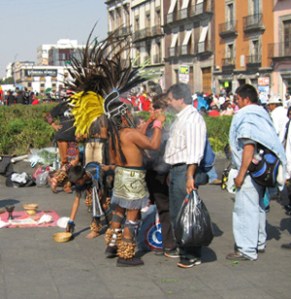
I really love this public square because many Mexicans feel compelled to visit it. El Zócalo is the center of Mexican life. You’ll also see many foreign tourists. Cathedrals, the presidential palace, and colonial buildings surrounding the Zocalo. If you look down in front of the cathedrals, you will see some glass inlaid into the sidewalk revealing the remains of Aztec pyramids below, which the Spaniards razed to construct the cathedral under orders of Hernán Cortés. As a reminder of Mexico’s past, Aztec dancers are ever present near el Zócalo dancing for the public. They will also perform a spiritual cleansing for you. They will cleanse you of any bad spirits that are hindering your happiness and wellbeing. Whenever you see the Aztec dancers, they are always cleansing someone with at least several others waiting in line for their turn.
I told my cousin that I probably needed a good cleansing, and she said I should get one. She confessed that she was once cleansed when life wasn’t treating her well and it improved her life for the better. She insisted that I should be cleansed. I would become a much better person. Well, I didn’t really believe a cleansing would really help me, so I passed. But now I wonder.






 Chicago USA