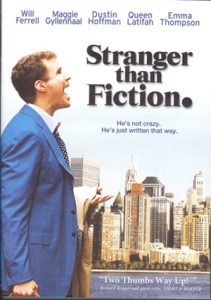
I actually saw the movie Stranger Than Fiction because it was about a writer writing a novel. I liked the way the line between reality and fiction was blurred. I bought the DVD when it came out and I actually saw it soon afterwards. I only say this because I have a stack of DVDs that I bought years ago and have yet to see.
Another reason I wanted to see it was because I have a personal connection with this movie. It was filmed partly at UIC. In fact, I had to change classrooms because they filmed in my classroom.
One day, as I talked to a student in the hallway, another student said, “Did you see who just walked behind you?” Of course, I didn’t. Because I like to make eye contact when I talk to someone. Well, it was Dustin Hoffman! And I didn’t see him! People at UIC who were around the film crew said that Dustin Hoffman was actually funnier than Will Ferrell in person.
So that was my brush with greatness. And I missed it!
As I sit down to write this, I know I won’t finish this blog post tonight. The cast of characters keep changing, but the title is always the same. I’m referring, of course, to Mayor Daley of Chicago.
Well, actually, Chicago has had two Mayor Daleys. For anyone who has lived in Chicago for as long as I have, you know that Mayor Daley and his clan are part of the fabric of Chicago politics. Mayor Daley was the only mayor, or Da Mare as he is known in Chicagoese, that I knew since I was in grade school until his death in 1976. And just when I thought the Daleys were out of my life, his son Richard M. Daley ran for Chicago mayor unsuccessfully. Eventually, we had a second Mayor Daley, henceforth referred to as Richard da First and Richard da Second, respectively. And I just have a feeling that someday we may have a third Mayor Daley when Richard da Second’s son Patrick Daley returns from the army after he fulfills his enlistment. Yes, we could possibly have a Richard da Third.
When I was a boy, sometimes Richard the first would show up in our neighborhood unexpectedly. If we had award ceremonies for our park district tournaments, Mayor Daley would be there to pass out trophies. As I grew older, he was always in the news. His name was on just about every sign in the city of Chicago. One day, I was at the library at St. Xavier University on the south side of Chicago. I looked out the stained-glass window and I noticed a little plaque underneath. The window was donated by Richard J. Daley in memory of his father. I often went to the library at UIC to study. Then one day, they changed the name to the Richard J. Daley Library. Just like that.
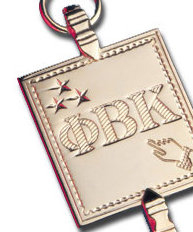
I am the proud recipient of the Phi Beta Kappa key!
PBK stands for Phi Beta Kappa, which is America’s oldest honor society. Some of you probably already knew that. I studied very diligently as an undergrad and I was fortunate enough to earn a PBK key when I graduated. I actually surprised myself! I was hoping that I would be inducted into the honor society, but I was actually surprised when they wrote to me to notify me that I was. Later, I felt that maybe I didn’t deserve to be a Phi Bete. I never wanted anyone to give me anything that I didn’t deserve. I always wondered about it.
Now as a Spanish lecturer at UIC, I volunteer to review academic records to see who deserves to earn a PBK key upon graduation. So I usually compare myself with PBK prospectives. I am proud to say that I usually fit right in the middle somewhere. I wasn’t a brainiac, but I wasn’t exactly a slacker, either.
Most students who earn the PBK key have a GPA of 3.7 – 4.0 out of 4.0. I had a 3.71 GPA. Students must also demonstrate depth and breadth of study, risk taking, and a general love of learning. So if a student takes many honors college courses that contributes to his or her dept of breadth of studies. Doing a double major also accomplishes this. Well, I was in the honors college, and I did a double major in English (3.79) and Spanish (GPA 3.99), and I took a lot of upper lever-courses that I didn’t need just for the fun of it.
I attended college later in life, so I really loved school and I tried to get as much out of it as possible. After reviewing students this year, I realize that I did deserve that PBK key!
Now that I think of it, I have also had some memorable Spanish teachers in addition to Enrico Mordini at Divine Heart Seminary. My first semester at UIC, I made sure that I registered for a Spanish class. I took a placement test on which I scored poorly. When you sort of know Spanish, as I did then, you manage to talk yourself into the wrong answer many times just because it sounds right. I had to take a second placement test in the Spanish department because I had a Spanish surname, I admitted that I came from a Spanish-speaking family, and I still actually spoke Spanish. Sort of. For the placement test, I had to write in Spanish and explain where I worked and what I planned to do at UIC. This was actually exceedingly difficult for me because I only studied Spanish for two years at Divine Heart Seminary and I didn’t really apply myself because I was just a rebellious teenager. I occasionally wrote letters in Spanish to Mexico, but they were usually truly short. So, I wrote this little essay in Spanish, and they placed me in Spanish class for heritage speakers. This class consisted of students from Spanish-speaking backgrounds who sort of knew Spanish, but not really.
I will always remember our first Spanish instructor. She was a teaching assistant from the Dominican Republic named Juana. She insisted that we call her Jenny. I think she wanted to fit in with the rest of the Americans. As a side note, I was always, and still am, amazed by the fact that graduate students would come from Spanish-speaking countries to UIC to study Spanish. Anyway, Jenny was quite a teacher. When we took exams, she would look it over and tell us we might want to look over a certain answer. When I did, I realized that I was wrong, and she gave me a chance to correct my mistakes. She came to Chicago in September, and she was amazed at how cold it was: about 60 degrees Fahrenheit! The next week, the temperature dropped to about 50 degrees. When I saw her walking to class that 50-degree day, she wore a full-length winter coat, a hat, a scarf, and gloves. She couldn’t believe how cold it was in Chicago. Just as a warning, I told her that it would get much colder in just a few weeks. I also reminded her that it also snowed in Chicago. Once winter arrived, she would only take off her hat, scarf, and gloves, but keep her coat on. She would shiver during the whole class. When she graduated with her master’s degree, she immediately went back to the Dominican Republic.
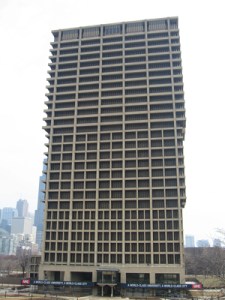
University Hall, University of Illinois at Chicago
When I was an undergrad, I couldn’t decide on a major. After much deliberation, I finally narrowed it down to English or Spanish. After even more deliberation, I decided not to decide and I double-majored in English and Spanish. My emphasis in both majors was literature.
I love to read. And besides, my personal agenda includes writing The Great American Novel, that is, if I ever actually got around to sitting down at my computer and writing a novel. Nothing would help me achieve my goal more easily than majoring in Spanish, and oh, yes, English, too.
Anyway, by doing this double major, I straddled two academic cultures. I saw the best and worst of both worlds. Most of the students who majored in Spanish were from the middle or lower class and were very humble. The students who majored in English were also from the middle or lower class, but they thought they were really cool. Not every English major exuded this arrogant aura of “cool.” Just a handful, but just enough to annoy the rest of the class. Whenever they said something they thought was extremely brilliant or witty, they would proudly announce, “I’m an English major!” as if no one else in the classroom was also an English major.
Some of the English professors were of the plain vanilla variety who seemed tired of Academia, the “cool” English majors, and the literature they taught. The Spanish professors, on the other hand, were from Spanish-speaking countries who also seemed tired of Academia, but lacked “cool” students, and absolutely loved their subject. In general, there was much more laughter in my Spanish classes than in my English classes. The Spanish professors weren’t afraid to reveal their cynicism and world-weariness in satirical and humorous ways, and besides, the literature in Spanish is generally much funnier than literature in English.
Of course, whatever literary theory I learned in English classes, I applied to my Spanish classes, thereby making me one of the better Spanish students. I have never regretted my decision to major in both English and Spanish. Eventually, I will write a novel, even if it doesn’t achieve The Great American Novel status. But I did learn a lot about world literature as a double major in Spanish and English. I feel so “cool” since I majored in English!



 Chicago USA