XX


Stay thirsty, my friends!

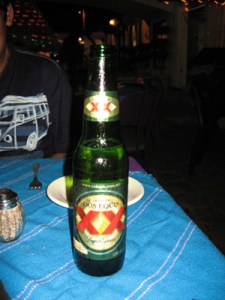
Sometimes we read Spanish texts in Spanish class. Often, the historical time period is referred to as siglo XX, pronounced siglo veinte in Spanish, which means twentieth century. Usually, they read, “siglo dos equis.” Some students actually think the text is referring to Dos Equis the Mexican beer! Thus, I learn about their weekend extra-curricular activities. Rarely do the students read the phrase correctly. Maybe I’m too literal when I read a text, but I never even thought of Dos Equis beer whenever I saw siglo XX. I really read it as the Roman numeral 20. And I love beer!

Anyway, this got me to thinking about Dos Equis beer a lot. But I managed to refrain myself from drinking any. And now they have a Dos Equis commercial that they play during the Ten O’clock News that always makes me laugh. They show an obviously macho machísimo man who I like to think is obviously Mexican. They show him walking into a pool hall, surfing under a huge wave, and surrounded, of course, by several señoritas, implying that he’s a lady’s man. Then the narrator says: “He’s been known to cure narcolepsy just by walking into a room. His donor donation card also lists his beard. He’s a lover not a fighter. But he’s also a fighter so don’t get any ideas. He is … the World’s Most Interesting Man.

The World’s Most Interesting Man

Then this macho machísimo man says with a thick, yet virulent, Mexican accent, “I rarely drink beer. But when I do, I drink Dos Equis. Stay thirsty, my friends.” I mean this guy makes being Mexican look cool! Some of my Spanish students mentioned this commercial to me because they also thought this guy was really cool. I can only hope to someday be half as cool as his beard!

DDR

Going to Mexico


Some of my home cooking.

Okay, I’ve been preparing my sons to go to Mexico. They’re still excited about going even though I told them that everyone in Mexico speaks Spanish. My oldest son used to speak Spanish when he was little because I always talked to him in Spanish, and he went to Cordi Marian and was taught by Mexican nuns. The twins are learning Spanish in school now.

For the past few years, I’ve tried to get them to speak Spanish at home, but they won’t. If they sneezed, I said, “Salud” and they were supposed to respond, “Gracias.” But they wouldn’t. Ever since I told them that we were going to Mexico, they speak a little Spanish with me. I’m glad their attitude has changed a little bit. If I’m writing something in Spanish, Adam will read it aloud and ask me if he pronounced it correctly. I’m happy that they’re trying because now I know they really want to go to Mexico.

I’ve also tried to explain some of the cultural differences between our two countries. They shouldn’t have any problems, but I want them to know in advance that they shoul expect some differences. They probably won’t play any video games while we’re in Mexico. But my sons are very adaptable. They’ll manage somehow. We’ve taken driving vacations before, and we always adapt to every situation. I’m really not worried about much. Well, except maybe Montezuma’s Revenge. If they get it, I hope they get it right away and they won’t get too ill. After that, they’ll build up their immune system.

I warned them about how the food will be different, too. We won’t be going to McDonald’s or Burger King once we cross the border. They won’t see a burger or chicken nugget until we get back to the U.S. And all the food will be spicy. In Mexico, even the candy is spicy.

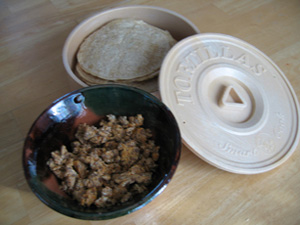
On Sunday mornings, I make huevos con chorizo and tell them to eat them with tortillas because that’s how Mexicans eat–without silverware. So far, they’re still excited about going to Mexico.

DDR

Carol


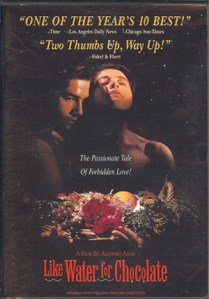
Como agua para chocolate.

Some Spanish students just amaze me with some of the things they tell me, particularly when it comes to criticism about teaching. Some students are very blunt and opinionated when criticizing teachers. Most often, they don’t tell me what they think about me or my style of teaching, but they will tell me how they changed to my class because they couldn’t understand the other instructor because he or she spoke Spanish too quickly. Sometimes students will tell me that my Spanish class is their favorite class, which makes me a bit uncomfortable. Then, some will even add that my Spanish class has been the best class of their entire college education.

I can honestly say that most of my students are happy to come to class and we often have fun together and laugh a lot during class. However, I don’t feel that I deserve all the compliments that I receive. When I used to teach at Morton College, an instructor who taught in the classroom next to mine commented about all the laughter she heard emanating from my classroom. “You must teach a fun class,” she said. “What do you teach?” “Spanish,” I said. She gave me this look of disbelief. Normally, most students dread studying a foreign language and only do so to fulfill the mandatory general education requirements. But most of my students love coming to class! This last semester, many students told me that this was the most Spanish they had ever learned. And they had fun in class.

When I first started teaching Spanish at UIC, I wasn’t sure what to expect of the students. Overall, they were certainly a notch above community college students because of stricter admissions standards. The main difference was in the attitude toward me as a Spanish teacher by the two school administrations. At the community colleges where I had taught, I was in charge. They would give me a textbook and tell me that I had to cover a certain number of chapters, which I always did. But I had a lot of freedom in the classroom. Then, I started teaching at UIC, which is a research university, where most of the 100-level Spanish classes were taught by teaching assistants. Since there are hundreds of 100-level classes and the possibility of cheating increases exponentially, the classes are more controlled and there is less freedom for the instructor in the classroom. Plus, the administration wanted all the classes to be equally fair to all the students. So, it took me a while to adjust.

I’ve always liked showing movies in Spanish class. At UIC, I once asked if it would be okay to show a movie if we had time and I was told no. So, I didn’t show a movie. I recalled how students liked watching a movie, in Spanish, set in a Spanish-speaking country. I always picked a movie that demonstrated some cultural aspects of Spanish or Latin American society. Anyway, I decided that I would show a movie to my classes the next semester. How did I get around getting permission? Simple! I just didn’t ask for permission to show the movie. If I had asked, I would have been told no. And then I wouldn’t be able to show a movie because I was ordered not to. So, I just showed it. If anyone of my superiors would have told me anything, I would have said, “But no one told me that I couldn’t show a movie.” Of course, none of my students ever mentioned watching movies in Spanish class.

So, one day at UIC, one of my students tells me that I’m a very good Spanish teacher. I said, “Muchas gracias” and left it at that because I don’t take compliments very well. She was a good student who always paid attention in class and always did the homework and participated in class. Another day, she told me that her friend was also in the same Spanish 103 class as her, but in a different section. Her friend wasn’t happy with her Spanish instructor. A couple of weeks later, she told me how her friend had transferred to UIC from Daley College and how her Spanish instructor at Daley College was so much better than the one she presently had at UIC. She just went on and on about how her friend had learned so much Spanish at Daley College and how her instructor was so enthusiastic and always answered all her questions. I must admit that I got very bit uncomfortable by all this talk. I wondered who this super Spanish instructor was. I was also afraid that my students would be disappointed to have to settle for me as their Spanish teacher instead of having that teaching wonder from Daley College. One day, I’m leaving Lincoln Hall where I teach Spanish 103. The student who always talked about her friend at Daley College is exiting alongside me. Well, who do see on our way out? Her friend. “Carol!” my student shouts at her. Carol and I looked at each other and we immediately recognized each other. I used to teach at Daley College and Carol was my student back then. The Spanish instructor she was talking about was me!

Passport issues


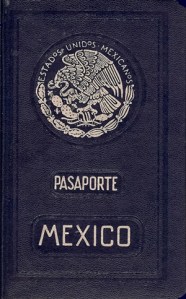
My Mexican Passport

Well, since I always talk about my name, let me get back to the name of David Rodríguez. Well, actually, David Diego Rodríguez. I bring it up again because I plan on going to Mexico in July with my sons. And every American citizen needs a U.S. Passport to return to the U.S.

So, I had to apply for passports for all three of my sons who are natural citizens by virtue of having been born in Chicago, Illinois. Two of the three passports were immediately processed by U.S. Department of State.

The one for my son with my name caused a delay. They needed more documentation for him. There are just too many David Rodríguezes. He’s only eighteen, so he doesn’t have a credit history, a driver license, or a credit card. They needed more proof to verify his identity. I wasn’t sure what they wanted or what other documentation I could provide. One of the enclosures listed in the letter was a Supplemental Identification List, which they had forgotten to enclose. I sent everything I could think of, including photocopies of his state ID, his school ID, his W-2 forms, federal tax return, state tax return, a prescription label with his name and address. I was extremely relieved when they accepted the enclosed documentation. I finally received his passport yesterday. We’re all set to go to Mexico now.

I remember when I went to Mexico in 1978, things were so much different. I had forgotten how to speak Spanish. I still understood it, but I never had to speak it much in Chicago. I stayed in Mexico for about a month and so I quickly learned to speak Spanish again.

However, when I returned to Chicago, I had trouble speaking English again. I flew back on Mexicana Airlines and when I was in Customs at O’Hare Airport the agent asked me for my proof of citizenship. All I had was my driver’s license and birth certificate. I gave them to him and then I worried that they wouldn’t let me go back to Chicago.

You see, my driver’s license didn’t have a picture of me. Back then, they were printed on thin cardboard and only described the driver as 5’8″, 128 Lbs., BRN Hair, BRN Eyes. My birth certificate didn’t have much information on it either and my last name was misspelled as, “Rodriquez” with a “q” instead of “g.” (My mother never thought the mistake was important enough to correct when she received my birth certificate in the mail soon after I was born.) The agent looked at my documents carefully and asked me if I had anything to declare. I understood him perfectly, but I couldn’t form the words in English. I thought for sure that the authorities would detain me because I couldn’t make myself speak my fluent south side English. But miraculously, he let me through. I could then understand how there were so many illegal immigrants from many countries in the U.S.

When I went to Mexico last December, it was a little more difficult to enter Mexico. I handed my passport to the agent, and he entered the information on a computer. He asked me some questions and when I answered them satisfactorily, he let me back into the U.S. Then about sixty miles into the U.S. there was another checkpoint where I had to present my passport again and answer some more questions. They asked me the questions to see if I really spoke English to prove I was a U.S. citizen. The agent spoke quickly and slurred his words together as if to test my knowledge of English. Either that or he was just bored of his job and just going through the motions. He asked me where I was from. When I said Chicago, he asked, “Born and raised there?” “No. I was born in Perth Amboy, New Jersey.” I suppose that if someone didn’t speak English well, they wouldn’t have been able to answer those questions, raising suspicions. I was glad that I didn’t have trouble speaking English this time.

DDR

Medieval road trip


Evanston, Illinois

One of the most memorable Spanish classes I ever took was a Medieval seminar on Spanish literature at UIC. There were only four students in the seminar. The professor, Reinaldo Ayerbe-Chaux, taught the course with great enthusiasm. So much so that I wanted to write my doctoral dissertation on some Medieval text. One of our writing assignments involved transcribing a Medieval text written on parchment into Spanish. I don’t know why, but I was truly fascinated by this project. The language of the parchment was archaic but comprehensible. The alphabet was moderately different from the modern Spanish alphabet. Some parts of the text taxed my brain for me to decipher the writing and then comprehend what was stated. Little did I realize that this was good training for me as a Spanish professor when I would have to decipher student compositions with illegible handwriting before I could interpret the student’s intended message. But, hey, I love puzzles!

Well, the highlight of our seminar came at the end when we went on our field trip to the University of Wisconsin, Madison. Their Spanish department had the largest collection of Medieval Spanish texts in the world. However, most of them were on microfilm. Professor Ayerbe-Chaux said we just had to go to the university and see the collection for ourselves. I offered to drive our class to Madison, Wisconsin, in my minivan, which he thought was a good idea. Of course, UIC paid for my gas.

Professor James Compton, who is now retired, also wanted to go with us since he had graduated from there. Maybe I’m just too easily amused, but I had a lot of fun on this trip. I enjoyed looking at all the Medieval texts even if they were only on microfilm. Professor John Nitti gave us copies of two of their publications, which I shall someday read. But the highlight of the trip for me was meeting the faculty. Professor Compton was happy to see his dissertation adviser Lloyd Kaston once again. He was now professor emeritus, but he still had an office in the Spanish department, and he still was actively transcribing Medieval texts. When we went to his office, he just happened to be napping. He was ninety-something years old, so he was entitled to nap whenever he wanted! Well, I got to see four generations of faculty in the same room!

I will always remember this seminar because Professor Ayerbe-Chaux gave the entire class, all of us, copies of a book by Don Juan Manuel that he had published. He had read the original texts by Don Juan Manuel and then transcribed them. He was even gracious enough to autograph the book for me!

DDR