Juan Goytisolo


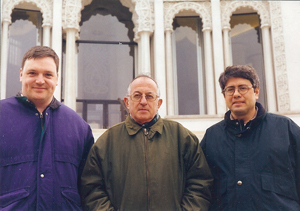
Juan Calduch, Juan Goytisolo, and Dr. D. in 1999.

There are famous people and then there are famous people you have never heard of.

As a graduate student in Hispanic Studies, I had to read a novel, La saga de los Marx, by Juan Goytisolo for a seminar on Modern Spanish (as in, from Spain) Literature. I had never even heard of Juan Goytisolo. Then the professor who assigned the novel assured the graduate seminar that he was a world-famous writer. I just took her word for it. But I was suspicious of just how famous he was.

Well, regardless of his claim to fame, I began reading La saga de los Marx. I was captivated by Goytisolo’s writing. I couldn’t identify a protagonist or a setting. He inserted foreign languages sans translations. There was no storyline to speak of. Or standard punctuation, for that matter. He seemed to have studied grammar and stylistic rules only so he could break as many rules as possible. However, the writing piqued my curiosity and I read the novel in a mere two sittings.

When the class met to discuss the novel, only one other student said she had read the entire novel. But she wasn’t sure if she really liked the novel. I, on the other hand, loved it! I immediately decided that I would write my seminar paper on this novel. I was intrigued by the postmodernist style.

As I was writing my paper, I decided to reread the novel to find supporting citations for my paper. Curiously enough, I enjoyed the novel even more upon reading it a second time. I loved it so much that I decided to write a letter to Juan Goytisolo, c/o of the publisher. Imagine my surprise when he wrote back! Usually when I like a writer that much, he or she has already been dead for a long time. Sometimes dying even before I was born. How rude!

Well, this paper inspired me to further my studies and become a doctoral candidate. I showed Juan Goytisolo’s letter to the seminar professor and she asked me to invite him to speak at UIC. He accepted the invitation and spoke at our university, with me as the guest of honor because he came on account of my letter, and I was writing my doctoral dissertation on his novels. I was truly honored. I was also surprised at how many people came from miles around to hear Juan Goytisolo speak and plug his latest novel. He was a fascinating man, as I discovered while giving him a tour of the Chicagoland area.

Well, Juan Goytisolo truly is world-famous. Every year he gets nominated for the Nobel Prize for Literature. One of these days, he may win it. But to think I had never heard of him before that graduate seminar!

DDR

La composición


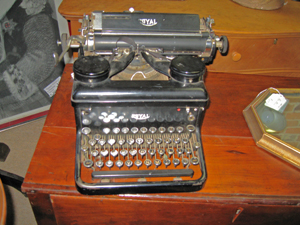
Diego Rivera’s typewriter, Guanajuato, Guanajuato, Mexico

If you take enough Spanish classes, you will have to write a composition in Spanish. By that time, you will know enough Spanish vocabulary and grammar to write a good composition. Here are a few rules you should keep in mind while writing la composición.

Think in Spanish! The worst thing you can do is write out the composition in English and then translate it into Spanish. You are doing double the work! Brainstorm for your composition using the Spanish vocabulary that you already know. Begin writing your composition in Spanish, without looking up words in your dictionary. Insert words in English to look up later. The main goal is to write out most of the ideas for your composition in Spanish. Don’t worry about spelling or grammar until after your finish the first draft, el borrador in Spanish.

Give your composition a good descriptive title. Only the first letter of the title is capitalized: La fiesta que le dimos a mi abuelita para su cumpleaños. If you use a proper noun in the title, it must be capitalized: Las vacaciones de primavera en Puerto Rico.

Pronouns are used less often in Spanish than in English. Once the subject is established, the pronoun is no longer necessary: María era buena estudiante. Siempre llegaba a clase a tiempo. Participaba en todas las discusiones de clase. Siempre sacaba buenas notas. In all the preceding sentences, we know that María is the subject even though we do not use the pronoun ella. Do not use another noun or pronoun for the subject until the subject changes Un día su mamá no la levantó a tiempo. La maestra se preocupaba por María.

When listing a series of items, do not use a comma before the last item: Compré pan, queso y huevos.

There are two abbreviations in Spanish, and you must use them: a + el = al, de + el = del

In general, commas are used less often than in English.

Do not translate everything into Spanish. If you live in River Oaks, do NOT translate it into Río Robles. Julio Iglesias is NOT July Churches!

Adjectives of proper nouns are not capitalized. Frida Kahlo es mexicana. Shakira es colombiana, Penélope Cruz es española.

Days and months are NOT capitalized: los días – domingo, lunes, martes, miércoles, jueves, viernes, sábado; los meses – enero, febrero, marzo, abril, mayo, junio, julio, agosto, septiembre, octubre, noviembre, diciembre.

“With me” and “with you” are written as one word: conmigo, contigo.

DDR

Combination locks


Security against terrorists

As a law-abiding citizen and a patriotic American, I would like to participate in our fight against terrorism. I agree that we must stop the terrorists at the border. 

I have crossed the border a few times, so I have an idea that may help. Sometimes the customs agents ask you questions to see if you’re really an American citizen. I don’t think they care how you answer the questions, but rather, they’re just checking to see if you speak English. I heard a story of an American family who was trying reenter the United States, but all their luggage, credit cards, and passports were stolen from their hotel room. They reported the theft and then flew back home without passports. Customs refused to let them through without passports or some form of identification. The customs agent asked them a lot of questions. Finally, the mother lost it and shouted, “We’re Americans! We only speak English!” Well, that was enough for the agent to wave everyone through! 

We have a cabinet in our UIC Spanish department where the exams are stored so all the instructors have access to them. The cabinet had a combination lock so we wouldn’t need to make thirty plus keys. Well, even with the combination, not everyone could open the cabinet. On occasion, I had to help other instructors open the combination lock. Then, I noticed a pattern. Only instructors who were foreign-born had trouble opening the lock. 

Only Americans are familiar with combination locks. Combination locks are an American rite of passage. I was indoctrinated to the use of padlocks in high school. Combination locks were perfect for adolescents who lose or forget their key. Plus, the school authorities could open any combination lock in the school by looking up the combination or with a little key that fits into the back of the lock. Everyone knew how to open a combination lock, or they would learn quickly enough out of necessity. Turn the dial twice to the right until you reach the first number. Then turn the dial to the left, passing the second number once. Then to the right to the last number. It was that easy! After a while, I would forget the actual combination numbers. I would spin the dial absent-mindedly and the lock would mysteriously open. The locks created the illusion that your property was safe. All those combination locks did was keep the honest people honest. 

So back to my fight against terrorism. One of the tests to test for citizenship and reentry to the U.S., in addition to all the previous ones that have been proven to be effective, would be to hand a combination lock to the person requesting to enter the U.S. Tell them the combination: 27 – 32 – 15. If they can’t open the lock, well, well, well! They will require more scrutiny! This will not pick out every terrorist, but it’s a step in the right direction. Don’t be surprised if terrorist camps begin offering training workshops on how to operate combination locks to circumvent the new security measures. But I’m just trying to do my part. 

DDR

You


I want YOU!

You! Yeah, YOU!

When translating “you” into Spanish, be careful! “You” is the second person singular subject pronoun. Quick! What is the plural of you? I hope you didn’t say “y’all” or “you guys”! In English, the plural of “you” is “you!” I occasionally have this argument with students who don’t seem to believe me because I’m a Spanish speaker. But it’s true. The second person plural subject pronoun in English is “you.”

Often my students will insist that the plural of “you” is “y’all” or “you guys.” Or, get ready for this, the even more emphatic “all y’all” or “youse guys.”* So how do I convince my students that the plural of you is you? I quote President John F. Kennedy: “And so my fellow Americans: ask not what your country can do for you–ask what you can do for your country.” “See!” I tell my students. “He addressed himself to ‘my fellow Americans’ and then he spoke to them calling them ‘you’!” They usually stop disagreeing at this point, but I’m convinced that I haven’t fully convinced them. I think they resent being corrected by a native Spanish speaker.

But back to the Spanish lesson about translating “you” into Spanish. Since you is both singular and plural–And for you students of Spanish, oh, yes! It’s also formal and familiar! –you can translate “you” into Spanish as: tú, vos, usted, vosotros, vosotras, ustedes. Remember that tú, vos, vosotros, and vosotras are always familiar. Do not use them to talk to someone you just met or don’t know very well. Use usted and ustedes for more formal situations ¡Ojo! In Latin América, ustedes is used as the familiar second person plural subject pronoun instead of vosotros and vosotras.

So there you have it. I’m addressing myself to all of my readers. And by that I mean all three of you!

DDR

* I won’t even mention that the plural of “you” is “yin” in the state of Virginia!

Durango


Would you believe Ivan is Mexican?

No, I’m not talking about the Dodge Durango.

I want to tell you about an incident that happened at my old house at 8029 S. Troy Street about eight years ago. My air conditioner wasn’t cooling off my house like it was supposed to, so I needed to have the air conditioner cleaned and the freon recharged, or whatever it is they do to make air conditioners blow frigid air again. I don’t remember the exact name of the company I called to service my air conditioner, but it was one of those typically generic sounding names. Something like 24 Hours Heating Cooling. There are many businesses in Chicago with similar sounding names. So, I called them, and they offered to come to my house withing two days. So, a young man comes to my house with all his air conditioner servicing tools. I was surprised when he asked to use my garden hose to clean my air conditioner coil in the backyard. I’m thinking, okay, I’m paying big bucks to have my air conditioner serviced and I must provide my own garden hose and water? I realized afterward that this was something I could do myself and save myself some money. However, he did have to add freon to the system, which I couldn’t have done all by myself.

Anyway, as I was watching so I could learn to do as many of these things as possible myself before I called for service the next time, he started talking to me in Spanish. “He’s talking to me in Spanish!” I thought to myself. Now why would he speak Spanish to me? Well, he had to know my name was David Rodríguez from the service order and so it was logical for him to strike up a conversation with me. But what I’m getting at is, this guy is speaking Spanish! He doesn’t even look Mexican! He has green eyes, light brown hair, and a light complexion. We converse for about a minute in Spanish. I must have an incredibly surprised look on my face the whole time because he finally tells me, “You’re probably wondering why I speak Spanish.” In fact, that’s exactly what I was wondering!  But I didn’t care to admit it. Then he says, “Guess my nationality!” I knew better than to guess since I knew I would definitely guess wrong, although I was beginning to think that perhaps he was Irish. When I didn’t venture a guess, he told me to look at his baseball cap for a clue. There was a scorpion on it. If you ever see a scorpion on a baseball cap or a car, that could only mean one thing. Durango.

He told me he was born and raised in México. He must have been reading my mind because he was answering every question I thought of. He said that he didn’t look Mexican because he was from Durango. He said that no one in Durango looked Mexican. I guess I thrown off because he didn’t look Mexican and by the fact that he spoke perfect English. Well, that was an educational experience that was not wasted on me!

This morning, I was driving to UIC when I saw this minivan stopped in front of me at a red light. The license plate read IVAN 925. And there were two scorpion decals on the back windows. I immediately knew the driver was a Mexican from Durango, o sea, un duranguense. I just had to take a picture of his van and license plate. And just verify that he truly was a duranguense, I drove up alongside and saw that he did not look Mexican at all!

DDR