Spanish in Burger King


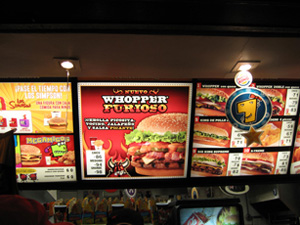
Burger King in Mexico City

Last night, I was in Burger King with my sons. A Mexican family was standing behind me in line. I joked around with the cashier who took my order. We spoke in fluent colloquial English, and I have a Chicago south side accent.

The father of the Mexican family then ordered his food in broken English. Later, while I was waiting for my order, the father spoke to me in Spanish about his son who had just learned to walk the week before. I was surprised! I’m always surprised when total strangers speak to me in Spanish! I told a non-Mexican friend about this, and she said, “But you don’t even look Mexican!” But to another Mexican I do!

As a boy, my father would take us to Burger King a lot. We would order our food and I dreaded waiting to hear my father’s order. After completing the order, my father would always ask, “Do you have hot peppers?” When the cashier would say no, my father would say, “That’s okay. I brought my own!” He would then pull out a jar of jalapeño peppers from his pocket.

My father had hundreds of ways of embarrassing me in public.

DDR

Appearances are deceiving


Chicago, Illinois

I am always amazed when a stranger approaches me and immediately speaks to me in Spanish! When I was in Arizona, I was pumping gas, and someone asked me for help with the gas pump in Spanish. My sons were surprised that this person knew that I spoke Spanish.

This happened again in the mall in Phoenix. A woman approached me to sell me a nail product by greeting me and introducing herself in Spanish. We spoke Spanish during the entire demonstration. My friend was surprised not only that she addressed me in Spanish, but also that I spoke Spanish so well. (I do teach college Spanish!) My non-Hispanic friends are shocked to learn that I know Spanish. I suppose that’s the only way I’ll shock anyone.

DDR

Language barrier


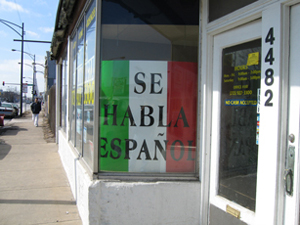
Back of the Yards, Chicago, Illinois.

When I was growing up, my parents always spoke Spanish at home. Once I began attending school, I was supposed to speak English at home. This way my parents would be forced to learn to speak English. This was a promising idea in theory, but the reality resulted in bilingual conversations in which I would speak English and my parents would speak Spanish. To this day, I still speak to my father in English; whenever I speak to him in Spanish, he doesn’t understand me.

When I was a boy, my mother sent me to the store to buy pork chops. She specifically told me to buy pork chops, but she told me in Spanish. As I’m walking to the store, I realize that I don’t remember how to say pork chops in English. I kept trying to remember as I walked to the store.

Luckily, there were two customers ahead of me. That gave me more time to think about what I had to buy. Unfortunately, I couldn’t remember the English name for pork chops. The best I could produce was “pig chops.” But I was too embarrassed to ask for “pig chops” because I knew that wasn’t the right term. So, I walked home empty-handed, and my mother asked me why I didn’t buy the pork chops. When I told her what happened, she said that I should have asked for “pig chops.” She didn’t know how to say pork chops in English, either.

That night, we ate chicken.

DDR

I am a Mexican!


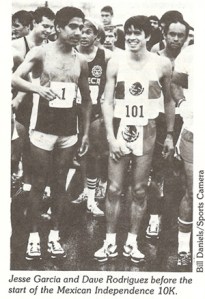
The Finish Line

What do you call someone of Hispanic descent? I am truly confused about what to call myself. I have heard a lot of terms, good and bad, to describe Spanish speakers or people from Spanish-speaking countries, for example, Latino, Hispanic, Latin-American, Mexican American, and on the negative side, beaner, spic, and wetback.

But what should I call myself? What term should I use to describe myself? None of the terms seem adequate. Latino, Hispanic, and Latin-American are too all-encompassing and include a lot of Spanish-speaking nations, but they don’t describe any of my individual characteristics. And let’s not forget that I have been born and raised in the United States of America as an American citizen.

When I think back to my childhood, I used to tell everyone, “I’m Mexican.” When I was a student at the Lithuanian Catholic grade school Holy Cross, the nuns would ask me what nationality I was and I would answer, “I’m Mexican.” Sometimes when visitors came to class, the nuns would tell the visitor, “This is David. He’s a nice Mexican boy.” Now that I look back, that seems to be the best term to use today in our politically correct times.

Let me explain. If I say that I am a Mexican American, that seems redundant. I was born in the USA to parents who emigrated from Mexico, and I speak fluent English. My parents were born in Mexico and were citizens of Mexico. My mother eventually became a naturalized U.S. citizen. If you asked my parents what they were, they would reply, “Somos mexicanos” in Spanish. So, when I say, “I’m Mexican” in English, without a Mexican accent–okay, perhaps a bit of a south side accent–, I imply that I am an American citizen of Mexican descent. If I were a Mexican national living in the USA, living and working here, legally or otherwise, I would say, “Soy mexicano,” perhaps even because I couldn’t speak English.

So, I say to you, “I am a Mexican,” in English, without a Mexican accent, but with a south side Chicago accent. Do you hear me? ¡I am a MEXICAN!

DDR

Rodriguez is the Spanish equivalent of Smith!


My telephone directory.

I often tell my students that my surname is as common as Smith or Jones. I have known so many Rodríguezes and only about half of them were related to me. I have often been confused for other Rodríguezes as well. Part of the reason may be that there aren’t as many surnames in Spanish-speaking countries as in the U.S. (But don’t quote me on that!) So, Hispanics must stretch out fewer surnames among more people. I also have a common first name. I just looked up David Rodriguez in the Chicago phone book and there are twenty-two of us listed in the directory! And that doesn’t even include the David Rodríguezes who are unlisted, don’t have a phone, have a cell phone, are minors, or reside in jail! I even argued with my wife against naming my oldest son David for that very reason. That’s why I wanted to name him José.

USA Today (May 11, 2006) states that the 5 most common surnames among U.S. home buyers are Smith, Johnson, Rodriguez, Brown, and Garcia. Why are there so many Rodríguezes buying homes? I’m not really sure. But you see, Rodriguez is the Spanish equivalent of Smith! Even the Rodríguezes are keeping up with the Joneses.

An analysis of the etymology of Rodriguez will help explain the popularity of Rodriguez. The surname Rodriguez comes from the combination Rodrigo, the name of the last Visigoth king in Spain, and -ez. The suffix -ez comes from the Visigoth word meaning “son of.” Therefore, Rodriguez means “son of Rodrigo.” All those Spanish surnames that end in -ez mean something. Gonzalez is son of Gonzalo, Lopez is son of Lope, etc. So, is it possible that someone with the surname of Rodriguez may be descended from the noble family of the last Visigoth king Rodrigo of Spain? If so, that means that I may actually have the blood of Spanish nobility coursing through my veins! But I seem to have lost the main point of all this!