Hoy


Brighton Park, Chicago, Illinois

In Chicago, we have newspaper Hoy that is published in Spanish by the Chicago Tribune. I enjoy reading the news in Spanish because it provides a different perspective. Sometimes Hoy has articles that wouldn’t appear in other local newspapers because they deal with local Hispanic interests. I also subscribed to the Chicago Tribune, but I read Hoy first. Some articles appear in both the Tribune and Hoy. When they do, the articles seem to have been written in English first and then translated into Spanish for Hoy; they contain the same information in the same order. There are many more typos in Hoy than in the Tribune, but I still enjoy reading Hoy.

I have Hoy delivered to my house. Would you believe that this subscription is free? I believe that if you live in the delivery area for the Chicago Tribune, you may subscribe. Here is their telephone number in case you’d like to subscribe: 312.527.8467.

Anyway, I also have the Chicago Tribune delivered to my house. When I ordered Hoy, I started having problems with my newspaper delivery. I’m not sure what happened, maybe the delivery person didn’t think I could read both English and Spanish. I would either get the Tribune or Hoy, but not both. I really couldn’t complain about not getting Hoy since I didn’t pay for the subscription. However, I was paying for the Tribune subscription, and I wanted to read the news. I called to complain and now I get both newspapers regularly. A couple of weeks ago, instead of receiving the Tribune and Hoy, I received the Korean Daily! I can’t read Korean! I wonder how the Korean Daily subscriber reacted when receiving Hoy!

DDR

Speaking Spanish at work


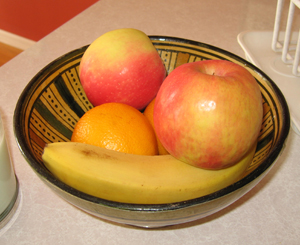
I love fruit!

When I was about sixteen, my friend Reinaldo stopped by my house early one summer morning after the school year had ended. Of course, I was sleeping because I was relaxing from another demanding year at school. He told me that he had found me a job at a fruit stand. I was surprised because I had never told him that I was looking for a job.

Rey worked on a fruit truck that drove through the neighborhood and sold fruits and vegetables curbside. As a sixteen-year-old young man, I was impressed by his well-paying job and how he was so proud of it, especially since Rey was only fifteen. Anyway, when they were buying their fruits and vegetables at the market before they started the day, the owner of a fruit stand asked Rey if he had any friends who spoke Spanish and English. The fruit stand was trying to attract Mexican customers since so many lived in the neighborhood. Rey immediately thought of me. Well, I liked the idea of working so I could have some money to spend during the summer.

Well, when I went to the fruit stand, the manager told me that the owner was on vacation. I would have to work three days a week: Saturdays and Sundays, and another day during the week as needed. My duties included unloading produce from delivery trucks and waiting on customers. If the customer were a Mexican, I would have to wait on them in Spanish. I don’t remember how much I earned, but it seemed like a lot of money to me at the time. The owner was supposed to give me a raise when he returned from vacation, the manager told me. I worked there all summer and never once saw the owner.

Well, at first there weren’t that many Mexican customers, but the manager would call me to wait on anyone who looked Mexican. He decided who was or wasn’t Mexican just by their appearance. He was judging people based only on their appearance. And I, as a Mexican, wasn’t always so sure if they were Mexican or not. This kind of bothered me until I realized that he was always right. Now that I am older and wiser, I realize that he was exercising good business sense.

By the end of the summer, many Mexicans were shopping at the fruit stand. My friend Rey would stop by occasionally when they ran out of some product on the truck, and they would buy it at cost from the fruit stand. He was so proud that he had found me such a fantastic job. And I was so thankful to Rey for thinking of me for this job!

What did I learn from this experience? I still haven’t quite figured it out yet. But I’m sure that I learned something.

DDR

Chispirita


Yet another chihuahua with a Napoleon Complex.

My uncle named one of his chihuahuas Chispirita. But none of the family children could pronounce Chispirita. All the children called him Cheese Pizza instead.

Translated to English, Chispirita is the English equivalent for a common name for a dog: Sparky. I have known of several dogs named Sparky in English, but this was the first Sparky I knew of a Sparky named in Spanish. Chispa means spark. Adding the diminutive “-ita” or “-irita” to “chisp-” makes the name Sparky or Chispirita, a term of endearment.

All the children in the family loved Chispirita, even though he was a moody chihuahua. When my twin sons were three years old, my uncle warned me that Chispirita would bite them. Although I had warned my sons, they still petted Cheese Pizza, and of course, Cheese Pizza bit them. But my sons laughed as Cheese Pizza bit them and they told me to let Cheese Pizza bite my hand. When my uncle saw that Cheese Pizza was about to bite me, he came running over and said, “Watch it! Chispirita bites!” But, alas, Chispirita started chomping down on my fingers with his tiny mouth and I started laughing because my sons were right. Chispirita’s bite didn’t even hurt. Cheese Pizza’s bark was certainly worse than his bite. My uncle picked up Chispirita to put him in the house and told me, “I hope you learned your lesson!” I couldn’t believe the pain I experienced from laughing so hard with my sons!

DDR

English only, please


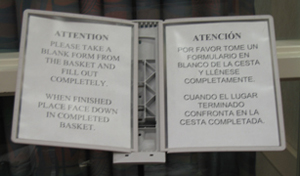
A poorly translated sign at Mercy Hospital.

We have so many foreign words in English that it’s quite pointless to insist on “English Only” or that English be made the official language. For one thing, what do we do about all the Spanish geographical names of the American southwest? There are too many names to translate to English.

And the reason they have Spanish names is because the Spaniards gave them Spanish names when the American southwest was still part of the Spanish colony called Nueva España (New Spain). Just think of the California cities called San Diego, Los Angeles, San Francisco, and Sacramento. There is a place in California (named in Spanish by the Spaniards) called La Brea Tar Pits. In Spanish La Brea means tar pits. So if we translate the name into English, we get The Tarpits Tarpits! We could do that for all the cities with Spanish names. San Diego will become Saint James, San Francisco, Saint Francis, and Sacramento, Sacrament! Perhaps this would be an impossible task, but we will eventually translate all those Spanish names into English! Dammit!

And speaking of redundant, I am reminded of the song, “Surfin’ USA” by the Beach Boys. There is a line in the song that says, “You’d see ’em wearin’ their baggies / Huarachi sandals, too.” In Spanish, “huaraches” means sandals, so these surfers are wearing sandals sandals! And then there’s Carlos Santana with, “Yo no tengo a nadie that I can depend on.” Hey, Carlos. English only!

In “Vertigo” by U2, the song begins with some “counting” in Spanish: “Uno, dos tres, catorce.” Either Bono doesn’t know Spanish or he just doesn’t know how to count. One of my students told me that these numbers really are a tribute to U2’s producer who produced albums number 1, 2, 3, and 14. And this reminds me of the song “Woolly, Bully,” by Sam The Sham and The Pharaohs that begins, “One, two, tres, cuatro.” He counts in both English and Spanish, but at least he gets the numbers in the correct order!

DDR

The story of the Spanish “O”


Aztec calendar = O

The letter “O” is an amazing letter in Spanish! “O” makes Spanish, Spanish. In my Spanish class, I demand that all my students to speak Spanish whenever possible.

Once there was a commotion in the classroom and I asked what had happened. When a student told me that his book fell, I asked him to tell me in Spanish. He then said, “El book-O fell-O.”

Merriam Webster’s Collegiate Dictionary even lists “el cheapo” as an entry! That’s the stereotype of the Spanish language: that all the words end in “O.” Do you understand? No problemo! (In Spanish it’s really “problema.”)

How about all those snacks derived from corn tortillas? They all end in “o” with an “s” to make it plural. Fritos, Doritos, Tostitos, Nachos, Chipitos, Crujitos, etc.

However, there are some English words that become Spanish when you add “o.” For example, insect becomes insecto, car becomes carro, Alfred becomes Alfredo, Robert becomes Roberto, but David remains David and under no circumstances does it become Davido. Nothing annoys me more than to be called Davido! False becomes falso, traffic becomes tráfico, and video, well, it stays the same, video. 

But be careful with cool. Don’t say coolo! Adding an “o” to cool will make it culo in Spanish, which requires much care when saying it because it’s a swear word referring to part of the body in the nether region known as the buttocks. ¿Comprendo? [sic]

DDR