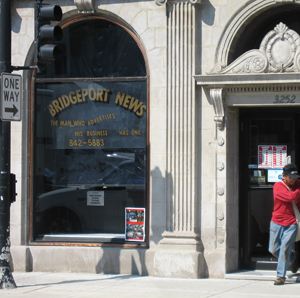
When I first moved to Bridgeport in 1986, I never thought of Bridgeport as a friendly neighborhood. In fact, as soon as I moved in, the Chicago White Sox announced that they were moving out.
Bridgeport is the home to five Chicago mayors. When I moved there, I found out why. When I went to change my address on my voter’s registration card, I found out I had been voting since my date of birth. I had been living on an empty lot.
In Bridgeport, if you didn’t vote a certain way, they did things to you. I didn’t vote the straight Democratic ticket, so they put a parking meter in front of my house. So, I had three hundred tickets. But I didn’t pay them. They put a Denver Boot on my car. It increased the value of my car. There was a bar around the corner that had an icon of the late Mayor Richard J. Daley. Richard Dah First. Every mayoral election, the icon sheds tears.
Hear that whirring in the air. The cicadas are here! I’ve seen their exoskeletons, their dead carcasses, and live cicadas in flight. I love Chicago, but I especially love my new neighborhood.
I live on the south side in Beverly. (Some politically incorrect acquaintances tell me that I live in a black neighborhood, when in reality the neighborhood is actually integrated quite well. In fact, this is the best and safest neighborhood in which I have ever lived after a lifetime of living in Chicago.)
So I get to experience the cicadas in full force for the first time in my life. When they surfaced 17 years ago, I merely read about the cicadas in the newspaper, but I didn’t actually see any. I lived in the famous south side neighborhood of Bridgeport where I didn’t see a single cicada because, in Bridgeport, they don’t want nobody nobody sent. So that meant no cicadas were welcome since they already have enough skeletons in their closet.
In Beverly, I’ve been seeing cicadas for the last month or so. And I’ve seen them in some compromising positions! I’ve seen them undressing by crawling out of their exoskeletons and I’ve seen them mating by backing up into each other, which looks very painful if I look at their mating from the human point of view. (The last time I backed up into a female, she slapped me.) I’ve stepped on a few cicadas while running, but not on purpose. Well, I’ll enjoy the cicadas while I can because I won’t see them again for another 17 years.
Last night, I was in Burger King with my sons. A Mexican family was standing behind me in line. I joked around with the cashier who took my order. We spoke in fluent colloquial English, and I have a Chicago south side accent.
The father of the Mexican family then ordered his food in broken English. Later, while I was waiting for my order, the father spoke to me in Spanish about his son who had just learned to walk the week before. I was surprised! I’m always surprised when total strangers speak to me in Spanish! I told a non-Mexican friend about this, and she said, “But you don’t even look Mexican!” But to another Mexican I do!
As a boy, my father would take us to Burger King a lot. We would order our food and I dreaded waiting to hear my father’s order. After completing the order, my father would always ask, “Do you have hot peppers?” When the cashier would say no, my father would say, “That’s okay. I brought my own!” He would then pull out a jar of jalapeño peppers from his pocket.
My father had hundreds of ways of embarrassing me in public.
What do you call someone of Hispanic descent? I am truly confused about what to call myself. I have heard a lot of terms, good and bad, to describe Spanish speakers or people from Spanish-speaking countries, for example, Latino, Hispanic, Latin-American, Mexican American, and on the negative side, beaner, spic, and wetback.
But what should I call myself? What term should I use to describe myself? None of the terms seem adequate. Latino, Hispanic, and Latin-American are too all-encompassing and include a lot of Spanish-speaking nations, but they don’t describe any of my individual characteristics. And let’s not forget that I have been born and raised in the United States of America as an American citizen.
When I think back to my childhood, I used to tell everyone, “I’m Mexican.” When I was a student at the Lithuanian Catholic grade school Holy Cross, the nuns would ask me what nationality I was and I would answer, “I’m Mexican.” Sometimes when visitors came to class, the nuns would tell the visitor, “This is David. He’s a nice Mexican boy.” Now that I look back, that seems to be the best term to use today in our politically correct times.
Let me explain. If I say that I am a Mexican American, that seems redundant. I was born in the USA to parents who emigrated from Mexico, and I speak fluent English. My parents were born in Mexico and were citizens of Mexico. My mother eventually became a naturalized U.S. citizen. If you asked my parents what they were, they would reply, “Somos mexicanos” in Spanish. So, when I say, “I’m Mexican” in English, without a Mexican accent–okay, perhaps a bit of a south side accent–, I imply that I am an American citizen of Mexican descent. If I were a Mexican national living in the USA, living and working here, legally or otherwise, I would say, “Soy mexicano,” perhaps even because I couldn’t speak English.
So, I say to you, “I am a Mexican,” in English, without a Mexican accent, but with a south side Chicago accent. Do you hear me? ¡I am a MEXICAN!





 Chicago USA