Duke


Duke

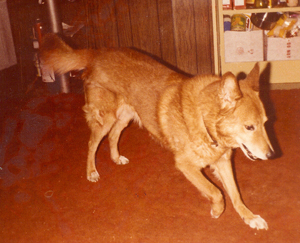
Duke was the best dog that our family ever had. When we lived at 4405 S. Wood Street, he followed my brothers and me home from school. He really did. At first, he followed us at a distance and that was fine with us because we weren’t sure if he would bite us. He was already full-grown, and he was at least part Golden Retriever and maybe a little bit German Shepard and Chow Chow. We were sure that, since Duke got along well with the whole family, he probably was also part Mexican.

He followed us into our backyard, and we went into the house. When we looked out the window later, he was still there. We gave him some bologna and went back inside. The next day, he followed us home again and we gave him some milk this time. He let us pet him and he seemed very friendly. He was too clean to be a stray dog and he didn’t have the battle scars of street dogs, but he didn’t have a collar or dog tags either. We never let him into the house because we knew our mother would get mad at us. But Duke kept following us home after school. He knew what time we got out of school, and he would meet us at the corner of our block and follow us home so we could give him something to eat.

One day, my mother came home from work and asked us about the dog on the back porch. “What dog on the back porch?” I asked, knowing we were about to get in trouble. We didn’t admit to anything. Eventually, my mother brought Duke into the house, and we all started playing with him. He was happy with us and never even growled when my little sister pulled his ears or fur. We asked our mother if we could keep it, but she said he belonged to someone else and they would eventually want him back. We could keep him until someone claimed him.

We were so happy to have a dog again. And the good news was that he was already house broken. At first, my mother would open the door to let Duke go out by himself thinking that he would eventually go to his real home. But he always came back. After a while, I started walking him without a leash. He always stayed close to me, and he would never run away. I walked him all over the neighborhood so that Duke would recognize his original home, but we never found his original owner. Soon I knew I was Duke’s master because one of the neighborhood bullies threatened me with Duke at my side and Duke growled at him ready to defend me.

Duke had some pretty good street cred, too, because when other dogs would see him, they would run away. I didn’t need a leash to control Duke because he so obedient that he listened to my every command. However, he loved to chase squirrels, but he would only do say when I gave him permission. Whenever he saw a squirrel at a distance, he ears would perk up and he would growl, but he would stay by my side until I said, “Go get him, Duke!” And he would run at full speed toward the squirrel. He never once caught a squirrel because the squirrels were usually too far away from us and too close to a tree that they climbed to escape. Only once did I think that Duke would actually catch a squirrel in his mouth. He was rapidly closing in on a squirrel that was foolish enough to try to outrun Duke instead of climbing a tree. I think that Duke slowed down to give the squirrel a running chance and the squirrel got away.

When we moved to 2509 W. Marquette Road, Duke moved with us. By then, he was part of our family. Somehow, I remained Duke’s master. My brothers and I had to be careful when we wrestled because Duke would attempt to bite my brothers in my defense. Even after I married and moved away from my mother’s house. Once I was visiting and I started wrestling with Tato, my brother Jerry, in the basement just like in the good old days. Duke just stood there watching. He was a lot older now and he didn’t growl at my brother as he once did. Well, I could still out-wrestle all my brothers even though we were all about the same size now. I managed to throw my brother down on his back on the sofa. I jokingly said, “Sic him!” and Duke ran and bit my brother’s face. I really didn’t think he would attack my brother. I immediately grabbed Duke by his collar, and he finally calmed down. My brother had some puncture wounds on his face from being bitten a few times. I apologized profusely to my brother. Neither one of us thought Duke would attack. But he did. I was still his master even though I had lived away from him for about a year. I still feel bad about this even now as I described the incident.

Duke lived to be incredibly old, but we never knew his exact age since he was already full-grown when he started living with us. Eventually, he had so many health problems that my sister had him put to sleep. He was such a great dog that I can still visualize him.
DDR

José y María


Celaya, Guanajuato, México

In Spanish-speaking countries, the two most common names are José and María. Some parents name their sons José María and their daughters María José. My Uncle Eutimio and Aunt Asunción named their sons José Eutimio, José Ricardo, José Carlos, José Ignacio, José David, José Daniel, and José Agustín. They named their daughters María Concepción, María Elena, María Angélica, and María Carmen. They had fifteen children, but I can’t remember all their names right now.

When I first met them on my last trip to Celaya, Guanajuato, they introduced themselves as Timio, David, Carlos, Ricardo, etcetera. Later, I heard one cousin call his brother Pepe, which is the nickname for José. I asked my cousin why he called him Pepe and he said that his name was really José.

Later on, another cousin called another brother Pepe. This was a different from Pepe from the first one. I asked how they could both be Pepe. Then they explained to me how all the brothers were named José and all the girls were named María. I still don’t understand how they can name them like that, but they did. Afterwards, I thought about how convenient that would be. If you needed something, you would merely shout José or Pepe and you would have at least two or three sons running in to help you. Ditto if you shouted María.

DDR

Going to Mexico


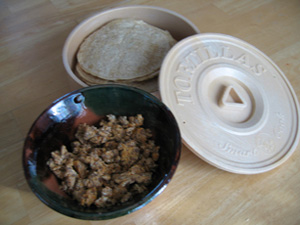
Some of my home cooking.

Okay, I’ve been preparing my sons to go to Mexico. They’re still excited about going even though I told them that everyone in Mexico speaks Spanish. My oldest son used to speak Spanish when he was little because I always talked to him in Spanish, and he went to Cordi Marian and was taught by Mexican nuns. The twins are learning Spanish in school now.

For the past few years, I’ve tried to get them to speak Spanish at home, but they won’t. If they sneezed, I said, “Salud” and they were supposed to respond, “Gracias.” But they wouldn’t. Ever since I told them that we were going to Mexico, they speak a little Spanish with me. I’m glad their attitude has changed a little bit. If I’m writing something in Spanish, Adam will read it aloud and ask me if he pronounced it correctly. I’m happy that they’re trying because now I know they really want to go to Mexico.

I’ve also tried to explain some of the cultural differences between our two countries. They shouldn’t have any problems, but I want them to know in advance that they shoul expect some differences. They probably won’t play any video games while we’re in Mexico. But my sons are very adaptable. They’ll manage somehow. We’ve taken driving vacations before, and we always adapt to every situation. I’m really not worried about much. Well, except maybe Montezuma’s Revenge. If they get it, I hope they get it right away and they won’t get too ill. After that, they’ll build up their immune system.

I warned them about how the food will be different, too. We won’t be going to McDonald’s or Burger King once we cross the border. They won’t see a burger or chicken nugget until we get back to the U.S. And all the food will be spicy. In Mexico, even the candy is spicy.

On Sunday mornings, I make huevos con chorizo and tell them to eat them with tortillas because that’s how Mexicans eat–without silverware. So far, they’re still excited about going to Mexico.

DDR

Joseph


2509 W. Marquette Road, Chicago, Illinois

My youngest brother Joseph’s name should have started with the letter D.

J should have been D. But he wasn’t. He was J. And for an incredibly good reason. My mother said so!

Well, I’ve already talked about my mother’s naming process in my previous blog entries. My parents had six children: David Diego, Daniel, Diego Gerardo, Dick Martin, Delia Guadalupe, and Joseph Luis. All of names started with D–except for Joseph (which starts with J and not D, as I’m sure you probably noticed. I have always admired the intelligence of my readers!).

The other notable oddity in the naming process is Daniel who has no middle name! I was less than two years old when Daniel was born, so I have no idea why he has no middle name. Were we too poor to afford a middle name for Daniel? Was my mother mad at my father for getting her pregnant again and so she denied my father Diego yet again the opportunity of having a son named Diego? I really don’t know because neither my father nor mother ever talked about how Daniel got his name. To this day, Daniel’s lack of a middle name remains one of the great mysteries of our family.

Before my youngest brother Joseph Luis was born, my parents were in the middle of a hostile separation and later a contentious divorce. How my mother got pregnant was a mystery to me even back then because I hardly ever saw them together for about a year. But somehow, she got pregnant. And my father was proud of the fact that he had gotten her pregnant.

However, there was never any doubt that Joseph was my father’s son because when Joseph was older, many people thought he and I were twins. The resemblance was that strong. So how did he come to be named Joseph Luis? Well, he was born in August of 1968, days after our Uncle Joseph, my father’s much younger brother, died in Viet Nam.

I remember when my Uncle Placido called to say he had to visit us to tell us something particularly important. He came after my brothers and I were already in bed, so I knew he had something important to say. I listened from my bedroom, which was right next to the kitchen where they sat. I heard my Uncle Placido say that my Uncle Joseph had died in Viet Nam. I could hear both my mother and father crying. I cried, too, in my bedroom. So, my mother named my brother Joseph in his memory. That was actually an incredibly good reason not to follow the D rule in naming us.

Our Uncle Joseph was everyone’s favorite uncle. He loved playing with all his nephews and nieces. Everyone cried when he died. It was the longest funeral procession I had ever seen–and I lived by a funeral home, so I saw a lot of funeral processions!

My father was one of his pall bearers. The day after the funeral, my father couldn’t get up out of bed. He was paralyzed from the waist down. Whether his paralysis was physical or psychosomatic was never determined, not even by the doctor who came to our house to treat my father. After about a week, my father just got up out of bed and started walking again. He wanted to go to work again.

DDR

Matilde


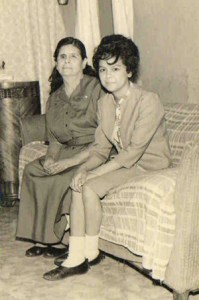
Mi abuelita y tía Matilde

My tía Matilde came to Chicago as part of the package deal when my abuelita came for eye surgery. Tía Matilde also needed surgery, so she came from México to have surgery on her ears. I’m not sure what exactly was wrong with her ears, but she was otherwise healthy.

My aunt was very young when she came, and she liked living in Chicago. She loved listening to pop music on the radio and she bought all the records by her favorite singer, Rick Nelson. She went wild when listening to his music.

What I remember most about my tía Matilde was how she did laundry. We, my parents, my three brothers, my abuelita, my tía Matilde, and me, all lived in a small four-room apartment. We had a washer and dryer in the kitchen next to the sink. When my parents were at work, tía Matilde would do all the laundry in the house, every handkerchief and sock. She would search everywhere in the apartment for dirty clothes. She found dirty clothes where I would never even think of looking. She just had to make sure that every last item of dirty clothing was clean when she was done doing the laundry. And so, when all the dirty clothes were in the washer, and there was a little room in the tub for more clothes, she would start taking off her clothes right at the washer and start putting them in the washer. She would be standing in the kitchen wearing nothing but her bra and panties, proud of the fact that all the dirty clothes in the house were now washed, obviously oblivious to my presence.

Back then, we always seemed to be either at home or at Cook County Hospital taking either my abuelita or tía Matilde to the doctors there. Anyway, my tía Matilde, who would undress at the washer, was very shy with the doctors when they asked her to disrobe. The day of her surgery, she refused to undress and refused to put on the hospital gown because it had no back to it.

I still remember her telling this story when she returned from her surgery. She absolutely refused to undress for the nurses and doctors. She thought she had won her battle, but after the surgery, she woke up in her hospital bed and immediately realized that she was completely naked! Whenever she told this story, she always sounded so shocked that this could have happened to her despite her precautions. She didn’t even remember when or why she lost consciousness. She always wondered who managed to see her naked. She would blush every time she told the story.  She was truly traumatized by this experience!

She eventually went back to México with my abuelita.

DDR