Lotería is a fun game to play just as it is, but Lotería needs to be updated to Lotería 2.0.
I’ve played lotería in both Mexico and the U.S. We need some new cards that reflect the influence of both Mexican and American culture to the game. There is nothing wrong with the cards now in use, but how about adding some new ones? I recommend: El Vato, La Gabacha, El Mariachi, La Abuelita, El Pachuco, La Malinche, El Macho, La Llorona, La Mamacita, El Maricón, La Jamona, El Cholo, and El Güero.
And then when you fill up your card, you have to shout, “¡Lotería 2.0!” That should liven things up a little. Do you have any other suggestions for other cards?
Hot dogs, chop suey, pizza, and burritos. What do all of these apparently different ethnic foods have in common? They are all American foods! As American as Mom, apple pie, and the Fourth of July. And while we’re on the topic of American foods: just how Italian is spaghetti? Marco Polo brought the noodles to Italy from China and there were no tomatoes in the tomato sauce until Columbus sailed to the New World.
My friend once returned from a vacation to Mexico and complained to me that Mexican restaurants in Mexico didn’t sell burritos. “I thought burritos were Mexican food!” he complained. Actually, burritos are just another American popular fast food that you can order to go and eat while you drive. Because real Mexican food is extremely messy to eat and must be eaten with your fingers at a table. Just try to imagine someone attempting to eat a chicken tostada while driving. It’s not a pretty sight, is it? By the way, if you ask for a burrito in Mexico, you will get some strange looks. A “burrito” is a small donkey and they’ll wonder what you plan on doing to that burrito. My point is that you won’t get a burrito in Mexico. So don’t order a burrito unless you really want a small donkey.
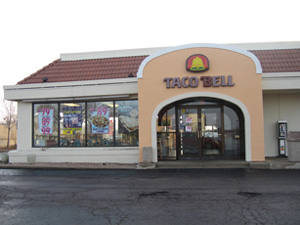
When I teach my college Spanish classes, students are amazed by the photograph of the Mexican dinner table in the Spanish textbook. They are shocked! “Where is the basket of tortilla chips?” they ask. Well, mis amigos, you will only see a basket of tortilla chips in a Mexican restaurant in the U.S. The last time I went to Mexico to visit mi familia, no one ate tortilla chips, Tostitos, Fritos, or Doritos! When mi familia visits me from Mexico, I never say, “You must be hungry for some real Mexican food. Let’s go to Taco Bell!” Because Taco Bell does not really sell Mexican food. However, Taco Bell has opened restaurants in Mexico and is planning on expanding there. I just wonder if they claim to sell authentic Mexican food in Mexico?
No, no, no! Scream it like you mean it! Yell it with passion! Now try it again.
“¡Lotería!“
That’s much better. Now listen to me: “¡Lotería! ¡Lotería! ¡Lotería!” Did you hear the tone of my spine-tingling, blood-curdling, eardrum-shattering scream. You have to make your voice demand the attention of everyone in the room and the surrounding environs in order to brag to the world that you are the proud winner of ¡Lotería! Now get ready to be awarded your prize: a pack of Chiclets.
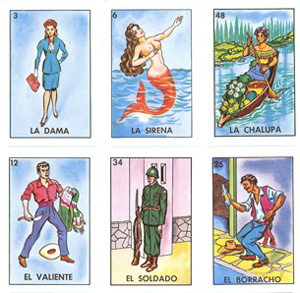
When we were little, we always played Lotería, whether we were in Chicago or Mexico. Lotería is a game very similar to Bingo–and sometimes people call it Mexican Bingo–where each player places markers on a card as the names of squares are called out. The first player to fill the entire card shouts, “¡Lotería!” and usually wins a small prize. Each card contains 25 pictures with the names listed below: La rosa, La dama, El valiente, El barril, etc. The names of the pictures are called out from a deck of cards that contains all the pictures. The cards are shuffled and called at random. The pictures on the card are marked by uncooked pinto beans. I always have fun playing Lotería. Especially when I win and I get to shout, “¡Lotería!” At our last family picnic, we played Lotería for 25 cents per card and the winner won the pot. It was certainly more exciting than playing for Chiclets.
When we were little, we once played Lotería with my cousins at their house. When we returned the next week, my mother noticed that my cousin Lulu had a strange odor emanating from her face. When my mother approached Lulu, she noticed that Lulu had extremely bad breath. My mother couldn’t understand how a five-year-old could have such foul-smelling breath. My mother looked in Lulu’s mouth, but saw nothing. However, while looking in Lulu’s mouth, my mother saw something suspicious in Lulu’s nose. My mother couldn’t tell what it was because it was so far up into her nasal passage. My mother and my aunt Marcela held Lulu down forcefully and used tweezers to pull the foreign object out of Lulu’s nose. Both my mother and my aunt shouted, “¡Ay, Díos mío!” They had extracted an uncooked pinto bean from Lulu’s nose. But the pinto bean had been in her nose so long that it had sprouted roots! Lulu must have put the pinto bean in her nose the week before when we played Lotería. So beware the dangers of playing Lotería, niños!
Well, it’s all about imperialism. And Phoenicians, Greeks, and Romans. So, what do they all have to do with Mexicans? It’s a long story that goes way back. I am often amazed by how events of thousands of years ago still affect us today. We should never forget the past because we are always repeating it! For example, history has a long, long history of repeating itself through imperialism and colonization. That is, one nation conquering another and then imposing their laws and culture upon the conquered (colonized) nation. Eventually, that empire is, in turn, conquered by another newer, bigger, “better” empire. So, what does all this have to do with Mexicans in the United States? A lot!
On the one hand, not all Mexicans physically resemble other European races or African Americans. However, Mexicans assimilate into the work force without much rebelliousness or resentment. Mexicans come from a culture that has European roots. They come from a Judeo-Christian-Greco-Roman culture, much like most citizens of the U.S. It all started when Spain arrived in the New World that was “New” to the Europeans, but not to the local inhabitants who had already lived there for thousands of years. It’s all a matter of perspective. The Spaniards mixed with all the indigenous people they met in the New World resulting in the fusion of races and cultures that still affects us today. The reason the Spaniards could create their own melting pot was because they had a history of thousands of years of mixing with other races. However, since Spain was also colonized many times throughout its own history by the Phoenicians, Greeks, Romans, Visigoths, and Moors, among others, Spain merely applies the lessons they learned to the New World.
But let’s look at Spain’s name. The country’s official name of España is derived from the Phoenicians who arrived there about 1100 BC and saw rabbits. They named their new colony “i-saphan-im,” meaning “coast or island of the rabbits.” When the Greeks arrived about 500 BC, they called the tribes the met “iberos” after the Ebro River, hence Iberia. Being fond admirers of the Greeks, the Romans also colonized Spain beginning in 218 BC giving the region the name of “Hispania” because the Romans didn’t bother to learn the local language and couldn’t pronounce the Phoenician name. (Does this sound familiar?) It seems like native residents always hate when foreigners come and don’t bother learning the language.
But getting back to Mexicans, what does all this have to do with the U.S. today? Well, by analogy, Spaniards–and Europeans in general–have a lot in common with Mexicans when you look back far enough in history. For example, when the Spaniards came to the New World, not everyone wanted to leave Spain to make their fortune. But some of those who left Spain did make their fortune and sent money back home. And that occurred for generations, including other Europeans who came to what would eventually become the United States of America. And Mexicans are no different. Except for some Mexicans in America’s southwest who never left Mexico but somehow found themselves living in America when the U.S. took over the northern part of Mexico, some Mexicans want to come north to America to make their fortune. Those who do come have many goals such as improving the living conditions of their family, here and in Mexico. If we examine previous generations of European immigrants to the U.S., not everyone learned to speak English. Usually, the first generation learned just enough English to get by, the second generation learned their native tongue at home and then English when they entered school, and most of the third generation only learned English. However, more Mexicans than other ethnic group seem to continue being bilingual due to the constant influx of Mexicans from Mexico who are actually related to them, and therefore, have an actual need for speaking Spanish.




 Chicago USA