Mexico City is the largest city in the Western Hemisphere. The traffic is a nightmare that I somehow managed to survive. And I did it at night.
My relatives in Celaya told me not to go to Mexico City just because of the traffic. Of course, that only served to make me even more determined to go. My aunt told me if the traffic scared me to turn around and go back to Celaya. But my cousin did give me some good advice: If you can’t find the address you’re looking for, ask a taxi driver to go there and follow him.
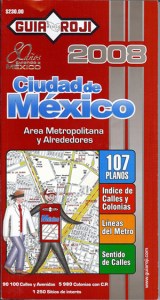
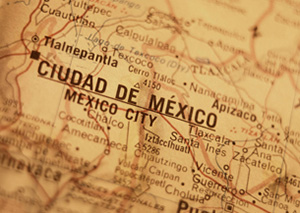
I was going to my cousin’s house in Mexico City, but I had no idea where in the city she lived. When I got to Mexico City, I’m driving in heavy rush hour traffic trying to read the map that didn’t really help me as other drivers were weaving all around me. Then, I see the sign for Paseo de Reforma, which I remember from my previous trip to México City 29 years earlier. So, I exit there and head to the Angel de la Independencia. There, I bought a map of the city and found her neighborhood and street address.
However, once I attempted to find her house, I couldn’t find her street. I circled the area several times before I finally gave up. I saw a taxi driver and asked him if he knew where la Calle Miguel Ocaranza was. He, a native Mexican, had never even heard of the street! I showed him the map and he said that he could find it. He led me there and I paid him 25 pesos plus tip. What an adventure it was driving in Mexico City! And I still have to drive through Mexico City to head home!!
One difference I noticed when I entered México was that EVERYONE speaks Spanish–as opposed to Chicago where only half the people speak Spanish. México is like a totally different country!
I may be Mexican, but I’m not a real Mexican who grew up in México. When I checked into a hotel in Matehuala, I realized that my name, David Diego Rodriguez, even though it sounds Spanish, is really American. My name if I were really, really a Mexican, would be David Diego Rodríguez Martínez. But so far, I’m blending in here in Mexico. Or at least, I’ve convinced myself that most people don’t really notice that I’m from America. I found this Internet Café in Celaya and it has accent marks and ñ just like a real Spanish keyboard!
Well, I must go now. My time is up at the Internet Cafe. Hasta pronto.
After Carlos Mojaro moved back to Mexico, we just didn’t have as much fun as before. Most of the time we just played baseball in the prairie or just sat on somebody’s porch talking about the good old days. Then we saw the Mexico City Olympics on TV, mainly because our parents were so proud of the fact that an international event could take place in Mexico City. So all my friends and I watched the Olympics religiously.
I especially liked the track and field events, but I also liked women’s gymnastics. Whenever we talked about the Olympic events we watched, we couldn’t help but act them out. Soon we started up our own Olympics. For the shotput, we through a brick in my backyard. Luckily, we weren’t strong enough to throw it out of the yard. We had competitions in many events. We even made charts with the athlete and team standings and the “world records” that we had achieved. After watching the Olympic marathon, we were amazed that anyone could run 26 miles. However, as we discussed this amazing feat, we realized that when we were very active on those long summer days, we ran quite a lot distance without realizing it. I even suggested that we could probably run a marathon if we tried. There was some dissension amongst us at first. But then we decided to put ourselves to the test.
There were about fifteen of us and we decided that we would run the Mexico City Olympic Marathon. I felt as if Carlos Mojaro was still with us. Well, we didn’t exactly know how a long marathon was, and since our mothers wouldn’t let us cross the street, we decided to run around the block until we competed the marathon or dropped dead like Phidippides. I didn’t know much about running back then, but I did know that we had to pace ourselves to go the distance.
After the opening ceremony, we toed the line and ran at sound of the exploding firecracker. Douglass sprinted from the start and only made it around the block once. The rest of us ran as a pack as we had observed the Olympic marathoners do. I’m not sure how long our Chicago city blocks are, but I believe our block at 4405 South Wood Street was about one-third of a mile when we ran completely around. As we ran around the block we would shout out the lap number as we passed my house. It was getting dark fast. We were actually having fun running around the block in the Mexico City Olympic Marathon.
My mother came out to see what was going on because a crowd had gathered in front of my house. We didn’t actually expect to have any spectators. This was just like the Olympics! By lap ten, a few runners had dropped out of the race. The spectators shouted out the lap numbers with us. About lap twenty, my mother said it was time to go in the house. My friends’ mothers were also waiting for their sons to go home. My mother insisted that I go inside so my brothers would go home, too.
I knew if I went in, then the marathon would stop and everyone would go home. I begged my mother, without breaking my stride, to let us keep running a little longer. We ran a few more laps and we were still having fun, but we were also getting tired and starting to feel pain in our legs. When we reached lap 27, my mother said that if I didn’t go in right now, she would beat me: ¡Te voy a dar una paliza! That was just the excuse we needed to save face. There were only six of us left running and we all complained to our mothers about interrupting our marathon. But we all went home, secretly thankful to our mothers for saving us from embarrassment.
However, we always felt great about our running accomplishments. We always talked about how much farther we could have run if weren’t for our mothers stopping us. Of course, we never attempted to run another marathon either.
Nothing scares an undocumented Mexican more than the words “la migra.” Immigration agents seem to pop up out of nowhere and roundup illegal aliens at their place of employment. As a warning, someone will shout, “¡la migra!” But sometimes, they mistakenly pickup legal aliens and citizens by mistake. This happens all the time.
When I was about ten, I was in charge of making sure that my brothers and I walked home safely after school while my mother was at work. Most days this was an easy task. However, other days, we would walk our separate ways and meet up at home within a half-hour. We were always home together before my mother returned from work. Usually, we did this when we wanted to walk home with friends from our class, or occasionally, when we were mad at each other and didn’t want to talk to each other.
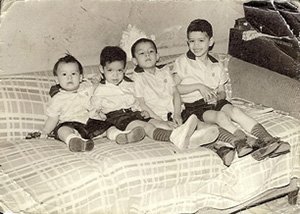
My three brothers and I would form different alliances depending on who was mad at whom. One of the most bitter was the one that pitted the Americans against the Mexicans. There were four of us: David Diego, Daniel, Diego Gerardo, and Dick Martin, in order of birth. Guess which brother was born in Mexico! That’s right, Diego Gerardo was born in Mexico. All because my mother insisted on going to Mexico while she was nine months pregnant even though everyone warned her not to do it. And my father Diego finally had a son named after him.
Anyway, when brother Diego would get mad at us, he would exclude himself from us because we were American and he was Mexican. He would proudly remind us that he was born in Mexico during these arguments. It was after one of these arguments after school that he walked off alone away from us. Well, I started to get worried when he didn’t return home within a half-hour. I went out looking for him, but I couldn’t find him at his usual hangouts. I knew my mother would be furious when she came home. Well, she came home and Diego still wasn’t home. She didn’t explode like I had expected, but she made me go with her and look for Diego everywhere. We looked for about an hour and still didn’t find him. We returned home to take a little break. While there, we heard a knock on the door. Two immigration agents were at the door with my brother. They had mistakenly picked him up after school. My mother explained to them that he was a legal resident and showed them the documentation to prove it.
Well, it turns out that the agents drove up alongside Diego and asked him where he was born. Of course, he said, “Mexico!” proudly. They scooped him up into their car and took him into their office for further questioning. Of course, Diego was only about six at the time and he didn’t know his address. When no one called for him at immigration, the agents asked my brother to show them where he lived. That’s when we saw him at home again. Would you believe we never fought the Mexican-American wars again? In fact, he never again bragged about being born in Mexico.
Mi Casa: Aztec calendar, la Virgen de Guadalupe, Mexican flag, and a picture of mi abuelito.
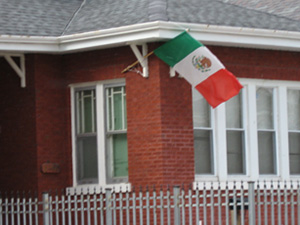
Mi casa es su casa. Come into my home, por favor. So you tell me. Am I Mexican or not? I have books written in Spanish on my bookshelves. I have movies in Spanish without English subtitles! I have a wooden Aztec calendar that my friend bought for me when he went to Mexico. However, I have a regular calendar to find the current date. I have a votive candle with the image of La Virgen de Guadalupe. My mother always lit up one of these when she prayed for someone or wanted something. I haven’t lit my candle yet, but I have it just in case of an emergency. Just in case there’s a blackout and I run out of tortillas at the same time. And I also have a Mexican flag hanging on the wall. Well, it’s actually a bandana that says “Made in China” in the corner. If you go to any Mexican home, you will find at least an Aztec Calendar, La Virgen de Guadalupe, and a Mexican flag.