Abuelito paterno


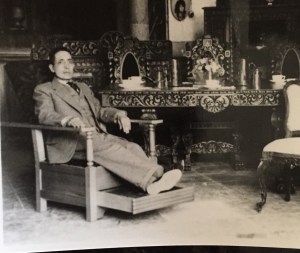
Eutimio Rodriguez
El Carmen Mueblería

I actually met my paternal grandfather when I was little and went to his funeral when he died in 1965. I didn’t know him very well, but I heard some stories about him that were not very flattering. My mother told me that he was very mean to me when I was little, but I don’t really remember how he treated me. When my Uncle Plácido became a bishop, I remember reading in his biography that my grandfather had to escape political persecution. I’m not sure where the truth lies. When I was in Celaya, Guanajuato, on my trip to México, my tío Eutimio told me that his father Eutimio Rodríguez Cárdenas, a distant cousin to President Lázaro Cárdenas, met one of the president’s cousins and they didn’t like each other. But other than that, there really was no trouble between them. My tío Timio was the only one from my grandfather’s family to stay in México when all the other family members eventually moved to America.

My grandfather had owned a furniture shop that made furniture to order. The shop was called Mueblería del Carmen because it was located near la Catedral El Carmen in downtown Celaya. He gave the furniture shop to my tío Timio and my grandfather went to America for about a year. While there, he met a priest named Father Thomas Matin, CMF. My parents met Father Thomas in Perth Amboy, New Jersey, and he would eventually become my godfather.

My grandfather promised Father Thomas some furniture if he could arrange U.S. citizenship papers for my grandfather. So, my tío Timio ran the mueblería while his father lived and worked in America. When my grandfather returned to Celaya, he locked himself in his room for days at a time. My tío Timio ran the shop and business was booming. All the profits belonged to my tío Timio since he was now the proprietor. Soon, the shop received a government order for chairs with a round backrest, but they wanted high-quality chairs and in a very short time. My uncle took the order even though he wasn’t sure he could complete it in such a brief time. My grandfather came out of his room and worked in the shop. In order to complete the chairs on time, my uncle devised a mold so that he could cut the rounded backrests four at a time. My grandfather didn’t think the mold would work and told his son that. Well, they had to finish the chairs on time in order to gain more business. My grandfather couldn’t work with the mold and his chairs kept breaking. So, he locked himself in his room again. My uncle finished the order with plenty of time to spare and the government agent was extremely surprised. He said that he should have given him the rest of the order that they gave to another shop. However, they weren’t even half-done with the order yet.

My uncle was paid handsomely for his work, and he gained a lot more furniture orders as his reputation increased. My grandfather took the profits from this enterprise and used the money to go to America. He also took the furniture that his son Timio had made and took it to Father Thomas. If it weren’t for tío Timio, my grandfather and his sons wouldn’t have had enough money to go the U.S. I wouldn’t have been born in the U.S.
DDR

Abuelito materno


Mi abuelito

My maternal grandfather, José Guillermo Martínez, is another family mystery. My mother told me several stories about him, but I’m not sure if any of them were true. Although they may be based on truth, my mother embellished them beyond recognition. My cousin and I compared stories when I was in Mexico and all the stories seem to be plausible to a certain extent.

My mother absolutely loved her father, and many things often reminded her of him. She would tell me about him on these occasions. I really believed all these stories for most of my life.

When I began playing chess religiously in high school, she told me that I reminded her of her father because he always loved to play chess. People would always go to visit him so they could play him at chess. One day, my mother asked me what the highest chess ranking was. I told her chess grandmaster. She then said, “That’s what my father was! A grandmaster!” I was truly proud of this fact! No wonder I suddenly developed this interest in chess. It was in my genes.

I started bragging about this little interesting tidbit about my grandfather to my chess friends. My friend Jim asked me what my grandfather’s name was, so I told him. A few days later, he gently broke the news to me. My grandfather was never a chess grandmaster, or even a master. Jim had looked up the names of all chess masters and grandmasters who had ever lived. If my grandfather were really a chess grandmaster, his name would have appeared on one of those lists. I was so embarrassed. I told my mother about this little discrepancy in her story, and she brushed it off as if it were nothing. I told this story to my cousin in Mexico, and she had heard that our grandfather did like to play chess but didn’t know much else about his chess career.

My mother also told me that her father’s father had come to Mexico from Ireland during a potato famine. His surname was either McLean or McLin, but she really wasn’t sure. Well, he met a Mexican girl, and when she got pregnant, they killed him. That’s what my mother told me when I was a boy.

My cousin had never even heard this story. She had heard that he was possibly Jewish and possibly from Germany. He had studied electrical engineering and had many books on the subject in German. He also knew various languages. My cousin’s mother told her that they called my mother and her sisters, las judías, again suggesting that my grandfather was possibly Jewish.

When my grandfather was on his deathbed, my mother flew to México from Perth Amboy, New Jersey, to be with him. I went, too, but I was still a baby in my mother’s arms. My mother was so concerned about his spiritual well-being in the afterlife that she told her father that she would get him a priest to administer him his last rites. My grandfather indicated that he didn’t need a priest and said, “If he comes, I’ll talk to him. But I won’t confess.” My mother never told me that story.

DDR

My American accent


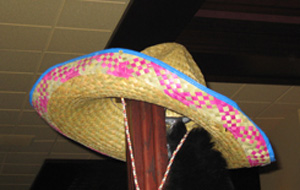
Sombrero in a Chicago restaurant.

I am bilingual. I know Spanish and English. I like to think that I speak, read, and write two languages very, very fluently. However, I always have the vague feeling that I don’t communicate like a native speaker in either language. Sometimes people tell me that I speak English with an accent, which I don’t doubt at all.

As I was driving through to Mexico to visit my family, I had no trouble communicating with anyone. Except at the border where I applied for an auto permit to drive in Mexico. The clerk asked me something that I didn’t understand. She repeated it three times, but I understood everything else she said, except for one word. She asked if I drove a Pontiac. But she pronounced Pontiac in Spanish, and I didn’t recognize the word immediately. Finally, her colleague pronounced Pontiac in English and I understood. This taught me that I had to adjust my way of listening since I would be listening to different dialects.

Once I reached Celaya, I had no trouble communicating with anyone. I met my family, and we understood each other perfectly. Ditto for my relatives in Mexico City. They mentioned other family members who had come from the U.S. who spoke no Spanish at all. However, a few relatives discreetly mentioned my accent, of which I have always been painfully aware. I wanted to buy some Mexican T-shirts for my sons at the mercado and my cousin told me to be quiet and she would do the haggling. If they heard me speak, they would think I was tourist, and we wouldn’t get a fair price. On the one hand, I had an American accent, but on the other, several people mentioned that I spoke Spanish extremely well. Well, that’s me to a tee. I abound in paradoxes. I speak Spanish with an accent, but very well. A few people mentioned that I stuttered through plenty of conversations while speaking Spanish. I pointed out that I stutter in English, too. But I was incredibly happy that I could communicate in Spanish in Mexico!

DDR

Waiting for Montezuma


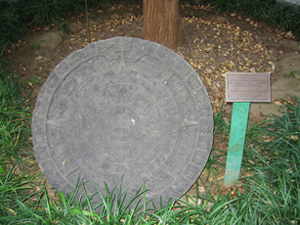
El Palacio Presidencial, Mexico DF

Okay, the one thing that worried me even more than the drive to Mexico was the fear of getting sick there. You know, Montezuma’s Revenge. When I went to Mexico in 1978, my mother advised me as to what to eat and what to avoid eating in order not to get sick. Since she went to Mexico every year, I honestly believed she knew what she was talking about. She told me, and I still remember to this day, to avoid drinking the water and eating fruits, chicken, and eggs. But most important of all: “Don’t drink the water!” I was there for a month, and I really enjoyed myself despite depriving myself of some foods in the beginning.

When I took the bus to Celaya with my aunt and cousin, all my relatives were eating chicarrón and I couldn’t resist indulging myself. Besides, chicharrón was NOT on my mother’s list of foods to avoid. So, I really, really indulged on chicharrón! Well, the next day, I felt nauseous, me who rarely gets sick. Soon, I was vomiting and had the runs. Simultaneously! My aunt attributed my illness to the chicharrón I had eaten. I felt so deathly ill that the only thing that kept me living was the hope that I would die. But blessings sometimes come disguised. After I recovered a few days later, I was able to eat anything I wanted. I even drank the water without getting sick again.

So, when I went to Mexico this time, I dreaded the risk of getting sick again. I remembered my mother’s list. But then I thought that if I got sick immediately I could then enjoy the rest of my trip with my newly acquired immunity. I drank agua de horchata, which is rice water that is very tasty. I assume that it’s made primarily of water, unpurified water, that is. It even had ice cubes! Presumably, also made from unpurified water.

When I went to my aunt’s house, I ate some fruit (I don’t remember what it was called) from a tree in her back yard and she scolded me for eating the peel since I didn’t wash it. Well, I kept waiting for my impending onset of “discomfort” with Montezuma’s Revenge. I remained healthy the entire trip! I felt like a real Mexican!

DDR

New Year’s Eve


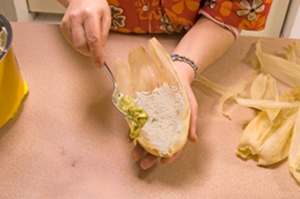
Making tamales with TLC

I have many fond memories of New Year’s Eve beginning in my childhood when our entire family would go to my Uncle Simon’s and Aunt Mari’s house. The party always involved eating a lot of  Mexican food and real hard play among cousins. At midnight, everyone, I mean children, too, toasted with a glass of champagne. That was the only time of the year I drank alcohol–until I became an altar boy and my friend once talked me into taking a sip of altar wine before mass.  But I only indulged that once because I felt so guilty and sinful afterwards.

Once, we were in Mexico for New Year’s Eve and we celebrated by making tamales and eating them. In Chicago, my mother made the masa during the day and then made buñuelos at midnight as a way of ringing in the new year. I think that New Year’s Eve wasn’t as exciting once we stopped going to my aunt’s and uncle’s house. I don’t really remember too many of those later celebrations now. When I was married, I was content to stay home with my wife and son and watch the festivities in Chicago on TV. When I lived in Bridgeport, I used to take my oldest son to the attic window at midnight where we could see the fireworks downtown. When the twins were born, we moved farther away from downtown, so we could no longer see the fireworks from the window. But we watched them on TV, although not quite as dramatic.

Later, after my divorce, my Mexicana girlfriend decided that we would make tamales for New Year’s Eve. She bought a giant pot for the tamales and lots and lots of masa. We would make tamales together, just the two of us. Actually, I enjoyed making the tamales. In Mexico, I only got to watch the women of the family make the tamales; males weren’t allowed to touch the masa. My girlfriend showed me how to mix the meat into the masa and stuff the masa into the corn husk. She had made tamales a few times and actually knew what she was doing. We even made some sweet tamales with raisins. We had about six different kinds of tamales. We literally did this for at least two hours and the giant pot was still only half-full. However, she insisted that we fill the pot all the way to the top. We filled the pot at about 3:00 a.m. And I was exhausted!

But wait! She put a penny at the bottom of the pot where there was boiling water to steam the tamales. The flame underneath had to be at just the right temperature and you could tell if the temperature was just right because the penny would keep making noise as the boiling water moved it. The only time I really saw tamales made was in Mexico as a boy, but my mother and aunts cooked the tamales over a bonfire.

Well, I went to bed about 6:00 a.m. because I couldn’t stay awake anymore. She stayed up to keep adding water and ensuring that the tamales cooked properly. I didn’t realize they would involve so much work. She woke me up a few hours later when they were done. She had stayed up the whole time! We then ate the tamales and they were so delicious! We ate them later that day. And the next day, too. There were so many tamales that she put some in her fridge and froze the some in her freezer. And there were still some tamales leftover! So I took some home and put them in my freezer. We ate tamales until the Fourth of July! And we never got tired of them. We loved them!

¡Happy New Year! ¡Próspero Año Nuevo!

DDR