When I was growing up, in an age before everyone tried to be politically correct, everyone told ethnic jokes. They were always insulting and mean-spirited to whatever group was targeted. Sure, some people were offended by these jokes, which only led to them being the target of more ethnic jokes. However, these jokes also brought a lot of joy and laughter among friends. For example, I worked in a peanut butter factory, named Derby Foods, with various ethnic groups who lived in the Back of the Yards neighborhood. In general, we all got along very well. Shirley, one of my Polish coworkers, loved to hear any kind of joke because she loved to laugh. Her real name was Ursula, but she preferred to be called Shirley. Anyway, she especially loved to hear Polish jokes. She always insisted that I tell her any new Polish joke that I heard. And when I didn’t learn any new jokes, she insisted that I retell her the old ones. Whenever I told her Mexican jokes, she told me she liked the Polish ones better. In this age of political correctness, I will not tell any Polish jokes lest I offend anyone. But I suppose it would be okay if I told some of the Mexican jokes that I still remember. I’m not doing this to propagate any negative stereotypes about Mexicans, but merely as a scientific exercise to preserve our humorous past. Now, I’m not saying that these jokes are funny anymore, but once upon a time, people laughed at these jokes. Some of them are quite dated. Okay, you have been forewarned!
Why can’t Mexicans be fireman? They don’t know the difference between José and Hose B.
Mexican weather report: Chili today. Hot tamale.
Why do Mexicans wear pointy shoes? To kill cockroaches in the corner.
What is the name of the Mexican telephone company? Taco Bell.
Why don’t Mexicans have barbecues? The beans keep falling through the grille.
How can you tell if you’re at a Mexican birthday party? There are more adults than children.
What do you call a Mexican basketball game? Juan on Juan.
What do you get when you cross a Mexican with an octopus? I don’t know, but boy can it pick lettuce!
Why doesn’t Mexico have an Olympic team? Because every Mexican who can run, jump, or swim is already in the U.S.
What do you call a Mexican in a BMW? A valet.
Upon further reflection, I retract the above listed jokes because they are in extremely bad taste. With apologies to Ursula, I mean, Shirley!
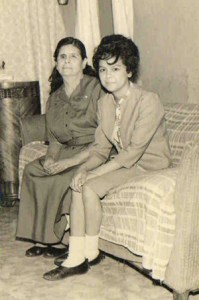
My tía Matilde came to Chicago as part of the package deal when my abuelita came for eye surgery. Tía Matilde also needed surgery, so she came from México to have surgery on her ears. I’m not sure what exactly was wrong with her ears, but she was otherwise healthy.
My aunt was very young when she came, and she liked living in Chicago. She loved listening to pop music on the radio and she bought all the records by her favorite singer, Rick Nelson. She went wild when listening to his music.
What I remember most about my tía Matilde was how she did laundry. We, my parents, my three brothers, my abuelita, my tía Matilde, and me, all lived in a small four-room apartment. We had a washer and dryer in the kitchen next to the sink. When my parents were at work, tía Matilde would do all the laundry in the house, every handkerchief and sock. She would search everywhere in the apartment for dirty clothes. She found dirty clothes where I would never even think of looking. She just had to make sure that every last item of dirty clothing was clean when she was done doing the laundry. And so, when all the dirty clothes were in the washer, and there was a little room in the tub for more clothes, she would start taking off her clothes right at the washer and start putting them in the washer. She would be standing in the kitchen wearing nothing but her bra and panties, proud of the fact that all the dirty clothes in the house were now washed, obviously oblivious to my presence.
Back then, we always seemed to be either at home or at Cook County Hospital taking either my abuelita or tía Matilde to the doctors there. Anyway, my tía Matilde, who would undress at the washer, was very shy with the doctors when they asked her to disrobe. The day of her surgery, she refused to undress and refused to put on the hospital gown because it had no back to it.
I still remember her telling this story when she returned from her surgery. She absolutely refused to undress for the nurses and doctors. She thought she had won her battle, but after the surgery, she woke up in her hospital bed and immediately realized that she was completely naked! Whenever she told this story, she always sounded so shocked that this could have happened to her despite her precautions. She didn’t even remember when or why she lost consciousness. She always wondered who managed to see her naked. She would blush every time she told the story. She was truly traumatized by this experience!
She eventually went back to México with my abuelita.
There are good-byes. And then there are Mexican good-byes. By this, I mean that most people say good-bye and then they leave. Mexicans, on the other hand, say good-bye and think of many reasons for staying un poquito más. Such as telling the story they just remembered on the way out, upon touching the doorknob. Or, because they haven’t seen each other in such a long time, since like last week. I, too, of course am guilty of these long, extended good-byes. Perhaps, I didn’t say everything that I wanted because I couldn’t get a word in edgewise or the stories told were so good that I didn’t want to interrupt them.
While I was in Mexico, every good-bye was a despedida mexicana, but one long good-bye especially comes to mind. I was staying at my cousin’s house and we were going to visit her sister, also my cousin. My cousin, her husband, my aunt, and I went to my other cousin’s house. We would leave about three o’clock in the afternoon in order to avoid the afternoon rush hour traffic. I agreed because Mexico City’s normal traffic is horrendous and traumatic, even if you’re just a passenger, let alone driving during rush hour. So we visit my cousin, we eat at a restaurant called California, we go back to the house of the cousin we just visited, look at some old family pictures, and talk and talk and talk over old times since the last time I went to Mexico, which was twenty-nine years earlier. By the way, we started up the conversation right where we left off the last time I was there as if I had just left a few days before.
At 3:00 p.m. sharp, my cousin announces that we’re leaving immediately in order to avoid the rush-hour traffic. My cousin’s husband says that we can’t leave his house without first drinking some tequila together. That would reflect poorly on their hospitality. Besides, how could I go to Mexico and not drink tequila?
As the guest of honor, he served me tequila in his very own special tequila shot glass that was wrapped in specially treated tan leather with his name embossed on the leather. How could I say no to this shot of tequila? So we all had a shot of tequila as we were standing to leave. Sure enough, we all start talking about when my cousin came to visit Chicago in 1979. As luck would have it, I was in California in the Marines at the time. So we all sit down to hear about her trip to Chicago and how she almost saw snow because the weatherman predicted a snowstorm, but then there was only a light dusting of snow.
Of course, this called for another shot of tequila! Which no one refused, including me because I always try to be polite and eat and drink everything that is served to me. (You’d be surprised at how polite I can be when food or tequila is involved!) Then it occurs to our host that if you drink tequila you should drink it properly. So he serves us another shot of tequila, but this time he passes around a bowl of lime slices and a salt shaker. That’s how Mexicans really drink tequila! You squeeze some lime juice on the side of your fist, shake some salt on the lime juice, you drink the tequila shot in one gulp, and then lick the lime juice and salt afterwards. Well, we down a few more tequila shots the proper Mexican way and then our host said he had to go to work to take care of some business, but when he returned, he would bring back some food for supper.
The tequila had long ago been consumed and we were left to our own devices to entertain ourselves. Actually, for Mexicans like my aunt, my cousins, and I, we merely entertain ourselves by talking about what we did in the past since the last time we saw each other. In fact, I spent most of my trip just sitting around talking to my relatives bringing myself up to date on their lives. Well, it’s after six p.m. and our host still hasn’t returned. His wife calls him on his cell phone and it turns out that he’s stuck in rush-hour traffic. When he finally returns, he returns empty-handed. We’re all extremely famished by this time. So we all pile into two minivans and go to their favorite restaurant in town. We eat supper and spend a couple of hours talking over our food. By the way, we’re still saying good-bye since three p.m.! We eventually return to my cousin’s house about 9:30 p.m.! However, we did manage to avoid Mexico City’s infamous rush-hour traffic! I have to admit that it was my longest good-bye ever, even by Mexican standards. But it was also one of the most entertaining.
Okay, let me just blurt this out and be off. ¡Adiós!
Olivia Maciel is a poet who was born in Mexico City, but has lived in Chicago a long time. She has written several collections of poetry over the years. She writes poetry in Spanish, but her books include an English translation on the facing page. I recently read two of her collections: Sombra en plata [Shadow in Silver], Chicago, Swan Isle Press, 2005, and Luna de cal [Limestone Moon], Chicago, Black Swan Press, 2000. All her books are available for purchase on Amazon.com.
I first met Olivia in one of my graduate classes at UIC. We took several classes together while earning our master’s degrees. She graduated from the University of Chicago with a Ph.D. When Octavio Paz died, she published an article about her reactions to his death that appeared in the Chicago Tribune. We occasionally bump into each other at UIC because we are both Spanish lecturers there. I really enjoy talking to her because she’s so creative. Sometimes, she begins writing poems as we speak. She says that I inspire her when we talk. I asked her if she would hire me as her muse.
Mexicanismos are words or phrases in Spanish that are unique to México, but may not be familiar to other Spanish speakers, also known as Hispanophones. French speakers are Francophones and English speakers are Anglo-Saxophones.
Anyway, in Mexico, people use words and phrases that are unique to that region and are commonly misunderstood by other Hispanophones. At UIC (University of Illinois at Chicago), we have graduate students who come from all over the Spanish-speaking world, most of whom specialize in linguistics. They can spot the dialect and region of most Spanish speakers almost immediately. Some have trouble identifying me because I have my American accent and I use words and phrases from almost every dialect that I’ve ever heard. I’m like a sponge in this regard. Sometimes, someone will throw their hands up in the air and just ask me where I’m from. They’re often surprised to hear that my parents were from México. My cousin’s husband thought I spoke with an Argentine accent. Once, a friend and I were speaking, and then I didn’t hear something she said. So, I said, “¿Mande?” and she said, “¡Ajá! You’re from Mexico!” That simple little mande gave me away as a Mexican.
Once, at the end of the semester, a professor from Argentina told us that she would bring us a torta for the last day of class. To most Mexicans and me, a torta is a type of sandwich that is served on a bun with meat and other condiments. I didn’t eat before class because I wanted to be polite and eat everything that was offered to me. Well, she came to class with a torta, but it was a cake, as in a pastry for dessert. I left the classroom hungry that day.
Another time, I brought some Thanksgiving leftovers to UIC for lunch. A graduate student from the Basque Country in Spain asked me what I was eating. I told her guajolote and camotes. She didn’t know what I was talking about. For her turkey was pavo not guajolote and yams or sweet potatoes were patatas not camotes because they didn’t differentiate between the various kinds of potatoes in Spain.
I have a friend who grew up in Seville, Spain, and we once had a minor misunderstanding. He told me that his car had broken down: “Se me estropeó el coche.” Being the nice guy that I am, I wanted to be helpful, so I offered him a ride: “¿Quieres un aventón?” I could tell by the tone of his voice that he was a little upset when he replied, “¿Y yo qué te hice?” You see, to a Mexican, un aventón is a ride, but to just about any other Spanish speaker un aventón implies some kind of physical violence. I explained to him that I only wanted to help him by giving him a ride to wherever he wanted to go, and I am happy to say that we are still friends to this day.
Another graduate student from Spain taught a class that had many Mexican American students. She frequently used the word coger, meaning “to get” or “to pick up” when she spoke not realizing that to Mexicans coger is a profanity that refers to the act of sexual intercourse that begins with the letter “f.” So, one day, she talked about picking up her dog: “Cogí mi perro.” She was surprised when the class began to laugh until someone explained to her what she had said.
While I was in México, I learned a few more mexicanismos. My cousin used the diminutive “-is” instead of “-ito, -ita.” For example, she went to see her “amiguis” instead of her “amiguitas.” Before we went to visit my cousin David Rodríguez in Celaya, everyone refered to him as Davis.
In the U.S. we have Spanglish, which is the mixture of English and Spanish, but I only thought it existed north of the Rio Grande (In Mexico, they call it El Río Bravo). For example, you take an English word like “to check” and make it Spanish: chequear, instead of comprobar or some other Spanish word that already exists. Anyway, they have a similar word in Mexico: checar. Several street venders approached me and called me jefe, showed some product they were selling, and said, “Checa esto.” Or “Check this out,” in English. So, this word is a little different than the Spanglish word chequear because it’s a mexicanismo. Or maybe it should be called inglañolismo.
I always thought of an aquarium as un acuario, but to my cousin in Celaya it was el pecero. I had never heard the word before, but I knew exactly what he meant. Then when I was in Mexico City, when people talked about taking the bus they still called it el camión, but now a lot of people also called it el pecero. That made perfect sense because if you look at the buses with their large windows, they do look like aquariums with people swimming inside instead of fish.
If you park your car in México City, you’re likely to meet el viene viene. He is a self-appointed parker of cars and is often found on public streets and grocery store parking lots. He doesn’t officially work for anyone. He’s just there–and everywhere else. You can’t miss him. He pops up out of nowhere waving his salmon-colored mechanic’s rag as you park your car. As you back up, he tells you how far you can back up by saying “Viene, viene.” When you get out of your car, he’s standing next to you with hand, and you’re supposed to give him a tip of two pesos or so.
Then, there’s also the aguinaldo that is a bonus that most employees receive before Christmas and before el Día de los Reyes to buy holiday gifts or pay off debts. At Christmas, children received candy bags. They were told, “Come get your aguinaldo!”





 Chicago USA