My father


José Diego Rodríguez Rosiles

My father is a very unique person who has his own way of doing things. He was a factory mechanic who could work wonders with duct tape. No matter where we were, he always had some tools in his pocket. He was proud of being mechanic. If someone had some sort of mechanical problem, my father would volunteer to fix whatever needed fixing. No problem was too small for him. A squeaky door? He carried a little oil can with him. Door knob keeps falling off? My father would attach it with his tools and extra screws that he always carried with him just in case.

I should write a novel about him: My Father, the Super Fix-It Handyman. Or maybe make him into a comic book superhero who can fix any problem no matter how small. My father was always fixing bicycles, skates, skateboards, and automobiles for everyone on the block. He had just enough mechanical aptitude, talent, and expertise to keep him trapped in the middle class the rest of his life. And, it turns out that I’m not much different than him, although I’ll never be able to make repairs just like my father.

When I was a boy, my father often embarrassed me. He always liked to attract attention to himself by telling jokes in his broken English. I was afraid to bring home friends when my father was home because then he would want to get in on the conversation with them and he didn’t speak English very well. So most of the conversation would involve a lot of repetition because he didn’t understand everything that was said, but he wanted to show that he was eager to learn English. It’s now forty years later and he still does this. He has never stopped trying to learn English. If I talk to him in Spanish, he still insists that I speak to him in English so he can learn English. In fact, if I talk to him in Spanish, he doesn’t understand a word I say.

Another thing about my father was that he was always so Mexican. He could just stand there silently and everyone would know that he was Mexican because he always stood there looking so Mexican. He was about 5’6″, thin, with black hair slicked back with vaselina, brown eyes, and a Cantinflas mustache. Plus, you could see the tools bulging from his pants pockets, along with a small jar of salsa or peppers, just in case.

Whenever we did something together, he would always preface it by saying that he used to do that activity in Mexico when he was a boy. When we played basketball in our backyard at 4405 S. Wood Street in Back of the yards, he told us that he always played basketball with his brothers in Celaya, Guanajuato, Mexico. When I was eight, I actually thought that basketball was a Mexican sport. While playing, my father told me that once I stopped dribbling the ball, I couldn’t dribble it again. I had never heard of such a rule. I told him, “I don’t want to play the Mexican way.” Of course, I didn’t know any better at the time even though there is a rule against double dribbling.

For breakfast, my father would prepare this concoction that he learned to make from his father in, you guessed it, Mexico. He would pour some Mogen David grape wine into a glass, put in a raw egg, and mix it up together.  He would drink the first glass to show me how it was done. Then, he would hand me a glass and I would force myself to drink it. At first I didn’t like it and I told him that I didn’t want a Mexican breakfast, but I eventually learned to like it. I also learned to eat raw eggs right out of the eggshell by poking to holes at either end of the egg. I learned this from my father because this is how he ate breakfast in Mexico. This was long before I had ever heard of salmonella. I guess God does protect children and idiotas. 🙂

DDR

Here and now


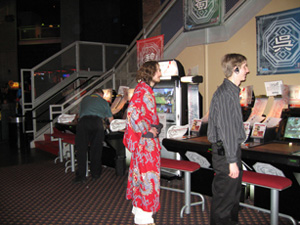
GameWorks, Schaumburg, Illinois

I have always believed that I am very adaptable and that I could survive anywhere in the world.

In fact, I’ve always fantasized that if you flew me anywhere in the world blindfolded and pushed me out of an airplane, I would somehow live and prosper because of my survival skills. Since I have never gone skydiving, you would have to blindfold me and you would have to push me very firmly to get me to jump out of a perfectly fully functioning, flying airplane. Not jumping out of airplanes is one of my innate survival skills that I highly value. I have never had the urge to go skydiving. When I was in the Marines, a few of my friends wanted me to go skydiving, but I am afraid of heights, so I went to the library instead. And, thus, I live to tell this tale!

Anyway, despite knowing that I’m very adaptable and can get along with just about anyone, just about anywhere, I always get this vague feeling that I’m always in the wrong place and the wrong time. I often feel that I do not belong right here where I am right now, if you know what I mean.

It’s an eerie feeling that’s difficult to describe. No matter where I am, I feel as if I should be somewhere else. As a boy, I truly thought that I was born into the wrong family. Maybe I wasn’t supposed to be born to a Mexican family because I certainly didn’t fit in. When I was in Mexico, I thought I should be in Chicago, until I returned to Chicago where I felt that I really belonged in Mexico.

I wasn’t born in the right era either. I should have been a medieval scribe of some sort. Or, I should have been born in New York City in the early 1900s. If I’m with my friends, I feel as if I should be with my sons and family. If I’m with my sons, I feel as if I should be with my girlfriend, but when I’m with her I wish I could be with her, and my sons, family, and friends.

As I write this, I feel guilty for not working on my tax return or correcting Spanish compositions. When I’m teaching, I think about how nice it would be to stay home. Now, that I’m on spring break, I miss my students. What should I do? Maybe I should jump out of a plane.

DDR

Blog entries


Universidad Nacional Autónoma de México

Okay, so how do I write my blog entries? Well, I’ll tell you. I don’t know. I have no rhyme or reason when I sit down at the computer to write a blog entry. In fact, when I’m at my computer, I’m usually supposed to be doing something else, “important academic work” such as grading online Spanish homework or compositions.

However, I never do what I’m supposed to do in a straight-forward fashion. For example, right now, I sat at the computer to grade online Spanish homework, send an email to my cousin in Mexico, enter student grades on my Excel spreadsheet, and then with time permitting, write a blog entry for the sake of posterity that will better the world in untold ways. Well, I hate correcting online homework online, I can’t think of anything to write my cousin, and I dread the thought of staring at a spreadsheet this early in the morning, so I think I’ll start with a blog entry!

So how do I choose my topics? I don’t know! I have many ideas percolating in my head, some for many years now, that somehow manage to ooze out through my fingertips and out into cyberspace. I can’t always contain them. And so they wind up in a blog entry.

As you’ve probably noticed, I’m rarely topical or current. I’ve reached that age where I’m very fascinated with the past, the nostalgic elements of life. I rarely invent anything that I write. I’m just not that creative. I write about just about everything that I remember because I have a good memory.

How good is my memory? Well, I remember things that most of my friends don’t remember even the slightest detail. But a good memory is like a double-edged sword: it cuts both ways. I also have some painful memories that I would like to forget but can’t. I have issues with my good memory: 1. I remember most things that ever happened to me, and 2. I remember many things that never happened to me. My imagination invents events from my past and I truly believe that they really happened to me. I try to block those out, but I don’t always manage to censor them.

Well, I will end this blog entry rather abruptly today, as I do with most blog entries. I have some things that I really have to do. But first, I’ll go out for my morning run.

DDR

Written Spanish


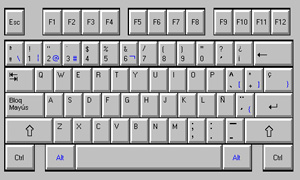
Spanish keyboard map.

I’ve already mentioned how when I went to Mexico everyone seemed to comment on my American accent when I spoke Spanish. Well, my written Spanish is much better than many of my Mexican relatives. I often get letters from Mexico and some relatives just don’t use accent marks that are necessary when writing in Spanish. When I e-mail my cousin in Mexico, she is always amazed that I write much better in Spanish than her, even though she’s a native speaker. Another cousin constantly IMs me. Every so often, she asks me how her Spanish is. I tell her it’s surprisingly good, even though she doesn’t spell very well, doesn’t capitalize at the beginning of sentences, and doesn’t use any punctuation. Some of my Spanish students have seen these types of writings in Spanish and then question why I insist that they use accent marks and ñ and all things Spanish. Well, the main reason is to show that you have been educated. It works for me because my cousins take more seriously when I write proper Spanish.

DDR

Mexicanas


Ixtapa-Zihuatanejo, México

Mexicanas are incredibly unique women in this world. However, I don’t want to lump them all into one group as there are different kinds of Mexicanas. Sure, they all have the common denominator of Mexico somewhere in their background and that’s enough to differentiate them from women of other ethnicities. So in an effort to educate you, gentle reader, I will over-analyze Mexicanas for you. Yes, there are different kinds of Mexicanas that I like to divide into three groups: 1. Mexicanas, 2. Mexicanas, and 3. Mexicanas. As you can see, UIC didn’t give me my Ph.D. for nuthin’! I learned to categorize just about everything while studying for my graduate degrees. Anyway, if you examine my groups of Mexicanas, you will clearly see that there are three different kinds of Mexicanas: 1, 2, and 3. Is that clear?

First, there are Mexicanas like my abuelita, born and raised in Mexico, destined never to live anywhere else. And they don’t want to leave Mexico either. Their names are usually María or Guadalupe. Or even Guadalupe María or María Guadalupe. No exceptions. My abuelita María Guadalupe Valdivía came to Chicago only because my mother insisted. Abuelita didn’t like Chicago at all because it wasn’t Mexico. She hated the winters here and she hated the fact that she would have to learn English. She stayed just long enough to have her eye surgery and then she returned to Mexico. And she never came back. And she never missed Chicago at all. My mother would visit abuelita at least once a year in Mexico. And even though she was blind, abuelita lived by herself in Mexico. She was an extraordinarily strong Mexicana.

Second, there are Mexicanas like my strong-willed mother who were also born and raised in Mexico, but not firmly rooted there. They come to America for a while, then go back to Mexico. But return to America even though they always complained about America in Mexico. They just keep going back and forth, never entirely happy in either place. In general, nothing seems to please them. My mother always complained about everything, to everyone in America and Mexico. When her Mexicana friends would visit, they would all sit around complaining about America. And then, to change the subject just a little, they would complain about Mexico. Nothing ever seemed to please these Mexicanas as they sat around complaining and breast-feeding their babies.

Third, there are Mexicanas like my sister or ex-wives, born in America, but unmistakably Mexicana by their accent. I once had a Mexicana girlfriend who had the Mexicana accent but couldn’t speak a word of Spanish! She used to get so mad when people automatically spoke Spanish to her and she would have to admit that she only knew English, albeit the Mexicana kind of English. These Mexicanas love everything about Mexico, the music, the food, the culture, but they wouldn’t want to live there. It’s okay to visit once in a while to catch up with family events, but that’s about it. America is their home, even if they are Mexicanas, and they never hesitate to let the gringos know it.

I’ve known Mexicanas all my life, beginning with my mother, then my abuelita, and finally, my significant others. The more I get to know them, the less I seem to understand them. I do know they are sexual beings from observing them and from my very own personal hands-on experience. I don’t know much about my abuelita’s sex life, but let me say this. She never married my abuelito and they rarely lived together. Yet they managed to have six children together. My parents were always fighting, and I never ever heard them having a normal, civilized conversation. My father was always affectionate with my mother, but she would repel all his amorous overtures, at least that I could see. Occasionally, when my father didn’t work the midnight shift, I could hear him trying to seduce my mother in their bedroom, right next to mine. My father always saying something affectionate and my mother always telling him to leave her alone. Apparently, he didn’t give up and she didn’t resist enough because they had six children together. My youngest brother was born soon after my parents separated.

The Mexicanas that came into my life were certainly very affectionate, if you know what I mean. That’s the thing about Mexicanas: They immediately know if they like you or not, if they will love you or not. I met my first wife Linda when my friend invited me to go with him to a wedding in Merrill, Michigan. We barely spoke and I didn’t see her again for another month–and we spoke even less then. Next thing I knew she moved to Chicago just to be with me–not that I minded, of course.

My second wife Anna chased after me, too. She kept hinting for me to ask her out. I really wasn’t interested in her, but she was persistent. She gave me her phone number and I threw it away. Her friend gave me Anna’s phone number and I threw it away again. She was so persistent that I finally gave in. If a Mexicana is that interested in me, I know we will be happy together. If Mexicanas don’t love you, or at least like you, you better back off because you don’t have a chance and you’re just wasting your time.

From what I’ve seen, the odds are against you if you think you can win a Mexicana over. However, once she yours, you better show her that you need her, and she’ll be yours for as long as she wants you. But that may or may not be till death do you part. One of the fringe benefits of having a Mexicana is having an active sex life. I mean there’s no begging at all. In fact, I was dragged into the bedroom many times, although I must admit that I didn’t put up much of a fight. And the fun doesn’t stop just because it’s that time of month, either. In fact, a Mexicana wants you even more right then. This happened to me many times. And just because you have all these intense arguments during the day, doesn’t mean that you’ll be ignored at night. In fact, that’s usually some of the best lovemaking. And the next morning? She continues being mad at you from the day before. That is, until night falls again.

Well, that’s about all I’m willing to say for my over-analysis of Mexicanas for now. But someday, I’ll truly delve into Mexicanas to try to understand them! Maybe, I’ll discover that there are many more than just three groups of Mexicanas.

DDR