Guadalupe


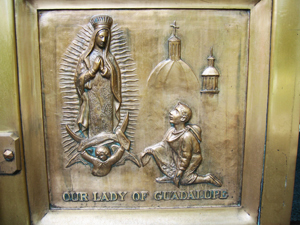
On the door of St. Petronille Church, Glen Ellyn, Illinois

Guadalupe is a common first name in Mexico. In Chicago, I have met both males and females who have this name. My sister’s middle name is Guadalupe. The adult nickname for Guadalupe is Lupe for both genders. Small children are called Lupito or Lupita, depending on their gender.

In Chicago, I knew a male Lupe who hated his name because non-Mexicans had trouble accepting his non-American name. They also mispronounced Lupe as “Loopy.” He hated this. But his name was Guadalupe Gonzalez, so he remained Lupe because he wanted to honor the name his parents had given him. He learned to not only accept his name, but also flaunt it, much to the annoyance of all non-Mexicans within earshot.

When I bought my house in Bridgeport, one of my tenants was named Guadalupe. she was a single mother with three children. As I later learned, only her youngest son was a U.S. citizen. I bought a four-flat because Derby foods was about to close down and move to Sylvester, Georgia. My plan was to rent out three apartments that would pay the mortgage while I was unemployed. All the tenants came with the building. Guadalupe lived in the second-floor rear apartment.

Guadalupe spoke hardly any English, but she understood most everything that was said. Her daughters were seven and six years old. Her son César was one. César, coincidentally, was also the name of the previous owner of my house. In fact, I bought my house from him. Well, it turns out that the previous owner was in fact César’s father, but he didn’t even worry about his son’s wellbeing at all. Guadalupe had to go to the welfare office to fill out some paperwork for her son, but she needed a ride and an interpreter. I offered to help her because she was struggling to get by. At the welfare office, I translated the social worker’s questions, which Guadalupe answered. Finally, we get to the question, “Who is César’s father?” Guadalupe has a hard time answering. The social worker turns to me and asks, “Are you César’s father?” “No,” I said. “I’m just her landlord and I was trying to help her.”

One day, she told me she couldn’t pay the rent. She was already about six months behind, but I didn’t have the heart to evict her. Eventually, I told her that I would have to evict her. I just couldn’t afford the mortgage unless all my tenants paid their rent. She was packing up one day when a nun stopped by her apartment to ask for donations. Guadalupe told the nun that she was moving out because she wasn’t working and couldn’t afford the rent. The nun said that her church could help her with the rent and find her a job. The nun talked to me and asked me not to evict Guadalupe and her children. She promised that she would pay all the back rent and find Guadalupe a job.

Well, this was a very agreeable arrangement for all of us. When Guadalupe needed repairs or rooms painted, she would make dinner for me afterwards. She didn’t like that I was always in a hurry to leave, but I was always so busy back then. Once she told me that she wanted her living room painted again even though I had just painted it about three months earlier. I wanted to know why her living room needed to be repainted so soon. She told me that her son had written on the walls with a magic marker, and she couldn’t wash the walls clean. I refused to paint again. She told me that if I didn’t paint, she would move out. I didn’t paint and she moved out.

I saw her about a year later. She had moved about two blocks away. She wasn’t feeling well. She had another baby a few months earlier and she never fully recovered from the delivery. I asked her if she had gotten married, but she said no. The father of the baby was her present landlord. She was sorry she had moved out from my building. That was the last time I saw her.

DDR

Irma Serrano


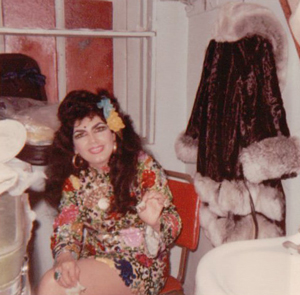
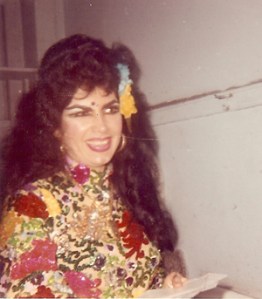
Irma Serrano at the People’s Theater, Back of the Yards, Chicago, Illinois

I never understood why my mother went to Mexico when Irma Serrano came to Back of the Yards to perform at the People’s Theater. She absolutely loved Irma Serrano. My mother had all her records. My mother saw all her movies. Yet, my mother went to Mexico the summer of 1970 when Irma Serrano came to People’s Theater.

But my mother had a plan! While she was away in Mexico, I would go for my mother to see Irma Serrano in concert! I was only fourteen at the time, so I was a little nervous when my mother explained her plan to me. I would see Irma Serrano in concert and then tell my mother all about the concert when she returned from Mexico. My mother thought her idea was absolutely brilliant. I, on the other hand, had mixed feelings. Because of my mother, I, too, loved Irma Serrano as a singer and an actress. I just couldn’t let my friends know this dirty little secret about me. What if my friends saw me going to the People’s Theater when I went to see Irma Serrano? What would I tell them? What if they wanted to tag along? That was my dilemma of the summer of 1970.

My mother arranged everything. She bought another camera just for the concert because she always took her camera to take pictures in Mexico. I was to take pictures of Irma performing on stage. I was to take pictures of every outfit she wore. She changed a few times during her performance, so I made sure I took pictures of every outfit. I must admit that this was fun, especially since Irma seemed to welcome the additional attention of an adolescent male admirer. My mother also wrote a letter to Irma that I was supposed to hand deliver to Irma Serrano personally. Those were my mother’s orders! My mother wanted me to go backstage after the performance to talk to Irma and take more pictures of her.

Irma Serrano in the dressing room.

“But how am I supposed to go backstage?” I asked my mother. “Just tell them that you’re delivering a letter to Irma Serrano from Carmen Rodriguez! They’ll let you in then!” I was always painfully shy, but now I was truly afraid to follow through with my mother’s plan. She wanted me to meet someone who was really a successful star and really, really famous. I was scared to approach Irma after the show. But I was even more afraid of how my mother would punish me if I didn’t take pictures of Irma and deliver my mother’s letter backstage.

I must admit that I thoroughly enjoyed the concert! Of course, that was also because none of my friends saw me going to the People’s Theater that afternoon. Luckily, the concert was on a Sunday afternoon when most of my friends spent the day visiting relatives. I recognized every song Irma sang because my mother always played them at home on her 8-track player. The only time I didn’t like listening to my mother’s Mexican music was on Saturday mornings. She played her music starting at sunrise. If I told her to turn it down a little, she would yell at me for being lazy and staying in bed. I would put the pillow over my head and the music didn’t sound so loud that way.

Since I was at the Irma Serrano concert of my own free will, according to my mother (under duress, if you asked me), I attempted to enjoy myself as much as possible. The audience consisted of less than about a hundred people, but they were all really into Irma. Even me! It was a really good concert! And since the audience was so small, it was also very intimate.

After the concert, I was able to get backstage by mentioning my mother’s name. I seriously doubted that would work, but I was amazed that I got to meet Irma Serrano in person. I told her that Carmen Rodriguez had written her a letter and I then handed her the letter. She smiled as she took the letter and said, “So you’re Carmen’s son? She told me about you.” I don’t know if Irma really knew my mother, but she knew how to treat fans appreciatively.  I asked Irma if I could take more pictures of her, and she consented. I was thrilled to be backstage with Irma Serrano all by myself!

So that was my closest encounter with a very famous star!

DDR

Juan Goytisolo


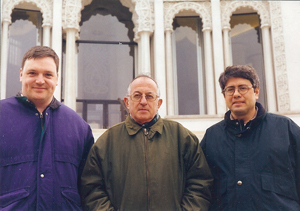
Juan Calduch, Juan Goytisolo, and Dr. D. in 1999.

There are famous people and then there are famous people you have never heard of.

As a graduate student in Hispanic Studies, I had to read a novel, La saga de los Marx, by Juan Goytisolo for a seminar on Modern Spanish (as in, from Spain) Literature. I had never even heard of Juan Goytisolo. Then the professor who assigned the novel assured the graduate seminar that he was a world-famous writer. I just took her word for it. But I was suspicious of just how famous he was.

Well, regardless of his claim to fame, I began reading La saga de los Marx. I was captivated by Goytisolo’s writing. I couldn’t identify a protagonist or a setting. He inserted foreign languages sans translations. There was no storyline to speak of. Or standard punctuation, for that matter. He seemed to have studied grammar and stylistic rules only so he could break as many rules as possible. However, the writing piqued my curiosity and I read the novel in a mere two sittings.

When the class met to discuss the novel, only one other student said she had read the entire novel. But she wasn’t sure if she really liked the novel. I, on the other hand, loved it! I immediately decided that I would write my seminar paper on this novel. I was intrigued by the postmodernist style.

As I was writing my paper, I decided to reread the novel to find supporting citations for my paper. Curiously enough, I enjoyed the novel even more upon reading it a second time. I loved it so much that I decided to write a letter to Juan Goytisolo, c/o of the publisher. Imagine my surprise when he wrote back! Usually when I like a writer that much, he or she has already been dead for a long time. Sometimes dying even before I was born. How rude!

Well, this paper inspired me to further my studies and become a doctoral candidate. I showed Juan Goytisolo’s letter to the seminar professor and she asked me to invite him to speak at UIC. He accepted the invitation and spoke at our university, with me as the guest of honor because he came on account of my letter, and I was writing my doctoral dissertation on his novels. I was truly honored. I was also surprised at how many people came from miles around to hear Juan Goytisolo speak and plug his latest novel. He was a fascinating man, as I discovered while giving him a tour of the Chicagoland area.

Well, Juan Goytisolo truly is world-famous. Every year he gets nominated for the Nobel Prize for Literature. One of these days, he may win it. But to think I had never heard of him before that graduate seminar!

DDR

Señora Independencia


Zaide Silvia Gutiérrez as Josefa Ortiz de Domínguez (1768-1829)

I went to see a dramatized reading of Señora Independencia last Friday at the National Museum of Mexican Art. We certainly need more productions in Spanish in Chicago. The play was by the Carlos Theater Productions starring Zaide Silvia Gutiérrez as la señora Independencia. You may remember her as the Guatemalan girl Rosa Xuncax in the 1983 movie El norte. Considering this was only a dramatic reading, I was impressed by the performances of all the actors. I seemed to always focus on the scripts the actors held in their hands and whether or not they read from the scripts. This detracted from my enjoyment a little, but very little. The writing was a little dense and heavy-handed. The playwright needed to illustrate with more concrete examples of how Josefa Ortiz de Domínguez contributed to Mexican independence from Spain. I was also bothered by the stage prop of a repeating rifle that was constantly referred to as an escopeta. The characters constantly referred to cartuches or cartridges for ammo. The sight of the repeating rifle and the mention of cartridges appear to be anachronisms. Perhaps this play is merely in its initial stages and all these details will be resolved.

Another pet peeve I had about the play was how we were admitted to the theater. Above, I have posted my ticket, or rather what’s left of it, as evidence of my attendance at this performance. This used to be a beautiful ticket before it was mutilated. Many people, as they handed over their tickets, asked to keep them as souvenirs. But they were all brutally ripped in half. Some theater goers even shrieked as the ticket was ripped. I’m proud to say, I was able to control myself, despite feeling my ticket’s pain.

On the plus side, complimentary appetizers and refreshments were served while we waited to be seated in the theater. Yes, I had a couple of glasses of white zinfandel. I had never been to a Carlos Theater Production before, but if they are all like this, I will certainly see more of their productions. If you ever have the opportunity to see this play, by all means go see it! Zaide Silvia Gutiérrez gave a superb performance with the help of her supporting cast.

DDR

La sirena


Lotería, el juego para todas las edades

When teaching Spanish, I always learn something new from my students, or rather mis estudiantes. Sometimes I don’t notice things that are part of our Mexican culture because they are just part of everyday life. For example, we don’t always notice daylight because it’s always there (in the daytime, of course) and we just take it for granted. In my Spanish classes, I just happen to take Spanish for granted. In fact, I’m rarely aware of which language I’m speaking. So, when I’m supposed to be speaking English, I’m speaking Spanish, and vice versa.

So, today, we had a little bit of free class time, so I decided to show a movie that was filmed in Spanish. Students just love watching movies in class. Rather than conversing in Spanish or doing more exercises. Well, I like to show movies in Spanish because this way they can learn something about Hispanic culture that they can’t learn from a textbook. A student had mentioned the Mexican movie Y tú mamá también earlier in the semester. In the culture section of our textbook SueñaGael García Bernal  is profiled and specifically mentions Y tú mamá también in his film credits. I thought this would be a good movie to teach students a little about Mexican culture and Mexican expressions, otherwise known as mexicanismos. Afterwards, the student who had originally mentioned the movie told me she thought the movie was a little racy. I must admit that it is. I saw it at the show when it first came out. I was in a theater full of Mexicans at the Ford City Theaters, and they were all shouting “¡Huy!” at some of the scenes at the end of the movie.

It seems that no matter what movie I show in class, a few students always comment about something in the movie that was offensive to them. All good movies will offend at least some of my students. Most of the other students love seeing the movie regardless of the content, whether deemed offensive or not. I’ve shown movies from México, Spain, Guatemala, Argentina, and the U.S. (in Spanish). They always address some controversial topic such as sex, incest, murder, etc. and they usually have a tragic, depressing ending. But they are always good movies. The advantage of showing these movies is that I know none of my students saw them in their high school Spanish class. No sane high school teacher would dare show such risqué films without taking a chance of getting disciplined and/or fired. I teach at a university, so I have a little more liberty in film selection since all my students are older than eighteen.

Sometimes when students tell me they find a movie offensive because of too much violence or sex, I tell them that they may leave the class without penalty if they find the movie objectionable. No one ever leaves. In fact, they find the movie enthralling. So I just don’t understand why they complained in the first place. Perhaps, to clear their conscience. Besides, everyone loves Penelope Cruz movies, and she hasn’t made a movie without any offensive topics. My favorite movie with her is the one where she plays a pregnant nun with AIDS.

On a couple of occasions, I offended some students unintentionally by playing Lotería. This is a board game like Bingo that I have been playing since I was a little boy. Every student gets a board with pictures of people and things such as La dama, El soldado, La rana, etc. There is a deck of cards with these same pictures. So, I shuffle the cards and call out the names. If your board has the picture that I called out, you mark the picture with an uncooked pinto bean (provided by me, since students don’t happen to walk around carrying pinto beans with them, but I do). When you cover all the pictures with pinto beans, YOU WIN! And you shout ¡Lotería! at the top of your lungs and I give you a little prize like a packet of chiclets or something else that’s Mexican. This is a child’s game that you would think would not offend anyone. Well, if you thought that, you would be wrong!

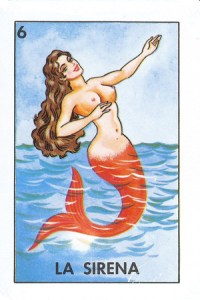
Once, actually, this happened several times, when I called, La sirena, a female student shrieked and said that the mermaid had exposed breasts. She was genuinely offended by the nudity. I didn’t know what to say. So, I looked at the card of La sirena and sure enough she had exposed breasts! I’ve been playing Lotería my whole life and I never even noticed her exposed breasts. To me she was just a mermaid. A cartoon mermaid. All I ever saw was her long hair and her fish tail. I mean, if I saw a real mermaid in person, I wouldn’t be caught staring at her breasts!

Why didn’t I see La sirena‘s breasts before? I’m not sure. Probably because I always saw my mother breast-feeding my younger brothers. And in public, too! I remember my mother taking my brothers and me to the park to play in the playground and she would breast-feed my baby brother right there on the park bench. And she wasn’t alone, either! There were always at least two or three other mothers breast-feeding, too. Maybe I just view breasts differently from everyone else. Breasts were just part of my Mexican culture while growing up and I just never noticed them on La sirena or in movies until students point them out to me! ¡Ay! ¡Ay! ¡Ay!

DDR