Chicago and Illinois residents awoke this morning to a new set of Chicago ordinances. Mayor Daley called an early morning secret meeting of the Chicago City Council. New city ordinances were enacted under the cover of night, surprisingly reminiscent of the Meigs Field Airport closing. The new Chicago ordinances take effect immediately.
All reporters are hereby prohibited from using the words “clout” and “bribes” in the same sentence with the name of Da Mayor or any council member.
Parking ticket books will be issued to all Chicagoans who purchase a Chicago city sticker.
Richard J. Daley is now formally recognized as one of Chicago’s founding fathers.
Illinois is now officially a suburb of the city of Chicago.
Lawsuits against the city of Chicago will immediately be dismissed if not filed by an attorney with Machine clout.
Four-day school week will become the law for teachers. Students will continue to attend school five days per week.
Old police motto of “To Serve and Protect” on police cruisers will be replaced with “To Curb and Collect.”
O’Hare Airport passengers are now officially Chicago citizens and must pay property taxes while at O’Hare.
Lake Michigan is now Lake Chicago.
St. Patrick’s Day will only be celebrated on March 17.
Days of the week beginning with the letter “R” or “D” are now parking meter holidays.
Alternate Leap Days will be designated “The City that Works” Day, whereupon all city workers must work a full day.
Yesterday’s problems will be deferred to future generations.
As a lifelong Chicagoan, Mayor Daley has always been part of my life. And by Mayor Daley, I mean both Richard J. Daley and Richard M. Daley. As a boy I lived under the reign of Richard Da First. In Back of the Yards, everyone knew Mayor Daley because his name always appeared on some of our neighborhood programs and in daily conversation. At Holy Cross, the Lithuanian nuns told us how Mayor Daley went to mass every day and was therefore a good Catholic and Chicagoan. Mayor Daley was a man of mythic proportions.
When Mayor Richard J. Daley died in 1976, I, along with many of my family and friends, were in shock. Mayor Daley was the only man we had known as The Mayor of Chicago. The last time I had such a feeling was when President Kennedy was assassinated. There was a period of alienation for Chicagoans during the interregnum until the next Mayor Daley was elected.
All true Chicagoans rejoiced when Richard M. Daley was elected mayor. The present Mayor Daley (Richard Da Second) is always highly criticized and panned for his politics and poor diction (like father, like son), but he always gets reelected, in part because of his father’s fame and reputation as good Chicagoan.
My life has crossed paths with the Daley family on many occasions. And I’m extremely thankful for that connection. Even when I’m not thinking about the Daleys, they remind me of their existence in some surprising way. Of course, there are all the signs at the Chicago airports to which Mayor Daley welcomes you. Then when I least expect it, I see another reminder somewhere totally unexpected. Once, when I was studying at the Saint Xavier University Library, I went to admire a stained glass window. I then noticed a small plaque that dedicated this window to Joseph Daley, father of Richard J. Daley who donated the window.
By good fortune, I was assigned to guard the home of Eleanor “Sis” Daley, the widow of Richard J. Daley, when I was a police officer. No police officer wanted to work the detail because it was perhaps the most boring assignment on the job, so as the rookie, I was assigned to sit it front of the house. I was attending UIC and I used to study while in the unmarked car. No one complained because I was always alert and awake and actually guarding the house. Sis once asked me if I was bored out there, so I told her I was going to school and the guard duty allowed me to catch up on my reading. When I finally graduated, somehow I made it into the Chicago Sun-Times for a Robert Herguth profile. Sis saw my profile and asked me to come into her house. She told me that she was proud of me. She said that her husband wanted to build a university in Chicago for students just like me and that was why UIC existed. She said that UIC was Mayor Daley´s greatest source of pride!
I thought it was a momentous occasion when Mayor Richard J. Daley’s writings went to the UIC library and the library was named after him. Yet another way that Mayor Daley impacted my life!
As I sit down to write this, I know I won’t finish this blog post tonight. The cast of characters keep changing, but the title is always the same. I’m referring, of course, to Mayor Daley of Chicago.
Well, actually, Chicago has had two Mayor Daleys. For anyone who has lived in Chicago for as long as I have, you know that Mayor Daley and his clan are part of the fabric of Chicago politics. Mayor Daley was the only mayor, or Da Mare as he is known in Chicagoese, that I knew since I was in grade school until his death in 1976. And just when I thought the Daleys were out of my life, his son Richard M. Daley ran for Chicago mayor unsuccessfully. Eventually, we had a second Mayor Daley, henceforth referred to as Richard da First and Richard da Second, respectively. And I just have a feeling that someday we may have a third Mayor Daley when Richard da Second’s son Patrick Daley returns from the army after he fulfills his enlistment. Yes, we could possibly have a Richard da Third.
When I was a boy, sometimes Richard the first would show up in our neighborhood unexpectedly. If we had award ceremonies for our park district tournaments, Mayor Daley would be there to pass out trophies. As I grew older, he was always in the news. His name was on just about every sign in the city of Chicago. One day, I was at the library at St. Xavier University on the south side of Chicago. I looked out the stained-glass window and I noticed a little plaque underneath. The window was donated by Richard J. Daley in memory of his father. I often went to the library at UIC to study. Then one day, they changed the name to the Richard J. Daley Library. Just like that.
Bridgeport is a neighborhood unlike any other in Chicago. Actually, there are two Bridgeports: the mythical, political Bridgeport that every Chicagoan hears about since starting school and the earthy, gritty Bridgeport that contrasts sharply with the mythical, political version.
In grade school, we learned all about Bridgeport, which is the birthplace of five Chicago mayors, including the present Mayor Richard M. Daley (Richard da Second). Bridgeport didn’t invent machine politics; they merely perfected machine politics, reaching its apogee in Mayor Richard J. Daley (Richard da First). Bridgeport is also very near the geographical center of Chicago. Many south siders often went to the White Sox games at Comiskey Park in Bridgeport. When I was a student at Holy Cross School, no school field trip would be complete without first driving past Mayor Daley’s bungalow at 3536 S. Lowe Avenue. Bridgeport was the Mecca of the south side. Every Chicagoan made a pilgrimage to Bridgeport at some point in their life.
When I told my mother that I was planning to buy a house in Bridgeport, she cringed and told me that I would regret it. For some unknown reason, I was drawn to Bridgeport. Besides, this was the location of the only house I could afford using the GI Bill. But before I bought this house, I checked out the neighborhood first. I drove past the house several times, at different hours of the day and night. Every time I drove past my future home, the block was extremely quiet. I never saw any movement in this vicinity at any time. I was sure that I was moving into a good neighborhood. After all, this was Bridgeport. So, I bought the house, much to my mother’s disappointment, and I moved in.
This was when I saw the earthy, gritty side of Bridgeport for the very first time. You don’t really know a neighborhood until you move in, and you live there 24/7/365. It was only then that I saw the seedy side of Bridgeport. My house was situated next to an alley that ran alongside the length of my house, an alley that everyone in the neighborhood used as a shortcut. I always heard whoever walked through the alley talking, at all hours of the day. Then one day, I noticed that Bridgeport had a gang problem, and my house was right on the border between two gang turfs. My neighbor always tried to start a fight with me by pointing to my camouflage shirt, a remnant from my Marine Corps enlistment, and tell me, “Hey, man! The war’s over!” I would ignore him and walk past him quickly. It was about that time that I learned that there were two sides to Bridgeport. And I lived on the wrong side of Bridgeport! I lived on the side where the public housing projects were located, the only white projects in the whole city of Chicago!
While I lived in the Marquette Park neighborhood, I had developed certain habits and I thought I could continue them when I saw all the stores, shops, and restaurants that were available in Bridgeport. I really thought that I would enjoy all these places that were within walking distance of my house. I went to Lina’s Italian restaurant that was less than one block from my house because they served authentic Italian food. Or so I thought. When I entered the restaurant, I was greeted by Lina herself. I asked for the beef ravioli because I love authentic beef ravioli. Lina said, “It takes too long to make.” I said, “That’s fine. I’m not in a hurry tonight. I brought a book that I can read while I wait.” “Well, I’m not going to make ravioli just for you. Why don’t you order something else?” So, I did. But I went back a few times hoping to eat ravioli, but she always refused to make it.
I once needed a button sewn on my winter wool coat, so I went to a tailor on Halsted Street. The tailor said, “You want this button sewn on? Why don’t you buy yourself some needle and thread and sew it on yourself?” He didn’t understand that I didn’t want to sew it on myself and that I was willing to pay him to sew the button on for me. He continuously refused, so I left.
I went down the block to the barbershop that appeared to be in a continuous state of disrepair, since at least the 1960s, judging by the newspaper clippings on the wall. There were no customers in the store, so the barber was sitting in a chair. When I entered, he stood up and said, “How may I help you?” I told him that I wanted a haircut. Well, he wasn’t giving haircuts that day. So, I left.
Then, I went to the 11th Ward Office because I needed garbage cans for my house. They refused to give me garbage cans because I didn’t appear as a registered voter within their ward even though I had just moved there. I left without garbage cans. This was certainly a fine welcome to Bridgeport. I eventually adjusted to life in Bridgeport. You just had to learn not to have too high expectations.
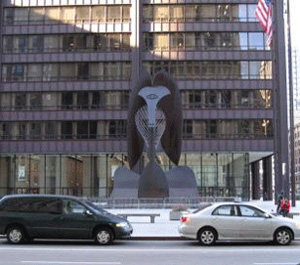
Picasso Sculpture, Daley Center, Chicago, Illinois
Today, I read the The Chicago Way by Tom McNamee in the Chicago Sun-Times in which he talks about jokes that work only in Chicago. Well, I would like to share some of those jokes with you, my fellow Chicagoans. He starts out with “Noel, Noel … So I took the bus.” I remember hearing a different version of this joke at Holy Cross School told by a nun: “Some Christmas carolers are under the El tracks downtown singing, “Noel, Noel …” Along comes a drunk and tells them, “Then take a bus!”
My friend Vito Vitkauskas wrote this Chicago joke that I used to use in my comedy routine: I once broke my arm in three places. Halsted, Lincoln, and Fullerton.
Ken Green, in today’s Sun-Times, wrote two funny haikus, or as he calls them, Chi-kus:
The CTA bus a very rare animal moves in packs of three
In my house we vote Even my uncle votes May he rest in peace
Here are some of the other jokes printed in the column:
How many Chicagoans does it take to park a car? Seven. One behind the wheel and six to rearrange the kitchen chairs.
Why is Chicago known as the city that works? Because whatever the problem–a parking ticket or a murder indictment–it can be fixed.
We all know why the chicken crossed the road, but why did the lady duck cross Walton Place? To get to the Drake.
I heard Mayor Daley has a plan to get crime off the streets. Yeah, he’s going to widen the sidewalks.



 Chicago USA