Since my parents came from Mexico, Spanish was my first language at home, and we never spoke English. When I started kindergarten at Holy Cross School, I didn’t know any English. So, when Sister Mary Joseph talked, I did what the other kids did. I sat next to Bridget, the smartest and prettiest girl in the kindergarten. I didn’t understand Sister Joseph’s instructions because she spoke English, so I watched Bridget’s every movement. When Bridget took out her crayons, I took out my crayons. When Bridget took a nap, I took a nap. Kindergarten was not that complicated. When Bridget got up and got in line, I got up and got in line. But I got in trouble. Sister Joseph walked me back to my desk. I noticed that the entire kindergarten class was laughing. I had followed Bridget to get in line to go the girls’ bathroom!
I always had a problem learning English. I didn’t quite understand everything correctly. I liked standing outside the corner bar on my block. You see, they had a sign that read, “3 IDs required. No minors allowed.” I was always waiting to see these miners wearing helmets with lights on top to come to the bar. And then they’d get really mad because they weren’t allowed in the bar and start a fight with the bouncer because he wouldn’t let them in. But I never saw any miners try to get in. I guess that sign really worked.
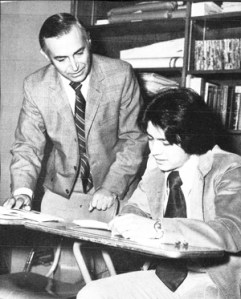
Enrico Mordini with Jerry Rodríguez at Divine Heart Seminary
Years ago, I attended Divine Heart Seminary in Donaldson, Indiana. I recently went to a DHS reunion where my classmates and I remembered our Spanish teacher Enrico Mordini. Señor Mordini was the Spanish teacher who taught me a lot about being Mexican even though he was an Italian born in Italy and raised in Spain. He taught me that there is more than one way to speak Spanish. I never realized there were so many dialects. I was originally in his Spanish I class, but he moved me up to Spanish II because I knew some Spanish. I had always wanted to learn Spanish formally so that I could read and write it. As an aside, when I attended Holy Cross Grade School, since the Lithuanian school didn’t offer Spanish classes, I asked if I could go to Saturday morning classes to study Lithuanian. I was told, “First, you have to learn English.”
Once I started classes with Señor Mordini, I questioned whether I even knew Spanish. He said some words so differently from my mother that it took me some time to recognize them. For example, “to drink” to my mother and me was “tomar” and to Señor Mordini it was “beber.” I had never even heard the word “beber” before! When my mother said “good” in Spanish, she would not say it the same way as Señor Mordini’s “bueno,” but rather, she would say, “güeno” instead. The Spanish word for needle was “aúja” to my mother and me, but to Señor Mordini, it was “aguja.” Our word wasn’t even in the dictionary without the letter g. When I informed my mother of these differences, she said that’s because Señor Mordini spoke “castellano” and not “español.” When I told Señor Mordini what my mother had said, he said that “castellano” and “español” were synonyms for the Spanish language. My mother never really believed him! After all, he wasn’t Mexican. In fact, he wasn’t even Spanish either. He was Italian!
Once while discussing Mexican culture in class, I said that I knew all Mexicans were a mixture of Spanish and Aztec blood. I was shocked when he said that was only partially true because not everyone, in fact, not many people were purely of Spanish and Aztec ancestry. I insisted that I was right. Even my father had told me so. Even after several convincing arguments by Señor Mordini that there were people in Mexico of pure, unmixed Spanish blood , I still didn’t believe him. When I reported this to my mother, she said that not all Mexicans were only of Spanish and Aztec ancestry. In fact, her grandfather had been Irish! “What?” I was so shocked. “Why didn’t you tell me before?” I asked my mother. She just nonchalantly said, “I didn’t think it was important.” Suddenly, I was sixteen and learning for the first time that I had more than just Spanish and Aztec blood coursing through my veins. In fact, I might not even have Spanish or Aztec blood coursing through my veins. I was in shock! It took me years to adjust to this new discovery about my ancestry. Was this a possible explanation for why my best friend in the Catholic Lithuanian grade school was Patrick McDonald from Ireland? But the fact remained that Señor Mordini was right again!
Years later, when I applied to teach Spanish at a community college, I was hoping against hope to get the position because I saw in the school catalogue that Señor Mordini was on the faculty! But such was not my luck. Señor Mordini died that year and I didn’t get the position! I suffered two severe blows at once. But I was lucky enough to have met Señor Mordini when I did. He certainly made more aware of myself and made me a much better person.
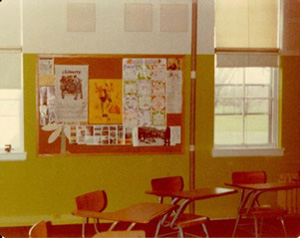
La clase del señor Mordini
Above: This was the Spanish classroom at Divine Heart Seminary in Donaldson, Indiana, in the 1970s. This is one of the many schools where Señor Enrico Mordini taught. As an aside, Señor Mordini had a good sense of humor and got along well with the students. Once my classmates talked me into hiding in the fire escape, which was a giant slide in a huge metal tube on the right in the picture but out of view, and Señor Mordini humored us by looking for me wherever my classmates suggested: under his desk, under the student desks, behind the bulletin board, etc. 🙂
The Mexican stereotype is that all Mexicans are Catholics. And most of them are. However, when I met my ex-wife’s family, I was surprised, even shocked, that most of her father’s family were Mexican Protestants. And her family was Protestant in Mexico, too! Talk about culture shock. Even though I’m a Mexican Catholic, I, too, stereotype all Mexicans in Mexico as Catholics.
As a young boy I was a parishioner at a Lithuanian Catholic church, Holy Cross, where I also attended their grammar school. The church population consisted of mostly Lithuanians, but there were also a lot of Mexican families in the parish and school. We always went to mass on school days before we went to class and on Sundays we sat with our classmates and teacher for mass. All the Mexicans in the neighborhood went to mass, if not every day, at least on Sundays. My father’s family was extremely religious, so I had this image of all Mexicans being devout Catholics.
When I went to Mexico, I realized that my mother’s family wasn’t as religious as I had imagined. All my aunts, uncles, cousins, and other family members always said that they were Catholic. What a disgrace it would be not to be Catholic!
Anyway, once I went to Mexico to visit for a month. By the third week, I realized that we had not even gone to church even once. I wasn’t really a practicing Catholic then, but I was worried about what my family would think of me if I didn’t go to church or even suggest going to church. So, I asked them if they ever went to church. Immediately, my aunt told everyone to dress up nicely. We were going to church! Well, we went to church and there was no one there. There were no masses scheduled for that day, on a Sunday no less. We sat in the pews for a while attempting to pray, or at least pretending to pray, and then we went home.
So now that’s how I remember Mexican Catholics. People who want everyone to think that they’re Catholic. And, I guess, I’m no exception, either. Whenever someone asks me my religion, I say, “I’m Catholic!”
Last night, I was in Burger King with my sons. A Mexican family was standing behind me in line. I joked around with the cashier who took my order. We spoke in fluent colloquial English, and I have a Chicago south side accent.
The father of the Mexican family then ordered his food in broken English. Later, while I was waiting for my order, the father spoke to me in Spanish about his son who had just learned to walk the week before. I was surprised! I’m always surprised when total strangers speak to me in Spanish! I told a non-Mexican friend about this, and she said, “But you don’t even look Mexican!” But to another Mexican I do!
As a boy, my father would take us to Burger King a lot. We would order our food and I dreaded waiting to hear my father’s order. After completing the order, my father would always ask, “Do you have hot peppers?” When the cashier would say no, my father would say, “That’s okay. I brought my own!” He would then pull out a jar of jalapeño peppers from his pocket.
My father had hundreds of ways of embarrassing me in public.
Hot dogs, chop suey, pizza, and burritos. What do all of these apparently different ethnic foods have in common? They are all American foods! As American as Mom, apple pie, and the Fourth of July. And while we’re on the topic of American foods: just how Italian is spaghetti? Marco Polo brought the noodles to Italy from China and there were no tomatoes in the tomato sauce until Columbus sailed to the New World.
My friend once returned from a vacation to Mexico and complained to me that Mexican restaurants in Mexico didn’t sell burritos. “I thought burritos were Mexican food!” he complained. Actually, burritos are just another American popular fast food that you can order to go and eat while you drive. Because real Mexican food is extremely messy to eat and must be eaten with your fingers at a table. Just try to imagine someone attempting to eat a chicken tostada while driving. It’s not a pretty sight, is it? By the way, if you ask for a burrito in Mexico, you will get some strange looks. A “burrito” is a small donkey and they’ll wonder what you plan on doing to that burrito. My point is that you won’t get a burrito in Mexico. So don’t order a burrito unless you really want a small donkey.
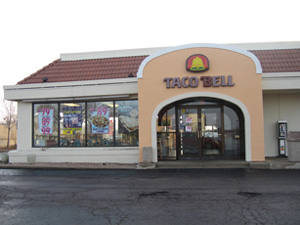
When I teach my college Spanish classes, students are amazed by the photograph of the Mexican dinner table in the Spanish textbook. They are shocked! “Where is the basket of tortilla chips?” they ask. Well, mis amigos, you will only see a basket of tortilla chips in a Mexican restaurant in the U.S. The last time I went to Mexico to visit mi familia, no one ate tortilla chips, Tostitos, Fritos, or Doritos! When mi familia visits me from Mexico, I never say, “You must be hungry for some real Mexican food. Let’s go to Taco Bell!” Because Taco Bell does not really sell Mexican food. However, Taco Bell has opened restaurants in Mexico and is planning on expanding there. I just wonder if they claim to sell authentic Mexican food in Mexico?






 Chicago USA