El Gallo de Oro


El Gallo de Oro, 2952 W. 63rd Street, Chicago, Illinois

When I lived at 3006 W. 64th Street, I always used to eat at this great Mexican restaurant that was exactly one block away. El Gallo de Oro, 2952 W. 63rd Street, 773.737.8101, has been there since at least 1981 when I moved back to Marquette Park after being honorably discharged from the Marines.

This Mexican restaurant serves real Mexican food cooked by real Mexicans to other Mexicans who patronize the restaurant. That’s how you can tell if a Mexican restaurant is really good: by how many Mexicans eat there. I remember once going to Milwaukee and my girlfriend suggested that we eat at a Mexican restaurant, either La Perla or La Fuente, but she didn’t know which one was better. We ate at the one where all the Mexicans ate! And it was great Mexican food! So, are you wondering which restaurant was better? Well, I honestly can’t remember because I drank a few too many bottles of Negra Modelo. Anyway, El Gallo de Oro has great Mexican food, and I say this after having come back from having eaten Mexican food in many Mexican restaurants and Mexican homes in Mexico. Well, lately, I’ve been going to different Mexican restaurants in the Chicagoland area, or Chicagolandia as I like to call it since we have so many Spanish speakers here, and I’ve been ordering the enchiladas de pollo. Today, I tasted the enchiladas at El Gallo de Oro, and they were ¡sabrosísimas! This is a great Mexican restaurant.

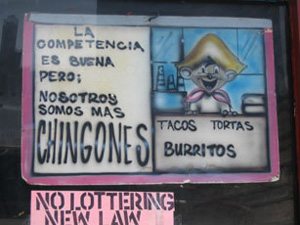
When I still lived in the neighborhood, I ate there several times a week. Of course, everything I needed in the neighborhood was within a two-block radius. The cleaners, the gas station, the locksmith, the used bookstore, my barber Aldo of Italy, and of course, El Gallo de Oro. I went to the locksmith exactly once, but it was nice to know that he was always available even though I dreaded the day that I would actually need him. Aldo of Italy cut my hair once a month before I ate at El Gallo de Oro. Aldo always loved speaking to me in Spanish while he cut my hair until I fell asleep. Anyway, again, I loved the attitude of the Mexican cooks at El Gallo de Oro. They were typical Mexicans who loved to brag about their food and service. I especially loved their sign in the window: “La competencia es buena, pero nosotros somos … ¡más chingones!” In English, “The competition is good, but we are … ” Okay, I’m not sure how to translate the last two words, but you could tell who was Mexican and who wasn’t by how they reacted to the sign. Of course, at that time the FCC let a lot of profanity get aired on all the Mexican radio stations. So the sign remained in the front window for many years until about two years ago. I rather miss that sign. That’s the thing about Mexicans. They have chutzpah!

One time, I told my father, brothers, and sister that I had a special surprise for them for our Thanksgiving dinner that year. They were so curious that I caved in to all their questions and told them my surprise beforehand. “We are eating Thanksgiving dinner at … ” and I paused for dramatic effect … “El Gallo de Oro!” “But we want turkey,” my sister shouted. “Yo quiero guajolote,” said my father. “Un momento,” I said. “El Gallo de Oro is serving turkey burritos on Thanksgiving Day!” After a little grumbling, they finally agreed to my Thanksgiving dinner plans! Everyone got to eat turkey, I got to eat at El Gallo de Oro, and my father got to eat so many jalapeño peppers that sweat poured from his forehead profusely and he had to keep asking for more and more water. Well, El Gallo de Oro managed to satisfy yet another finicky Mexican family–again!
DDR

Cordi Marian


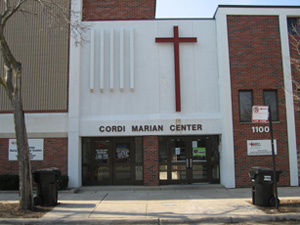
My oldest son went to daycare at Cordi Marian, 1100 S. May Street in Little Italy for three years. They accepted all children provided they were potty trained. My son was hardly qualified, but they accepted him anyway. These three years were quite a learning experience for me because of series of unbelievable coincidences, the kind you couldn’t include in a novel or a movie. First of all, I learned that my aunt Concha also sent her son Peter there for daycare. Peter and David didn’t really know they were related because they had never met before. One day, I recognized my aunt Concha as she was leaving Cordi Marian with her son. Our sons soon became good friends and since Peter was a year older he kind of looked over my son to make sure he was fine.

Another surprise was that the nuns who taught at the school knew our family. In fact, the nuns were all from Mexico. So were all the lay teachers and teacher aids. All the parents liked the fact that the children were learning Spanish. Since most of the teachers spoke very little English, most of the children were speaking Spanish. One day, Sister Teresa, the principal, asked me how my father was. She knew my father by name. We talked a while and then she told me how she knew not only my father but also his brothers and sisters and their parents, my grandparents. Since my grandfather was a carpenter, he did some carpentry with his sons at Cordi Marian. Sister Teresa showed me some of the shelves and bookcases that they had made for the school. And three generations later, my son is using these cubby-hole shelves to store his backpack and blanket.

One day my father told me to me that his sister, Sor Ancilla, had come from her convent in Texas where she is Mother Superior. I go to Pilsen to pick up my father and I ask where we have to go to pick up my aunt. He asks me if I know how to get to 1100 S. May Street. Of course, I do! That’s were I take my son to daycare, I tell him. Well, I get there and sure enough, my aunt Sor Ancilla is staying at Cordi Marian for the weekend. What a coincidence! Or rather, what a series of coincidences that no one would believe if I wrote them into a novel.

DDR

Bonus years


Queen of Heaven Cemetery.

When I was little, I wasn’t sure how long I would live. I was a healthy boy, so I’m not sure why I always wondered about my longevity. Of course, being a Catholic, I was always reminded not to commit any mortal sins because if I died suddenly and unexpectedly, I would immediately go to hell.

And now that I think about it, I could die at any moment. I could some day walk out onto Halsted Street and get hit by a bus. I only say this because I was once almost hit by a bus on Halsted Street. In fact, it was just the other day. I was thinking about many things other than paying attention to crossing the street. I’m still not sure why I didn’t see the bus.

When my uncle Joseph “Pepe” Rodriguez died in Viet Nam, I was sure that I would never live to see twenty-one. I was sure I, too, would be drafted and die in Viet Nam. So I always considered all the years beyond twenty-one bonus years.

My mother died when she was fifty-one, and now that I’m fifty-one, eight months old, I have lived longer than her. I have always been an optimist and I realize I’m lucky to have lived to be this old. I actually like having gray hair, particularly because I have a full head of hair. I can still run six miles everyday, when I have time. I’m not rich, but I’m not starving either. Since I didn’t get drafted to go to Viet Nam, I’ve had all these bonus years that I haven’t always used very wisely. However, I realize that I’m lucky to be alive! The way I see it now, all the years that I live beyond fifty-one will be bonus “bonus years.”

There was a time when I wanted to live to be a hundred, mainly because 100 is a nice big round number. Now, I’d rather continue living the happy life that I now have without thinking about how much time I have left. I am ever the optimist!

DDR

Mexicanismos


El Paseo de la Reforma, México D.F.

Mexicanismos are words or phrases in Spanish that are unique to México, but may not be familiar to other Spanish speakers, also known as Hispanophones. French speakers are Francophones and English speakers are Anglo-Saxophones.

Anyway, in Mexico, people use words and phrases that are unique to that region and are commonly misunderstood by other Hispanophones. At UIC (University of Illinois at Chicago), we have graduate students who come from all over the Spanish-speaking world, most of whom specialize in linguistics. They can spot the dialect and region of most Spanish speakers almost immediately. Some have trouble identifying me because I have my American accent and I use words and phrases from almost every dialect that I’ve ever heard. I’m like a sponge in this regard. Sometimes, someone will throw their hands up in the air and just ask me where I’m from. They’re often surprised to hear that my parents were from México. My cousin’s husband thought I spoke with an Argentine accent. Once, a friend and I were speaking, and then I didn’t hear something she said. So, I said, “¿Mande?” and she said, “¡Ajá! You’re from Mexico!” That simple little mande gave me away as a Mexican.

Once, at the end of the semester, a professor from Argentina told us that she would bring us a torta for the last day of class. To most Mexicans and me, a torta is a type of sandwich that is served on a bun with meat and other condiments. I didn’t eat before class because I wanted to be polite and eat everything that was offered to me. Well, she came to class with a torta, but it was a cake, as in a pastry for dessert. I left the classroom hungry that day.

Another time, I brought some Thanksgiving leftovers to UIC for lunch. A graduate student from the Basque Country in Spain asked me what I was eating. I told her guajolote and camotes. She didn’t know what I was talking about. For her turkey was pavo not guajolote and yams or sweet potatoes were patatas not camotes because they didn’t differentiate between the various kinds of potatoes in Spain.

I have a friend who grew up in Seville, Spain, and we once had a minor misunderstanding. He told me that his car had broken down: “Se me estropeó el coche.” Being the nice guy that I am, I wanted to be helpful, so I offered him a ride: “¿Quieres un aventón?” I could tell by the tone of his voice that he was a little upset when he replied, “¿Y yo qué te hice?” You see, to a Mexican, un aventón is a ride, but to just about any other Spanish speaker un aventón implies some kind of physical violence. I explained to him that I only wanted to help him by giving him a ride to wherever he wanted to go, and I am happy to say that we are still friends to this day.

Another graduate student from Spain taught a class that had many Mexican American students. She frequently used the word coger, meaning “to get” or “to pick up” when she spoke not realizing that to Mexicans coger is a profanity that refers to the act of sexual intercourse that begins with the letter “f.” So, one day, she talked about picking up her dog: “Cogí mi perro.” She was surprised when the class began to laugh until someone explained to her what she had said.

While I was in México, I learned a few more mexicanismos. My cousin used the diminutive “-is” instead of “-ito, -ita.” For example, she went to see her “amiguis” instead of her “amiguitas.” Before we went to visit my cousin David Rodríguez in Celaya, everyone refered to him as Davis.

In the U.S. we have Spanglish, which is the mixture of English and Spanish, but I only thought it existed north of the Rio Grande (In Mexico, they call it El Río Bravo). For example, you take an English word like “to check” and make it Spanish: chequear, instead of comprobar or some other Spanish word that already exists. Anyway, they have a similar word in Mexico: checar. Several street venders approached me and called me jefe, showed some product they were selling, and said, “Checa esto.” Or “Check this out,” in English. So, this word is a little different than the Spanglish word chequear because it’s a mexicanismo. Or maybe it should be called inglañolismo.

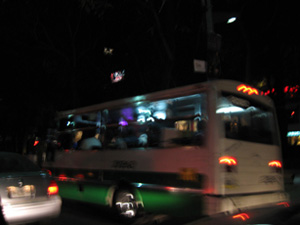
I always thought of an aquarium as un acuario, but to my cousin in Celaya it was el pecero. I had never heard the word before, but I knew exactly what he meant. Then when I was in Mexico City, when people talked about taking the bus they still called it el camión, but now a lot of people also called it el pecero. That made perfect sense because if you look at the buses with their large windows, they do look like aquariums with people swimming inside instead of fish.

If you park your car in México City, you’re likely to meet el viene viene. He is a self-appointed parker of cars and is often found on public streets and grocery store parking lots. He doesn’t officially work for anyone. He’s just there–and everywhere else. You can’t miss him. He pops up out of nowhere waving his salmon-colored mechanic’s rag as you park your car. As you back up, he tells you how far you can back up by saying “Viene, viene.” When you get out of your car, he’s standing next to you with hand, and you’re supposed to give him a tip of two pesos or so.

Then, there’s also the aguinaldo that is a bonus that most employees receive before Christmas and before el Día de los Reyes to buy holiday gifts or pay off debts. At Christmas, children received candy bags. They were told, “Come get your aguinaldo!”

DDR

Abuelito materno


Mi abuelito

My maternal grandfather, José Guillermo Martínez, is another family mystery. My mother told me several stories about him, but I’m not sure if any of them were true. Although they may be based on truth, my mother embellished them beyond recognition. My cousin and I compared stories when I was in Mexico and all the stories seem to be plausible to a certain extent.

My mother absolutely loved her father, and many things often reminded her of him. She would tell me about him on these occasions. I really believed all these stories for most of my life.

When I began playing chess religiously in high school, she told me that I reminded her of her father because he always loved to play chess. People would always go to visit him so they could play him at chess. One day, my mother asked me what the highest chess ranking was. I told her chess grandmaster. She then said, “That’s what my father was! A grandmaster!” I was truly proud of this fact! No wonder I suddenly developed this interest in chess. It was in my genes.

I started bragging about this little interesting tidbit about my grandfather to my chess friends. My friend Jim asked me what my grandfather’s name was, so I told him. A few days later, he gently broke the news to me. My grandfather was never a chess grandmaster, or even a master. Jim had looked up the names of all chess masters and grandmasters who had ever lived. If my grandfather were really a chess grandmaster, his name would have appeared on one of those lists. I was so embarrassed. I told my mother about this little discrepancy in her story, and she brushed it off as if it were nothing. I told this story to my cousin in Mexico, and she had heard that our grandfather did like to play chess but didn’t know much else about his chess career.

My mother also told me that her father’s father had come to Mexico from Ireland during a potato famine. His surname was either McLean or McLin, but she really wasn’t sure. Well, he met a Mexican girl, and when she got pregnant, they killed him. That’s what my mother told me when I was a boy.

My cousin had never even heard this story. She had heard that he was possibly Jewish and possibly from Germany. He had studied electrical engineering and had many books on the subject in German. He also knew various languages. My cousin’s mother told her that they called my mother and her sisters, las judías, again suggesting that my grandfather was possibly Jewish.

When my grandfather was on his deathbed, my mother flew to México from Perth Amboy, New Jersey, to be with him. I went, too, but I was still a baby in my mother’s arms. My mother was so concerned about his spiritual well-being in the afterlife that she told her father that she would get him a priest to administer him his last rites. My grandfather indicated that he didn’t need a priest and said, “If he comes, I’ll talk to him. But I won’t confess.” My mother never told me that story.

DDR