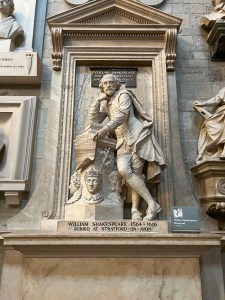
Westminster Abbey


William Shakepseare, Westminster Abbey, London, England

As you may have gathered from reading my blog, I am a voracious reader. I’m mainly enjoy reading fiction, but I will read almost anything. I even read candy wrappers I see on th ground.

I especially love to read novels. The novel to which I can most relate, although it is not my favorite, but I have read it four times, is Jude the Obscure, by Thomas Hardy. Jude, the title character, tries to compensate for his lack of a forma education by immersing himsef in books that will provide him with a good education. For the longest time, I lacked a formal education, so I read all the books that would constitute a sound educational background. I also read the complete works of William Shakespear on my own. Eventually, I went back to school and majored in English.

As an English major, I discovered that I had already ready many of the required readings on my own. However, I did add more authors to my reading list of books read. I enjoyed reading the biographies of the authors I read. I soon discovered that many of them had something in common: They were all either buried or memorialized in Westmister Abbey. Back then, I thought I would enjoy going to Westminster Abbey to make a connection with those writers, but I never thought that would be possible.

Well, I have reached that point in my life where I was able to go to Westminster Abbey. I have never done much international travel, other than to Mexico to visit my family. My wife and daughter wanted to go to Rome last December. I was reluctant to go to Rome, mainly because of our language barrier. I suggested that we go to London, mainly because I was an English major and I speak English. My wife and daughter agreed.

My wife’s friend told she should prepare for the trip to England by watching the TV series The Crown. I realized then that I was doing it all wrong! I was watching Mr. Bean and Benny Hill!

So there we were in London, England, the birthplace of the English language. The streets were filled with lots of tourists, very few of whom were speaking English. But I have finally arrived at Westminster Abbey! I was enthralled, motivated, and inspired by being in the presence of so many great minds! I saw the names of many of the writers I had read. I had read most of them! Except for William Longfellow, Henry James, and T.S. Eliot, they were all English.

I took pictures of almost all the writers. Here’s a list of the writer’s whose name I saw at Westminster Abbey and that I had read at least once, in no particular order:

  • Geoffrey Chaucer
  • John Dryden
  • William Shakespeare
  • Thomas Stearns Eliot
  • Alfred Lord Tennyson
  • Robert Browning
  • Henry James
  • Robert Browning
  • Wystan Hugh Auden
  • George Elit (Mary Ann Evans)
  • Lewis Carrol
  • Oscar Wilde
  • Ted Hughes
  • D.H. Lawrence
  • Edward Lear
  • Wilfred Owen
  • Ben Johnson
  • Edmond Spencer
  • Jane Austen
  • Charlotte Bronte
  • Emily Jane Bronte
  • Anne Bronte
  • Samuel Johnson
  • Rudyard Kipling
  • Thomas Hardy
  • Charles Dickens
  • C.S. Lewis
  • William Blake
DDR

Bilingual idiot


I bought this dictionary in 1979 at the PX in 29 Palms, California.

As a boy, I set the ambitious goal of learning ten foreign languages. I’m not sure how I came up with the number ten, but once I picked ten, I stuck to it. And I’m still sticking to it even if it’s an unrealistic goal. As of today, I am still many languages away from achieving fluency in ten. But I like ten because it’s a nice round number.

I have had several setbacks along the way. For example, people would tell me, “Learn to speak English first!” (Have you ever noticed that people who insist that foreigners learn English only speak English? I’d like to see them learn another language!) Of course, they were right because my first language was Spanish. I spoke English very poorly at first and later with a foreign accent.

In my quest for foreign language fluency, I have studied many languages over the years. At Divine Heart Seminary, I took French as an elective my sophomore year in addition to Spanish with Señor Mordini. When I went to Tilden Technical High School, I continued my French studies with disastrous results, about which I wrote a blog post. At Gage Park High School, I gave up on foreign languages altogether.

In the Marines, I tried learning Japanese from a roommate who was stationed in Okinawa, Japan. I learned only as much Japanese as he knew, which wasn’t very much. But I can still say, “Domo arigato” and “Sayonara“! During this time, I spent a lot of time reading. I many read books on English grammar. I would check out books on grammar and writing from the library and read them cover to cover. My Marine roommates thought I was crazy, but that helped because then they avoided started trouble with me. I also bought a Spanish/English dictionary, and I would browse through it to improve my Spanish vocabulary. I got this great idea from reading the biography of O. Henry who read a dictionary that he received as a gift for the first book he had ever read. Amazingly, I also improved my English vocabulary.

When I finally went to college, I studied Spanish in earnest for the very first time. The grammar I had learned from the English grammar books helped me immensely with the Spanish grammar that we studied in class. I also took Portuguese and did well in class, but I never did learn to speak Portuguese fluently because of a lack of time and contact with Portuguese speakers. I took Latin because I thought it would be fun and might prove helpful for the foreign language requirement if I went on for my Ph.D. Well, I didn’t learn to speak Latin either. Not that anyone speaks Latin anymore, but I did learn the difference between the relative pronouns who and whom.

So, I thought I would take a practical language that someone actually speaks worldwide.  I studied Russian for four semesters. There were very few cognates! It was only then that I realized that I had only studied Romance languages, other than English, and learning new vocabulary was easy because of all the cognates derived from Latin. Sadly, I did well in Russian class, but I can’t speak Russian either.

The next language I studied–actually, I’m still studying it–is Polish. There aren’t very many Latin cognates, but since I studied Russian, some of the grammar rules are similar. Polish pronunciation is much easier than Russian. The most amazing part about learning Polish is that the accent always, with very few rare exceptions, falls on the second to the last syllable (la sílaba penúltima, en español). After studying Russian, I feel more confident studying Polish. Perhaps I will learn another language after all!

But I’m not so sure I will. Even though I have attempted learning other languages and failed, I console myself that I’m fully fluent in Spanish and English. Perhaps I am destined to forever remain a bilingual idiot.

DDR

Rebeca


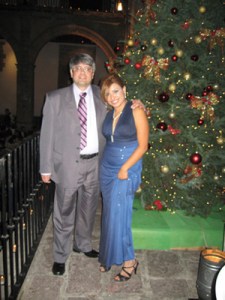
Con mi prima Bequi en su fiesta de graduación, México DF.

One of the highlights of my trip to Mexico was going to my cousin Becky’s college graduation party! Becky invited me last summer when I visited with my sons, so I planned to go to México for it. She graduated as an engineer in December and from now on she will be addressed by her official title of ingeniera. As part of her curriculum, she had to learn English because it’s an international business language. So when she couldn’t take courses she needed in Spanish because they were closed, she would take them in English. We went to see The Day the Earth Stood Still, El día que se detuvo la Tierra in Spanish, and Becky insisted that we see it in English with Spanish subtitles. In many Mexican theaters you have the option of watching movies dubbed in Spanish or in the original English language with Spanish subtitles. Unlike when I was boy, the movies come out at the same time in Mexico as in the U.S.

This was such a cool graduation party! We went to the Ex-Convento de San Hipólito near the Zócalo in downtown México City. There is a courtyard in the middle of the building, but they put up a temporary roof in case it rained. We arrived at 9:30 pm, even though the party officially started at 9:00, and many graduates and their guests were still arriving. Becky had a table for ten reserved for her. Her parents, my cousin Mara and her husband Enrique, Becky, six of Becky’s friends, and me sat at that table. There was a DJ playing music until the evening program began.A few students gave speeches and each table cheered on their graduate. Click on the link below to hear Becky’s.

And, of course, there were Mariachis. Everyone who wanted to drink brought their own liquor. The waiters for our table would then mix our drinks. We had tequila, so the waiter made me a Paloma, tequila with Squirt (Esquirt in México). This custom was something foreign to me. For some strange reason, one of the waiters kept speaking to me in English. The waiters served us our dinner, but I can’t even remember what we ate! After dinner, there was dancing. Everyone danced except me. That is until Mara asked me to dance. My cousin-in-law Enrique commented that I danced like an American because I didn’t raise my hands above my head.

Each graduate was seated at a table for ten, for family and guests. Throughout the night, tables would cheer on their graduate. They would erupt into cheer unexpectedly. Click the link below to hear our table cheering Rebeca proudly.

Rebeca’s Graduation Party

The party roared all night long. About 6:30 am, the waiters started asking us if we wanted coffee and chilaquiles, fried tortillas with eggs. That was the one thing I loved about the party. We didn’t have to forage for food after the party as we usually do in Chicago. As the evening progressed, the waiters became friendlier with us and talked with us when they weren’t busy. The one who spoke English to me was especially friendly. I told him I could tell he had lived in the U.S. At first he denied it, but then admitted to living and working in Las Vegas for about eight years. But he came back to Mexico because he missed his family. I asked him why he spoke to me in English. He told me that he thought I was Canadian! Go figure!

Well, the party was a lot of fun! When we got home, we immediately went to bed because when we woke up, we were driving to Ixtapa Zihuatanejo!

DDR

¿Mande?


I just received a very disturbing phone call. Well, maybe not all that disturbing, but it made me think. A Mexican female–I could tell by her accent when she spoke Spanish–called and asked for Señor Rodríguez? Señor David Rodríguez?

At first, I thought it was one of the Spanish TAs asking about a solution to a problem while teaching at UIC. But I didn’t know this woman at all. Our entire conversation was in Spanish. The more I spoke as I answered her questions in Spanish, the more engaged she became in our conversation.

Then, she asked me if I spoke English. If I was bilingual. I answered yes and yes. In fact, I told her, I was very fluent in English. She sounded very disappointed. I guess I spoke Spanish well enough for her to think that I didn’t speak English. Apparently she was trying to gather students for an ESL class.

I think I hurt her feelings because I spoke English–but not to her. This comes as quite a surprise to me because for my entire life almost everyone I ever met insisted that I speak English. And today I finally met someone who was disappointed that I already spoke English.

DDR

Passport issues


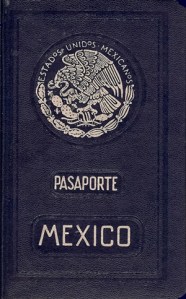
My Mexican Passport

Well, since I always talk about my name, let me get back to the name of David Rodríguez. Well, actually, David Diego Rodríguez. I bring it up again because I plan on going to Mexico in July with my sons. And every American citizen needs a U.S. Passport to return to the U.S.

So, I had to apply for passports for all three of my sons who are natural citizens by virtue of having been born in Chicago, Illinois. Two of the three passports were immediately processed by U.S. Department of State.

The one for my son with my name caused a delay. They needed more documentation for him. There are just too many David Rodríguezes. He’s only eighteen, so he doesn’t have a credit history, a driver license, or a credit card. They needed more proof to verify his identity. I wasn’t sure what they wanted or what other documentation I could provide. One of the enclosures listed in the letter was a Supplemental Identification List, which they had forgotten to enclose. I sent everything I could think of, including photocopies of his state ID, his school ID, his W-2 forms, federal tax return, state tax return, a prescription label with his name and address. I was extremely relieved when they accepted the enclosed documentation. I finally received his passport yesterday. We’re all set to go to Mexico now.

I remember when I went to Mexico in 1978, things were so much different. I had forgotten how to speak Spanish. I still understood it, but I never had to speak it much in Chicago. I stayed in Mexico for about a month and so I quickly learned to speak Spanish again.

However, when I returned to Chicago, I had trouble speaking English again. I flew back on Mexicana Airlines and when I was in Customs at O’Hare Airport the agent asked me for my proof of citizenship. All I had was my driver’s license and birth certificate. I gave them to him and then I worried that they wouldn’t let me go back to Chicago.

You see, my driver’s license didn’t have a picture of me. Back then, they were printed on thin cardboard and only described the driver as 5’8″, 128 Lbs., BRN Hair, BRN Eyes. My birth certificate didn’t have much information on it either and my last name was misspelled as, “Rodriquez” with a “q” instead of “g.” (My mother never thought the mistake was important enough to correct when she received my birth certificate in the mail soon after I was born.) The agent looked at my documents carefully and asked me if I had anything to declare. I understood him perfectly, but I couldn’t form the words in English. I thought for sure that the authorities would detain me because I couldn’t make myself speak my fluent south side English. But miraculously, he let me through. I could then understand how there were so many illegal immigrants from many countries in the U.S.

When I went to Mexico last December, it was a little more difficult to enter Mexico. I handed my passport to the agent, and he entered the information on a computer. He asked me some questions and when I answered them satisfactorily, he let me back into the U.S. Then about sixty miles into the U.S. there was another checkpoint where I had to present my passport again and answer some more questions. They asked me the questions to see if I really spoke English to prove I was a U.S. citizen. The agent spoke quickly and slurred his words together as if to test my knowledge of English. Either that or he was just bored of his job and just going through the motions. He asked me where I was from. When I said Chicago, he asked, “Born and raised there?” “No. I was born in Perth Amboy, New Jersey.” I suppose that if someone didn’t speak English well, they wouldn’t have been able to answer those questions, raising suspicions. I was glad that I didn’t have trouble speaking English this time.

DDR