On the road


CD Book from the Chicago Public Library.

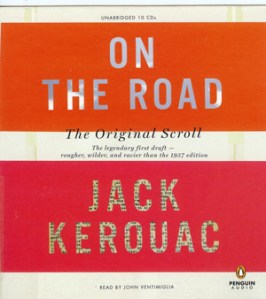
For someone who spends so much time on the Internet, I also spend a lot of time on the road. Since I’m on the road a lot, I feel like I’m wasting time if I’m not on the Internet. True, I occasionally check my e-mail on my iPhone while I’m driving, and I do study road maps while on the Internet. The best of both worlds! Years ago, I tried listening to books while driving. That was back when most of them were on cassettes. I quickly gave up because it involved too much work changing cassettes. So lately, I once again felt the need to occupy myself productively while driving. While studying Russian, I listened to the oral activities on an mp3 player via my car radio. But it just wasn’t the same as reading. I remembered the audio books. Most books are on CDs now and are much easier to manage while driving. The first one I heard was On the Road by Jack Kerouac. Because I imagined writing a blog entry, titled “On the road”! I also listened to Heart of Darkness by Joseph Conrad, but decided against writing a blog entry titled, “On the River Niger”! How would that be possible while driving my 2005 Pontiac Vibe?

I went to the library to check out their collection of audio books. I immediately gravitated toward Jack Kerouac because On the Road has been on my “To Read” list since the 1980s. I have always heard about that book and any book that constantly attracts my attention deserves to be read–at least in my book. I had no idea what it was about, but I knew I just had to read it. I was intrigued by the fact that it was written on one continuous sheet of paper. I tried to imagine how Kerouac could have written his book lugging his manual typewriter and roll of paper while driving all over the country. To think that I complain whenever I must lug my laptop computer around with me! Anyway, the book was an interesting read because I was disappointed by its plot but enticed enough by the writing style to continue listening to the end. The reader of the audio book made it remarkably interesting in the way he acted out some of the scenes. He added so much to the text. If I were reading the actual book, I would have finished reading it because it captivated me in a way I had not expected.

Kerouac has this enormous vocabulary that occasionally upstaged the action of the novel. For instance–however, I don’t recall all the details nor the exact wording–in one scene Kerouac and his friends find themselves released from jail after a night of heavy drinking, carousing, and fist-fighting. They have no money, and they don’t know where their car is. Jack says, “whereupon we pondered our dilemma.” Somehow, the high diction added to the incongruity of their situation. Of course, I would never associate with such friends for very long, which is why I never wrote my own On the Road.

When I was in high school, I inherited a manual Underwood typewriter that was in the attic where my new bedroom was located. Since I was little, I wanted to be a writer, so this was my perfect opportunity. I spent a lot of time in my unfinished attic bedroom typing away on that typewriter. I also found a roll of paper and inserted it into my typewriter. This was before I even heard of Jack Kerouac! Now I wouldn’t have to stop writing to insert a new sheet of paper! I can’t say what I wrote was remarkably interesting since I spent most of my waking hours cooped up in that attic. I don’t know what ever happened to my manuscript(s) (Depending on how you count everything I wrote on the scroll), or if anything I wrote was any good. But I enjoyed my time as a writer, living in squalor in an unfinished attic, living the Bohemian lifestyle. Minus the Kerouac road trip and alcohol.

DDR

Bob Bloom Roofing


The south side of Chicago

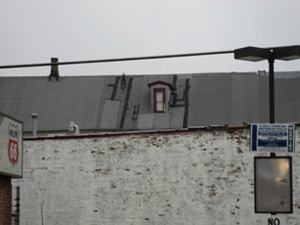
So, I was at the gas station at 55th and Ashland this morning filling up my tank. The first thing I thought of was how this used to be my neighborhood on the outer boundary of Back of the Yards. I used to wait on this corner for the bus whenever we went to the Museum of Science and Industry. Sometimes we would eat at the Burger King on the corner there. I used to deliver newspapers in that neighborhood. Then, the neighborhood changed, and it became the “bad side of town,” but when I hear that, I have to laugh because it was also called the “bad side of town” when I lived there in the 1960s. So, I’m getting gas there this morning and I’m getting dirty looks from people who think I shouldn’t be on their turf. I just smile at them, knowing they don’t know that I feel comfortable right there on their turf because it’s still my turf.

The second thing I thought of was Bob Bloom Roofing. You see, I was pumping gas when I looked up at the roof in front of me, when I wasn’t watching my back. I saw the black tar that repaired a once leaky roof. When I owned my house at 1018 W. 32nd Place, my roof started leaking. At first, I was in denial because I couldn’t afford to get a new roof. I talked to my brother Jerry the fireman because it is a well-known fact that all firemen have a side job because of their work schedule that gives them forty-eight hours off after working twenty-four. In fact, my brother is also painter on the side who will paint apartments, houses, and just about anything else on his days off. In college, he majored in art. So, he’s overqualified to paint your house just in case you’re interested.

Anyway, I told my brother about my leaky roof. Yes, it continued leaking despite my denial. Jerry recommended Bob Bloom Roofing, a fireman who worked with him. Off-duty firemen seem to gravitate toward jobs that involve ladders. Jerry gave me his phone number and Jerry promised to talk to him before I called him. This is how Chicagoans take care of each other. They recommend a contractor who is trustworthy and then they’ll call him up and tell him to take care of his brother, or whomever.

I never actually met Bob Bloom Roofing until years later. To this day, I still think of him as Bob Bloom Roofing because whenever we spoke on the phone, he always, but I mean always, called himself Bob Bloom Roofing. He was always advertising his company. And that’s why I still remember him, I mean his business, all these years later. Anyway, I called him up and explained my roof leak to him. We couldn’t find a mutually convenient time to meet in person at my house because I was busy every day and evening for the next two weeks, but I really needed the leak fixed. Bob Bloom Roofing suggested that he could go check out my roof on the way home from the firehouse. He left me a message saying that it would be an easy repair and he would only charge me about $150. I agreed and within three days my roof was repaired. I mailed the check to Bob Bloom Roofing’s home, and we were both happy with our business transaction.

A couple of years later, another section of my roof leaked, and we went through the same process to repair my roof. I never actually met Bob Bloom Roofing until one day my brother had a party at his house and he invited a lot of his firemen friends. As I wandered through the party, I would introduce myself to the firemen, who are not exactly known for being polite guests. Eventually, I introduced myself to one fireman who responded, “Hi, Bob Bloom Roofing!”

DDR

¡Buen provecho!


Back of the Yards, Chicago, Illinois

What I love about going to Mexico is all the attention I receive from my relatives who are genuinely happy to see me. They ask me many questions about my life, in particular, and life, in general, in America. The only problem with this is that they tend to ask me these questions while I’m eating. So I am always the last one done eating.

I’m a slow eater anyway, but answering questions slows me down even more. And they ask rather personal questions, too. But everyone is so honest when speaking that I feel compelled to answer their questions honestly. And no one judges anyone about each other’s behavior. At least not that I noticed.

So, how did I enjoy a good home-cooked Mexican meal with everyone insisting that I answer their questions? Well, I didn’t want to be rude, so I answered every question immediately. Of course, sometimes I answered with my mouth full of food because I was caught off guard by the timing of the questions. I guess I was being rude by talking with my mouth full just because I didn’t want to be rude!

DDR

The streets of Mexico City


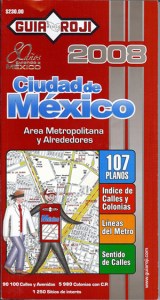
My passport to Ciudad de México

Driving on the streets of México City requires excellent driving skills, a good memory to remember all the major street names, great intestinal fortitude, and at least a couple of loose screws in the brain housing group. Because, who, in their right mind, would want to drive someplace where the drivers view the rules of the road as mere suggestions to be ignored whenever possible? I mean, besides me. Red lights mean stop if you think you’ll get into accident. Otherwise, don’t stop too long or the drivers behind you will start beeping at you to make you drive through the red light. Amazingly, you don’t see very many traffic accidents in Mexico City considering the congestion.

I felt embarrassed that I needed a map to get around México City. Until I found out that anyone who drives all over the city also has a map, like the one above by Roji. It’s a geographically large city, so there are way too many streets to memorize all their names. In fact, many Mexicans know the routes to various places such as their workplace and the homes of family members. But ask them to give you directions to a place they travel to daily, and they’ll be hard pressed to be able to give you accurate directions. Mainly because the don’t know the street names of all the streets on which they drive. My cousin drove me from her house to our aunt’s house. As we were driving, I took out my little notebook with everyone’s address. I asked my cousin the name of the street on which she was driving. She didn’t know its name. Or the names of half the streets we took.

When I drove to the house of another cousin, I followed the directions I was given. They were easy enough to follow. When I arrived at my cousin’s house, I got there way too early and I didn’t feel like waiting around for a few hours for her to get back. So I looked at my Roji and tried to drive to my aunt’s house following a new route that I plotted out, against the advice of my cousin. How hard could it be? Besides, I have been lost in Mexico City many times before. I started to miss driving on my own and getting lost on my own and then trying to find my way to my destination. The other thing about driving in Mexico City is that the street signs are so small, posted on the sides of buildings, making them difficult to locate so that they are rarely helpful. And sometimes when you do find them, they’re covered with graffiti and therefore unreadable.

Anyway, I’m driving to my aunt’s house, but the main street that I wanted to take is a one-way street in the opposite direction of my destination. So I figure I’ll take a parallel side street. However, the streets do not follow a regular grid system because Mexico is such an old city. So all side streets radiate out from the main strip of any given colonia, or neighborhood. Well, if I wanted to drive in a more or less parallel course to the main street, I had to zigzag my way from a couple of blocks away. It was easy to lose my sense of direction because very few streets ran in straight lines. Luckily, I thought to use the GPS feature of my iPhone and I could tell I was more or less on course.

Well, this was quite an adventure! And even though I swear I’ll never drive the streets of México City again (mainly when I’m completely lost while driving), I now miss that roller coaster ride of emotions ranging from fear to sheer terror while driving. I can’t wait to drive back to México City!

DDR

Topelandia


Ixtapa-Zihuatanejo

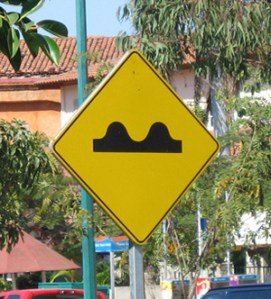
When driving in Mexico, you will encounter el tope. It’s a speed bump that is very unique to Mexico. They come in all shapes and sizes. They actually resemble a speed hump, but they’re actually taller and wider so it takes longer to drive over them. My cousin Mara’s neighborhood has so many topes, that she calls it Topelandia. In America, we also have speed bumps or speed humps. Usually their existence is often linked to petitions. About half of all Americans will petition to have speed humps placed in their residential neighborhoods in order to slow down traffic and make the streets safer for their children. After the construction of said speed bumps, the other half of the residents will petition to have those speed humps removed in order to speed up traffic. Besides, parents should be watching their children so they don’t play in the streets! You either love them or you hate them. I mean the speed humps, not the children.

Most of the time the topes are clearly visible and you must slow down before approaching them to avoid totaling your car. Occasionally, you don’t see one because it hasn’t been painted and you are driving too fast. Your car bottoms out and all your passengers hit their heads on the car roof. It happens to the best of Mexican drivers every so often. It even happened to me. Everyone complains about the topes, but they’re there here to stay. You just have to accept them. Driving over topes would makes for great astronaut training. The only place they don’t have them is on the toll roads that lead to America, otherwise no one would pay to use these toll roads that closely resemble American highways. Without those topes, Mexican drivers would drive even more recklessly, if you can even imagine that! I absolutely hated driving over them. The topes, not the Mexican drivers. But I did have a few close calls. With Mexican drivers.

When I was younger, I never slowed down when driving over speed bumps or speed humps. In fact, if I drove over them at regular speed, the speed bumps felt less bumpy the faster you drove over them. And they never damaged any of my cars, all of which I drove until they were totaled in accidents, none of which were my fault–I swear. I remember always driving full-speed ahead over the fourteen railroad tracks at 55th Street and St. Louis Avenue on Chicago’s south side and feeling less jolts than when I drove over the tracks slowly. I don’t know who said you should slow down over tracks, speed bumps, or speed humps. You should go over them as fast as possible to feel less bumps. That’s why cars have shock absorbers! I now have a car, a 2005 Pontiac Vibe, with a wheelbase so short that I can ride over speed humps or topes without actually having to slow down! It’s actually kind of thrilling! You go up and down rather quickly, much like an amusement park ride!

DDR