Chicano


The story of Chicago, Illinois

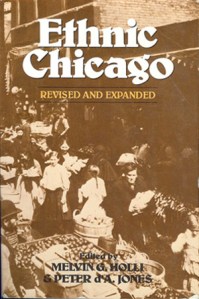
When I was growing up I never heard the word “Chicano.” No one in my family used it and I never heard it in the neighborhood even though there was a sizable Mexican population in the Back of the Yards neighborhood. I’m reminded of this because I was just reading Ethnic Chicago edited by Melvin G. Holli and Peter d’A. Jones, Grand Rapids, Michigan, William B. Eerdmans Publishing, 1984.

What reminded me of never having heard the word “Chicano” was Chapter VIII written by Louise Año Nuevo Kerr titled, “Mexican Chicago: Chicano Assimilation Aborted.” She uses “Chicano” throughout the chapter to refer to Mexicans who came from Mexico illegally, who were part of the bracero U.S.-Mexican agreement during WWII, were from Texas and therefore were American citizens, or had ancestors from Mexico.

So I’m thinking back to the very first time when I heard “Chicano” and I remember I first heard it at Divine Heart Seminary in Donaldson, Indiana, when I was a freshman. There were only three Mexican students out of 130 at DHS: Fred Casillas from Gary, Indiana, Tony Hernandez from Los Angeles, California, and me, from Chicago. There was also Hiram De Jesus, a Puerto Rican from Cleveland, Ohio.

I remember Ken Jones, an African-American who was from Detroit, telling me when we had our first family visits that he wanted me to meet his mother. He insisted that I meet her for the whole week leading up to our first family weekend visit. Well, when I finally met her, I was surprised that she was Mexican. That explained why Ken wanted me to meet her so badly. Hiram also wanted me to meet his mother, whom I did. I was surprised that she was so young. She was only twenty-nine even though Hiram was fifteen. Fred and Tony were sophomores and Hiram and I were freshmen. Tony was my big brother when I visited DHS in eighth grade. Hiram and I were in Enrico Mordini’s Spanish II class with other sophomores.

Anyway, one day, Fred calls me a Chicano, but I had no idea what he was talking about because I had never heard the word before. He then explained it to me. None of this made any sense to me at first. I attended a Lithuanian Catholic school with mostly Lithuanian and Mexican students in a neighborhood that was home to Lithuanians, Mexicans, Germans, Italians, Poles, and other ethnic groups that in general maintained their ethnic customs, but got along well with everyone else. This Chicano movement that Fred described to me was something that was entirely new to me given where I had grown up.

One day after Fred returned to DHS from a weekend visit home, he wore a brown beret with a patch that said “Chicano Power” and a picture of brown clenched fist with an iron manacle with a dangling chain that had a broken link on the end. He also wore a white T-shirt with the same exact message and image. Fred made me feel like I was some sort of traitor for not having the same feelings as him about the Chicano movement.

Well, when I went home one weekend soon after, I had my father take me to Old Town to Bizarre Bazaar where I bought the same beret, “Chicano Power” patch, and T-shirt that Fred had. My father didn’t understand why I wanted these items, but he bought them for me anyway. He asked me to explain what they meant, but he didn’t seem to understand and didn’t give them too much importance. When my mother saw me wearing the beret with the patch and the T-shirt, she thought I had joined a gang. None of my friends understood why I would wear “Chicano Power” even after I explained it to them. All their parents thought that I had joined a gang, just as my mother did. Everyone misunderstood me. Luckily, I was only home for the weekend.

When I returned to DHS, Fred was so proud of me. Tony didn’t think much of my commitment to the Chicano movement. Since Hiram was Puerto Rican, it really didn’t affect him in any way. Surprisingly, none of the priests or brothers acknowledged my new apparel, much less reproach me for it. In general, unless you violated the seminary rules or you committed a sin, everyone pretty much left you alone. The only one who was really excited about all this was Fred. I was disappointed that I went through all this trouble to buy these items and no one, other than Fred, really cared.

After a while, I stopped wearing the beret and the T-shirt. When I returned home for the summer, they stayed in my dresser drawer. I never again heard anyone in Chicago mention the word “Chicano.” Everyone I knew in Chicago was American.
DDR

Divine Heart Seminary


Divine Heart Seminary
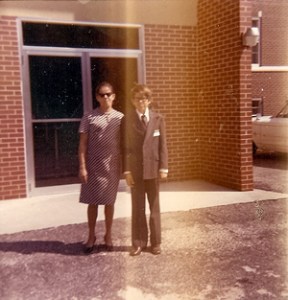
My mother Carmen and me. 1971

I attended Divine Heart Seminary in Donaldson, Indiana, despite my protests. It all started when I was in the seventh grade at Holy Cross School. Two seminaries, Divine Heart Seminary and Divine Word Seminary, sent priests to talk to the boys about vocations. When I was thirteen, I thought I might be interested in becoming a priest. After all, I attended mass almost everyday. My father and all his brothers attended a seminary in Montezuma, New Mexico. My aunt was a nun, and two of my uncles were priests. But I had my doubts about the priesthood because I would have to take vows of obedience, poverty, and celibacy. Celibacy? Now wait a minute. The vow of celibacy was my main stumbling block. I knew that someday I would like to have children. Anyway, I gave both priests my name because I said I might be interested in the priesthood. Then, I forgot all about their visit.

In the eighth grade, Divine Heart Seminary called me to see if I wanted to visit their campus. They would come to my house to pick me up and drive me all the way to Donaldson, Indiana. How could I say no? Before I went to visit DHS, I truly wondered if I wanted to become a priest. I was an altar boy then and a very devout Catholic, but I did have my mischievous side. Overall, I considered myself a good person.

At the Divine Heart, I saw how the seminarians lived. I spent one weekend there and got a taste of seminary life. I slept in the dorm where I would sleep as a freshman and I got a tour of the campus with the “big brother” that I was assigned. I got to see how real seminarians lived! Well, I was disillusioned by the seminary life. I didn’t think that potential future priests should behave like these seminarians.

At Holy Cross, I was taught that just about everything was a sin: swearing, smoking, playing pool, etc. Well, I was shocked to hear the boys swearing when their were no priests or brothers present! And they were going to be priests? Then, my big brother showed me the smoking lounge. These boys were allowed to smoke? I thought smoking was a sin. But my biggest shock of all was that they had pools tables! Not one or two pool tables, but many pool tables. In fact, there were several rooms that were exclusively reserved for playing pool. At that moment, I decided that future priests should not behave like these seminarians. I absolutely knew that I would not attend this seminary because they lived sinful lives.

Later, when I had forgotten all about my visit to Divine Heart Seminary, Sister Cecilia, the principal, called me outside of the classroom to talk to me. I thought I was in trouble for something I did. She told me that DHS called and wanted to know if I was still interested in attending their seminary. I immediately told her, “No.” She said, “You’re just too shy to admit it.” We went back into the classroom, I sat down, and she addressed the class, “Well, boys and girls, you are all very fortunate! David has received a vocation. He will become a priest someday! Next year, David will be attending Divine Heart Seminary in Indiana.”

Well, that little announcement truly changed my life forever. I sure didn’t want to attend any seminary, let alone Divine Heart Seminary. Soon, my classmates started calling me Father David. In the neighborhood, the kids would see me coming and mutter under their breath, “Watch what you say. Here comes the priest.” The girl I really liked in the class lost all interest in me. The next morning when I served mass as an altar boy, Father Gilbert congratulated me on my vocation. I told him that I didn’t want to become a priest, but he didn’t believe me and said that I was just being modest.

I told my father about what had happened to me with the seminary. That’s when I learned he, too, had attended a seminary for many years. He was actually proud of the fact that I would also attend a seminary. When my mother found out about my “vocation,” she told me that she was so proud of me. No one would listen to me! I didn’t want to attend Divine Heart Seminary. I had narrowed down my choices for high school to Leo High School or De La Salle High School. Try as I might not to attend DHS, I was forced to attend DHS. Before I even started school there, I had already made up my mind that I would never become a priest. Yet everyone was so proud of me and the fact that I would attend Divine Heart Seminary!

Again I traduce


On the southwest side of Chicago

I was curious as to who was actually reading my Blog. So, I did some snooping around, I mean some investigating. For some unknown reason, I keep getting hits from Russia. I can’t quite figure it out. My most viewed Blog entry is the one about Enrico Mordini, my Spanish teacher at Divine Heart Seminary. I guess I should go back and actually finish writing it and editing it since so many people are reading it. Now I feel embarrassed that I didn’t fix it up sooner. Another thing that really surprised me was the fact that people in Spanish-speaking countries are also finding my blog. I was wondering how they would read it since I mostly write in English. I went to the referring page and found that an automated translator could actually translate my blog into Spanish with a link on the search engine page. Wow! I mean, ¡Ay, ay, ay! The webpage is automatically translated into Spanish, but in very poorly-written Spanish at that. Upon reading the translation, I realized that people in Spanish-speaking countries will think that I don’t know Spanish!

Let me give you a sample of some of these translations. Well, it actually starts out quite well. The title at the top of my blog is David Diego Rodriguez, Ph.D. without an accent mark on the “i” of Rodriguez because otherwise all these strange characters appear and distort my last name thanks to the mysteries of computers and the Internet. However, the translator actually put the accent mark where it belongs! The rest of the translations are rather sad. For example, under my name I write, “¡Hola! ¡Yo hablo español e inglés!” For some strange reason that phrase is translated as, “¡Yo hablo español electrónico español!”, which somehow fails to convey my original message. I suppose if someone really wants to read my blog, they will gladly plod their way through this computer-generated translation.

When my Spanish students write compositions, I ask them to do the best they can. I ask them to write the composition in Spanish right from the start. I know that the student will make plenty of mistakes, but that’s part of the learning process. Sometimes the original text is upstaged by all my corrections in red ink. That’s fine by me if they make a valiant effort to write in Spanish. However, I do not want a student to write the composition in English and then translate it into Spanish. That’s double the work! And of course, I can always tell when they write it in English and then use an internet or computer translator. Well, the output hardly resembles proper Spanish. In fact, in many cases, I cannot even decode what the student wanted to say in the first place. All the words are in Spanish, but the composition is incomprehensible! I always ask the student to rewrite such a composition, “but in Spanish this time.” About the only word that doesn’t lose anything in translation is the English word “no” that also happens to translate to “no” in Spanish. Even an automated translator gets this translation right!

DDR