No manches


Ford City Mall, Chicago, Illinois

If you ever start to offend a Mexican, they will reply with a remark like, “¡No manches!” In other words, don’t smear my good name.

Well, I was at the Ford City Mall the other day with my sons when I saw this T-shirt stand right there in the middle where you can’t miss it. I immediately saw the t-shirt with the map of Mexico. Underneath the map it read, “United States of Mexico.”

The girl working at the stand immediately approached me and handed me a card saying that they had a website. I responded half in English, half in Spanish without really thinking. I assumed that she wasn’t even Mexican because Mexicans, or any Spanish speaker in Chicagolandia, are always happy to meet someone else who speaks Spanish. So, I gathered that she wasn’t a Spanish speaker, or perhaps not even Hispanic. And here she was selling these Mexican-themed T-shirts to–well, actually, to no one!

The whole time we were in the mall, I was the only one to approach the stand and read the t-shirts. I didn’t even bother to ask the price of the T-shirts. As I read these T-shirts, I was offended. I like to think of myself as very open-minded and I have a high tolerance for political incorrectness and profanity, but I wondered what kind of Mexican would buy a T-shirt that read, “got mica?” and “as seen on immigration”? Maybe I’m missing something here! They seemed more offensive than funny.

If they’re going to be that politically incorrect, they might as well should have named their business, “¡No manches, güey!” Why did they stop short? Don’t get me wrong. I’m not overly sensitive. In fact, I always smile when I see someone wearing a T-shirt that says, “I’m not late. I’m running on Mexican time!”

My favorite Mexican t-shirt.

Look closely at the T-shirt above. I was looking to buy T-shirts as souvenirs from Mexico, but they mostly sold stuff from the U.S.A. Talk about American cultural imperialism! It’s such a good parody of the actual Corona shirt that my cousin and I almost didn’t notice it. I suppose this t-shirt will only be funny for people who speak Spanish and know Mexicans.

DDR

Béisbol


Chicago White Sox Promotion in Spanish.

I’m watching the World Series even though neither the White Sox nor the Cubs are playing. “World Series” is a misnomer because it’s not really a world competition at all. However, there are many players from many countries such Venezuela, Mexico, Cuba, Dominican Republic, and Japan among others.

When I read Ragtime by E.L. Doctorow years ago, he described a professional baseball game in the early 1900s. He noted that the ethnicity of the baseball players was representative of the immigration pattern of the period. Here’s the passage from Chapter 30 of Ragtime:

On the Giant side were Merkle, Doyle, Meyers, Snodgrass and Herzog, among others. The Boston team boasted a player named Rabbit Maranville, a shortstop who [sic] he noted roamed his position bent over with his hands at the end of his long arms grazing the grass in a manner that would more properly be called simian. There was a first baseman named Butch Schmidt, and others with the names Cocrehan, Moran, Hess, Rudolph, which led inevitably to the conclusion that professional baseball was played by immigrants.

If you look at the players of today’s Major League Baseball, you will see many Spanish last names. Of course, those, too, are representative of the migration patterns of Spanish speakers from Latin America to the U.S.

When I was in Mexico last July, I watched the All-Star Game with my cousin and her family. We laughed every time the announcer mispronounced a Spanish last name. Both announcers consistently mispronounced Evan Longoria. Well, tonight, I had to laugh when Jason Bartlett stole second base and the announcer let everyone know that Taco Bell had a promotion: Steal a Base, Steal a Taco for every stolen base. So next Tuesday, we can go to Taco Bell for a free taco. They even interviewed Taco Bell president Greg Creed who personally invited everyone to go to Taco Bell to get their free taco!

DDR

Writing letters


My best friend!

I don’t know why, but Mexicans find it difficult to write letters to each other.

When I left Mexico, both times, I said I would write back and send pictures. Well, it took me a while took write back, but I finally wrote back! And guess who wrote back? One cousin to whom I didn’t even write. So, I felt guilty and wrote her a letter.

I wrote to my aunt and then she relayed a message to my cousin who e-mailed me telling me that my aunt said hello. This same aunt still had letters that I had written to her thirty years ago. They were tucked away in her picture box along with my Chicago Marathon medal, which I have no idea how she obtained it. Perhaps, I gave it to my mother before she went on one her trips to Mexico.

Now it’s starting to come back to me. My mother said if I wanted to give something to my aunt, so I gave her my marathon medal. Actually, it was a lot easier than writing a letter. Even with the Internet, we don’t seem to be writing to each other any more frequently. I still have a long list of relatives to whom I will write before my next visit. But even if I don’t, we’ll pick up the conversation right where we left off the last time. My cousin likes to IM me and that’s fine when I have time. It is a lot easier than writing letters.

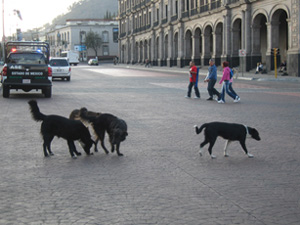
Dogs


Toluca, México

While driving through Mexico, I noticed two things about dogs. One, not many people keep dogs as pets. And two, stray dogs didn’t scare people like they do in the United States. In America, if someone sees a large, unleashed dog, they feel automatic dread and run for cover.

I don’t recall seeing a pedigreed dog even once during my last two trips to Mexico, except for my cousin who has an English sheepdog. Most of the dogs I observed on the street were large mutts that were some shade of brown. They usually stood on the curb looking at the traffic as if they were waiting for an opportunity to cross the street. These dogs looked calm and relaxed and didn’t seem to be in any kind of hurry. I saw more dead dogs on the highway in the U.S. than in Mexico. These Mexican dogs coexisted peacefully with the people, which surprised me. They often sleep on the streets and sidewalks, and no one bothers them.

When I was a boy, I remember laughing at one of the pushcart food venders in Mexico City because he sold hot dogs. I just never imagined any Mexican wanting to eat American hot dogs. But I laughed even more when I saw the sign on the pushcart that advertised the hot dogs as PERROS CALIENTES! A literal translation of the name for hot dogs.

In English, I never pictured a four-legged furry animal when I thought of hot dogs. But in Spanish, perros calientes did not evoke any appetizing image of one our typically American foods (As American as baseball, hot dogs, and apple pie, so the saying goes.). I pictured an actual dog on a hot dog bun.

Well, on this last trip to Mexico, I noticed that the venders who sold hot dogs no longer advertised them as perros calientes, but rather as hot dogs. I asked my cousin in Celaya why that was, and he told me because the name conjured up the image of actual dogs, which they didn’t want to eat. Well, in Mexico, according to my cousin, there are people who eat tacos made from dog meat. So now hot dogs are sold instead of perros calientes.

DDR

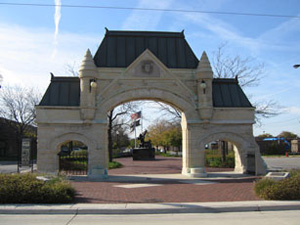
Canaryville


Gate to the Union Stockyards, Chicago, Illinois

Canaryville is a neighborhood that is south of Bridgeport and southeast of where the Union Stockyards used to be. I spent a few years there visiting friends who lived there.

I was from Back of the Yards, so not many people from Canaryville knew me. I was risking life and limb every time I went, but I liked the sense of danger I experienced every time I visited. When I left Divine Heart Seminary, I had to attend Tilden Technical High School at 4747 S. Union, right in the heart of Canaryville. As luck would have it, the school had a lot of daily racial fights between blacks and whites. But that was my school and I was stuck attending it. I made the best of a bad situation.

I lived about a mile and a half away from school. After the first snowstorm, it was too cold to stand at the bus stop to wait for the bus, so I started walking to school in order to stay warm. I planned on getting on the bus when it eventually showed up. However, I walked all the way to school without ever seeing the bus.

I didn’t mind walking at all since I used to walk seven and a half miles to town every weekend when I attended Divine Heart Seminary. The next day was even colder, so I left the house a little earlier and walked all the way to school without looking back over my shoulder for the bus. I ended up walking to school the rest of the year because I was able to spend the bus fare on magazines and books. A few months ago, I was talking to my cousins about high school and it turns out that they also walked to school so they could keep the bus fare for spending money.

I never had any trouble with anyone until I got near the school. Someone, they would either be white or black (I was an equal opportunity crime victim), would ask me for money, implying that I should comply with their request or they would use physical force if necessary. I never gave anyone any money. I always had a response for them. “If you need money, you should get a job!” Or, “If you want my money, you have to take it from me.” I would then give them my crazed look that implied they might get the money, but they would be sorry they did because I would inflict some pain on them in the process.

Surprisingly, no one ever accepted my invitation to take my money. Although I did get close once. Two Canaryville residents on their way to school saw me and told me to give them my money or they would beat me up, only not in those words but a rather more colorful vocabulary. They looked like they were really going to beat me up but good. I collected myself and focused deep within. I clenched my fists and gave them a deranged look that I hoped would scare them off. Suddenly, they looked at each other, and as if by silent agreement, they walked away from me. They continued looking over their shoulders at me as they walked away. Then a police paddy wagon passed me from behind. They had walked away from me because they had seen the police! The police asked me if the boys had threatened me. I said that we were friends. I don’t think the police really believed me, but I stuck to my story. Those boys never bothered me again. In fact, they were so grateful that I didn’t rat them out that they even protected me on a few future occasions when I really needed some help at school.

DDR