Dogs


Toluca, México

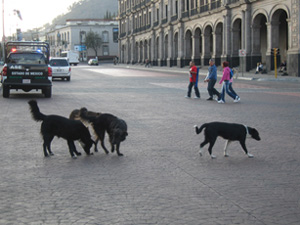
While driving through Mexico, I noticed two things about dogs. One, not many people keep dogs as pets. And two, stray dogs didn’t scare people like they do in the United States. In America, if someone sees a large, unleashed dog, they feel automatic dread and run for cover.

I don’t recall seeing a pedigreed dog even once during my last two trips to Mexico, except for my cousin who has an English sheepdog. Most of the dogs I observed on the street were large mutts that were some shade of brown. They usually stood on the curb looking at the traffic as if they were waiting for an opportunity to cross the street. These dogs looked calm and relaxed and didn’t seem to be in any kind of hurry. I saw more dead dogs on the highway in the U.S. than in Mexico. These Mexican dogs coexisted peacefully with the people, which surprised me. They often sleep on the streets and sidewalks, and no one bothers them.

When I was a boy, I remember laughing at one of the pushcart food venders in Mexico City because he sold hot dogs. I just never imagined any Mexican wanting to eat American hot dogs. But I laughed even more when I saw the sign on the pushcart that advertised the hot dogs as PERROS CALIENTES! A literal translation of the name for hot dogs.

In English, I never pictured a four-legged furry animal when I thought of hot dogs. But in Spanish, perros calientes did not evoke any appetizing image of one our typically American foods (As American as baseball, hot dogs, and apple pie, so the saying goes.). I pictured an actual dog on a hot dog bun.

Well, on this last trip to Mexico, I noticed that the venders who sold hot dogs no longer advertised them as perros calientes, but rather as hot dogs. I asked my cousin in Celaya why that was, and he told me because the name conjured up the image of actual dogs, which they didn’t want to eat. Well, in Mexico, according to my cousin, there are people who eat tacos made from dog meat. So now hot dogs are sold instead of perros calientes.

DDR

José y María


Celaya, Guanajuato, México

In Spanish-speaking countries, the two most common names are José and María. Some parents name their sons José María and their daughters María José. My Uncle Eutimio and Aunt Asunción named their sons José Eutimio, José Ricardo, José Carlos, José Ignacio, José David, José Daniel, and José Agustín. They named their daughters María Concepción, María Elena, María Angélica, and María Carmen. They had fifteen children, but I can’t remember all their names right now.

When I first met them on my last trip to Celaya, Guanajuato, they introduced themselves as Timio, David, Carlos, Ricardo, etcetera. Later, I heard one cousin call his brother Pepe, which is the nickname for José. I asked my cousin why he called him Pepe and he said that his name was really José.

Later on, another cousin called another brother Pepe. This was a different from Pepe from the first one. I asked how they could both be Pepe. Then they explained to me how all the brothers were named José and all the girls were named María. I still don’t understand how they can name them like that, but they did. Afterwards, I thought about how convenient that would be. If you needed something, you would merely shout José or Pepe and you would have at least two or three sons running in to help you. Ditto if you shouted María.

DDR

Moving to Mexico


Could I actually live in a condo in a tourist area? I don’t think so.

Over the years, I have had one identity crisis after another. The identity crisis recurs most often is the one in which I can’t decide if I should live in Chicago or Mexico because I’m not sure if I’m Mexican or American.

Sometimes I feel as if I don’t belong here in the U.S. because I feel so Mexican and like a foreigner here. When I’m Mexico, I feel very comfortable there. Of course, that could be merely because I’m a guest there and the excitement and the newness of my being there hasn’t worn off yet. If I stayed much longer, everyone might not be as friendly toward me. I’ve mentioned to some of my friends that I was thinking of moving to Mexico and they immediately offered to help me pack! Wow! What friends!

I went to Mexico when I was 22 and I seriously considered staying there. But then I realized that I would have to get a job in order to support myself. But Mexicans don’t really want foreigners coming in and taking away their jobs. Besides, I didn’t really want to work a back-breaking job in Mexico when I already had a back-breaking job in Chicago. So I went back home to Chicago. However, I often daydreamed about living in Mexico.

Now, I am actually in a position where I can afford to move to Mexico since I have a small pension. I now have to work a job in order to live comfortably in Chicago, but I could live more than comfortably if I moved to Mexico. And I won’t have to work at all if I lived in Mexico. I could sit at home all day writing blog entry after blog entry. Wait, that’s what I’m doing now! But I have to teach in order to supplement my pension.

In Mexico, I would always find something to keep me busy since they do have the Internet down there. And I wouldn’t be lonely because I have a lot of family in Mexico in several cities. Our family, both on my father’s and mother’s side, was very prolific. That’s why Rodriguez and Martinez are some of the most common Spanish last names in the world. So I wouldn’t be lonely.

And even though I’m American, Mexicans–my family in particular–consider me Mexican, sort of. Since I’m American, everyone in Mexico was surprised that I spoke Spanish and ate tortillas. I’m glad that Mexicans thought of me as a Mexican, at least most of the time.

When I go back to Mexico in July, I’ll take another look at where I could possibly live in Mexico. I really love Celaya, Guanajuato, the home of my father’s family. It’s a fairly big city with a small-town feel to it. And, I have an uncle, two aunts, and fifteen cousins who live there! Plus, there’s a university in the city where I could possibly find a teaching position if I ever have the urge to teach again. That would be quite an adventure for me. So now I’m struggling to redefine myself and resolve my latest identity crisis. I’m sure that this time I’ll find myself. Or, maybe not.

DDR

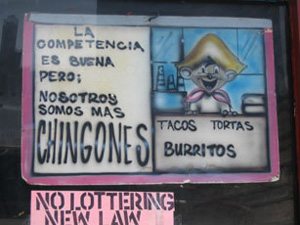
Chin …


El Gallo de Oro Mexican Restaurant

Actually, that’s only the half of it. When I was in Celaya, Sometimes my cousin Ignacio caught himself in mid-word, “¡Chin … !“, when he saw children around, and not complete the final syllables of “-gado.” My father would start out, “Chi …” and then see my brothers and me, and immediately change to the word, “¡Chihuahua!” You see Mexicans are famous for being the most notorious practitioners of swearing of all Spanish speakers in the world. And their favorite swear word has to be, “chingado.” Occasionally, when my father didn’t feel like referring to dogs or cheese with the word “chihuahua” would say, “chispas,” which merely means sparks. So if you hear someone who is frustrated by their present circumstances, and they shout, “¡Chispas!“, “¡Chihuahua!“, or “¡Chingado!“, behold (and beware), because you are most certainly in the presence of a Mexican.

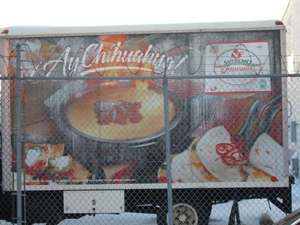
¡Ay Chihuahua! is a common Mexican expression.

The other day, my Spanish class asked me about the word “chingado” and I was brutally honest with them. I told them that it’s derived from an Aztec word. Since I had the interest of the entire class, I snuck in a Spanish class without them realizing it. I began with the infinitive chingar and I conjugated it for them: chingo, chingas, chinga, chingamos, chingáis, chingan. They were so enthralled by me lesson that they didn’t even complain that I had used the vosotros form of the verb, as they usually are scared of it. I even showed them how to use the past participle as an adjective: chingado gobierno, chingada migra, chingados rateros, chingadas cuentas. Once I had their interest, I was able to teach that day’s lesson easily. They paid attention the whole class. It was simply amazing!

DDR

My father


José Diego Rodríguez Rosiles

My father is a very unique person who has his own way of doing things. He was a factory mechanic who could work wonders with duct tape. No matter where we were, he always had some tools in his pocket. He was proud of being mechanic. If someone had some sort of mechanical problem, my father would volunteer to fix whatever needed fixing. No problem was too small for him. A squeaky door? He carried a little oil can with him. Door knob keeps falling off? My father would attach it with his tools and extra screws that he always carried with him just in case.

I should write a novel about him: My Father, the Super Fix-It Handyman. Or maybe make him into a comic book superhero who can fix any problem no matter how small. My father was always fixing bicycles, skates, skateboards, and automobiles for everyone on the block. He had just enough mechanical aptitude, talent, and expertise to keep him trapped in the middle class the rest of his life. And, it turns out that I’m not much different than him, although I’ll never be able to make repairs just like my father.

When I was a boy, my father often embarrassed me. He always liked to attract attention to himself by telling jokes in his broken English. I was afraid to bring home friends when my father was home because then he would want to get in on the conversation with them and he didn’t speak English very well. So most of the conversation would involve a lot of repetition because he didn’t understand everything that was said, but he wanted to show that he was eager to learn English. It’s now forty years later and he still does this. He has never stopped trying to learn English. If I talk to him in Spanish, he still insists that I speak to him in English so he can learn English. In fact, if I talk to him in Spanish, he doesn’t understand a word I say.

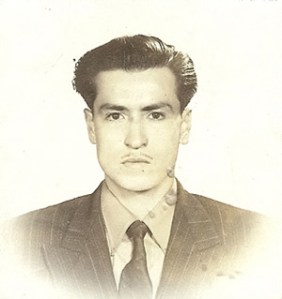
Another thing about my father was that he was always so Mexican. He could just stand there silently and everyone would know that he was Mexican because he always stood there looking so Mexican. He was about 5’6″, thin, with black hair slicked back with vaselina, brown eyes, and a Cantinflas mustache. Plus, you could see the tools bulging from his pants pockets, along with a small jar of salsa or peppers, just in case.

Whenever we did something together, he would always preface it by saying that he used to do that activity in Mexico when he was a boy. When we played basketball in our backyard at 4405 S. Wood Street in Back of the yards, he told us that he always played basketball with his brothers in Celaya, Guanajuato, Mexico. When I was eight, I actually thought that basketball was a Mexican sport. While playing, my father told me that once I stopped dribbling the ball, I couldn’t dribble it again. I had never heard of such a rule. I told him, “I don’t want to play the Mexican way.” Of course, I didn’t know any better at the time even though there is a rule against double dribbling.

For breakfast, my father would prepare this concoction that he learned to make from his father in, you guessed it, Mexico. He would pour some Mogen David grape wine into a glass, put in a raw egg, and mix it up together.  He would drink the first glass to show me how it was done. Then, he would hand me a glass and I would force myself to drink it. At first I didn’t like it and I told him that I didn’t want a Mexican breakfast, but I eventually learned to like it. I also learned to eat raw eggs right out of the eggshell by poking to holes at either end of the egg. I learned this from my father because this is how he ate breakfast in Mexico. This was long before I had ever heard of salmonella. I guess God does protect children and idiotas. 🙂

DDR