Marquette Park Track Club


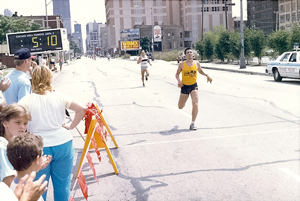
Proudly wearing the Marquette Park Track Club colors of black and gold!

When I returned to Chicago after three years in the Marine Corps, I moved back to Marquette Park. I lived at 3006 W. 64th Street for six years before I moved to Bridgeport. I loved living so close to the park because then I could go running every day. While in the Marines, I began running seriously after I ran a marathon in California. I thought that if I trained well enough, I could become a good runner. I joined the Marquette Park Track Club after running the Roy Bricker Memorial 5 Mile Race where I placed third in my age group. Roy Bricker was the best runner that the club ever produced. All thanks to Coach Jack Bolton whom all his runners adored. The club would meet every weeknight at 5:30 p.m. rain or shine, snow, or sleet. Jack never missed a practice.

Jack Bolton came from Ireland many years before, but he never lost his Irish brogue. We all loved it. Some of the runners imitated him lovingly. He was a world-class miler back in Ireland and when he came to the U.S. he coached high school teams in Chicago. He always had great runners running for him.

When I first joined the club in 1981, all the practices began with six laps (one mile) on the cinder track at Marquette Park. Jack would lead the pack, and everyone had to stay behind him. This was a group warmup. Jack’s philosophy for this warmup was twofold. 1. Runners learned to run in a pack and 2. Runners learned to run at someone else’s pace, as sometimes happens in a race. In later years, Jack’s ankles gave out on him, and he didn’t run the warmup with the club anymore.

Jack especially loved working with younger runners. He was known for the female runners that came out of his club system. In fact, some high school girls would join Jack’s club in order to develop as runners and qualify for running scholarships at the universities of their choice. Most girls achieved their goal. Of course, many boys also received running scholarships, too.

What everyone loved about Jack was his eternal optimism. He always believed that one of his runners would win the race outright, no matter how overwhelming the odds. I once entered a race and learned at the starting line that Jack had predicted that I would win. I wanted to live up to his expectations, but I had a difficult day and faded halfway through the race. But Jack was always touting some up-and-coming runners from his club. He was usually right, too.

Click here to read an article that I wrote about Jack Bolton for the CARA Finish Line the January/February edition of 1985:

http://davidrodriguez.us/docs/bolton.html 

DDR

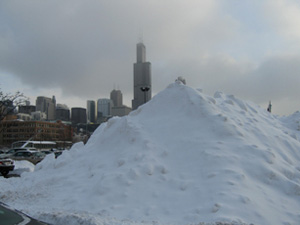
Just a snowstorm?


UIC Parking Lot

Snow was falling as I drove to school today. In all of my Spanish classes today, some students asked me if the exam might be canceled tomorrow because of the snow. Of course, there would be class tomorrow! This is Chicago!

This one particular student was sure that if it kept on snowing, I wouldn’t be able to get to campus and give the exam. However, in Chicago, a snowstorm is not merely a meteorological event. Every snowstorm, and other major climate changes, are political events of major consequences in Chicago.

You can trace this back to the snowstorm of 1979 that was improperly handled by Mayor Michael Bilandic. A few heads did roll after the snowstorm, including Bilandic’s. (I’m sure a few heads also rolled after the Chicago Fire in 1871.)

Luckily, I was living in sunny, southern California at the time. I know that even if we get three feet of snow tonight, I will be able to drive from my house in Beverly on the south side to UIC near downtown. Chicago will not be slowed down by such an insignificant snowstorm as that! Every time meteorologists predict even the remotest possibility of snow, city workers are on standby all over the city and even salting the streets before even the first snowflake has formed. Sometimes, there is more salt on the streets and sidewalks than snow. Yes, my dear students, I will be at UIC on time tomorrow morning to give you your exam. I love Chicago, the city that works (especially at Chicago overtime rates).

DDR

Reality


Dr. D. has his head in the clouds again.

This morning, as I drove my son to work, I looked up at the clouds in the sky. They were unbelievably beautiful and comforting. Then, I realized that they looked exactly like the clouds from the opening credits to The Simpsons! Suddenly, the sky and the clouds looked so artificial. Well, I couldn’t return to my initial moment of awe and wonderment.

Sometimes I wonder if reality is real enough. Robin Williams had a comedy album titled, “Reality: What a concept!” I think he was onto something. I recalled a few other moments in my life when life just didn’t seem “real” enough.

I had a similar experience years ago in California. I was driving from 29 Palms to Los Angeles pondering the meaning of life, among other things. I was truly soul-searching. At the point where I began my descent from the Mojave Desert, I was at the same altitude as the clouds on the horizon. I could see the sun above the clouds and the sun’s rays as they flitered through the clouds underneath. The rays spread out diagonally below the clouds and onto the ground.

I’ve seen God appear this way in a few movies. Then, I realized as beautiful as this scene was, it was just too unrealistic! I doubted that I could possibly be seeing this scene unfolding before me. I can recall seeing it even now.

I’m not sure what this entire experience means. Perhaps it’s a phenomenon like déjà vu, but I just don’t know the name. Reality: what a concept!

DDR

Accents


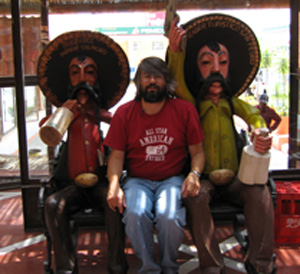
On the road in México

Accents are a funny thing. An accent separates or distinguishes you from another person or group when you speak. For as long as I can remember, I have always had an accent. In kindergarten, I spoke broken English since I only spoke Spanish at home. So, I had a Mexican accent. But when I went to Mexico, I had a gringo accent when I spoke Spanish. Then, I met my friend Patrick McDonnell in the second grade, and I spoke with a little bit of an Irish brogue. Since I attended a Lithuanian Catholic grade school, I picked up a few Lithuanian words. In high school, classmates made fun of the way I talked, so I only talked when necessary. I remember reading books aloud to practice my pronunciation. I was trying to eliminate any trace of an accent. Unsuccessfully, I might add.

When I enlisted in the Marines, I met people from all over the United States for the first time in my life. It was the first time someone told me that I had a Chicago accent. I was surprised when I met someone new, and he said he knew I was from Chicago because I had no accent. My accent adapted unconsciously so it would fit in. And I did fit in. During my enlistment, I spoke with the accents of Brooklyn, Texas, Queens, Boston, Virginia, Oklahoma, and California. But I didn’t do this on purpose. I just somehow blended in with everyone around me.

When I began teaching Spanish, I also unconsciously adapted the accent of the people around me. So, depending on to whom I spoke, I would speak like them. I’m not sure what my authentic original voice sounds like anymore. A colleague once said, “I was trying to figure out what dialect you were. Now I know you’re Mexican because you said, “Mande.”

I suppose if I listen to myself carefully, I hear all these different accents in my voice from different places.

DDR

English only


Chicago, Illinois

Everyone in America wants to speak English—even immigrants. To function in this country, to get ahead in this country, you must speak English. However, not everyone will learn to speak English, no matter how much government officials demand it. Carpentersville, Illinois, even went so far as to pass a municipal ordinance that mandates English as the official language. Will this motivate all immigrants to learn English? Not really. If anything, this will create some animosity toward the government on the part of the immigrants, whether they’re here legally or not.

Most immigrants learn just enough English to get by on. Of those who do master English, not all of them will lose their foreign accents. That’s just the reality of learning English. Think of Henry Kissinger, who spoke fluent English, but never overcame his accent. However, he spoke fluent English. Nevertheless, someone like California Governor Arnold Schwarzenegger should be careful how he encourages people to learn English. Yes, he learned enough English to get by on when he came to this country, but he seems to direct himself only toward Spanish speakers when he tells hundreds of Hispanic journalists that Latinos must stop watching Spanish-language television in order to learn English.

There are immigrants from all over the world who speak many languages other than Spanish who should learn English. Living in Chicago, I have met some of those immigrants with whom I could not communicate in English or Spanish. As is typical of any immigrant group, the first generation learns only enough English to get by on, if that much. The second generation is bilingual, but by the third generation, most speak only English. Hispanics seem to be the exception to the rule. Many Americans equate being monolingual English speakers with assimilation into the American culture. Still, America is multicultural and can accommodate many cultures simultaneously. The English language is living proof that there is room for all cultures.

DDR