Lupita


Lupita is the nickname for Guadalupe

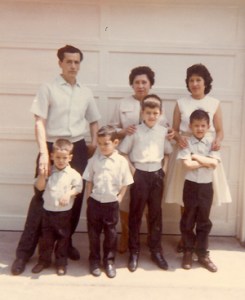
I only knew her as Lupita. I was incredibly young, about six years old, when one day she appeared in our lives in the Back of the Yards. She used to take care of us when my parents went to work. She looked like most Mexicanas of that era in the 1960s: long black hair, brown eyes, short, and pleasingly plump. Since I was so young, I’m not even sure how old she was, but I’m fairly sure that she was older than my mother who was in her twenties at the time. She spoke very little English with a heavy Mexican accent, even less than my parents. She was single and had no children of her own. Even though we were children, we always called her Lupita, just plain old Lupita, nothing more formal than that. Now that I think of it, Mexican children were always taught to call an adult woman Señora or Señorita plus her last name. Now I’m wondering why we even called her Lupita, just Lupita. Anyway, I’m not sure how my mother met Lupita, but it may have been at a factory where they both worked. Back then, factory jobs were plentiful, and when someone got tired of doing the same job for too long or they just got tired of their coworkers or bosses, they would just quit and find another factory job almost immediately.

Before Dicky was born, my brother Danny had to go to the doctor at Cook County Hospital a lot because he had osteoporosis in his right arm. My parents would take Danny and my younger brother Tato (Diego) to the hospital and Lupita would take me to her house on the bus. She lived about two miles north of us, which seemed like a long, adventurous trek to me back then. We would take the Ashland Avenue bus (Number 9, I think). Many of the buses were still electric then, and there were overhead wires to provide the electricity. Many parts of Ashland Avenue were still paved with cobblestones. I would take my train set that I received for my birthday or Christmas–I don’t remember which. At her house, Lupita would clean her house and when she was done, she would read novelas, which were books that were printed in sepia-colored ink that told soap-opera-like stories but looked like comic books. I would play with my train set that entertained me for hours at a time! It consisted of a locomotive, two boxcars, a caboose, and a small circular track. Most children my age would have been bored by it, but not me! The train set also came with some small wooden barrels that I would put under the tracks to create a “hill.” I could while away the hours just by positioning these barrels in every imaginable position! When I had accomplished that, I liked to experiment with the sequence of the locomotive and boxcars and caboose. I was so easily amused back then! Oh, wait a minute! I haven’t changed all that much since then. I’m still easily amused!

Well, when my brother Danny was better and no longer had to go to the hospital, Lupita would babysit us at our apartment after school. She genuinely enjoyed being with us. My brothers and I would play well together, but she would get nervous when we wrestled. We loved to wrestle. Since I was the oldest and biggest brother, I always won. The last match would involve Danny, Tato, and Dicky wrestling against me. I always won! I would pile them up, one on top of the other, and then pin them down for the count. Lupita was so afraid that we would hurt each other that she would stop us from wrestling. She always stopped us from having too much fun. Like the time we were throwing my mother’s records out the back window like frisbees. Or the time we used my grandfather’s encyclopedia from Mexico to build a fortress wall. I told Lupita that my mother always let us use the encyclopedia to build a fortress, but she didn’t believe me and made us put the tomes back on the shelf.

She never talked much, but she always sat in the living room with us. If we went to our bedroom and we were too quiet for too long, she would come to see what we were doing. Once, my brothers and I were in the bedroom just reading comic books, but she made us go into the living room with her. She didn’t trust us. And with good reason! We once gave her a really good scare. We were reading comic books in our room, and she didn’t check up on us. When we read comic books, we became our favorite comic-book heroes. I was Spiderman, Danny was the Silver Surfer, Tato was the Torch, and Dicky was Batman. Well, once, Dicky felt the power of Batman coursing through his veins and he dove headfirst into the air shouting, “I’m Batman!” However, he didn’t fly very far. His head hit the dresser drawer handle, which had pointed ends, and he had a huge gash from his forehead to the back of his head. Dicky screamed from the pain, and we just stood there silently not knowing what to do. Lupita came running to the bedroom and she almost fainted when she saw Dicky bleeding from his forehead. She picked him up, carried him to the sofa, and stopped the bleeding by putting a warm, wet towel on his head. My parents came home shortly after that and took him to the hospital where they closed the gash with twenty-seven stitches. Lupita stayed to watch Danny, Tato, and me while my parents and Dicky went to the hospital. We just sat there quietly in the living room with Lupita until they came back from the hospital.

I don’t remember the last time we saw Lupita. She was always a part of our family, but suddenly one day she just wasn’t there anymore.
DDR

Irma


Duke

Irma was a Mexicana who lived on my block when I was about ten. We lived at 4405 S. Wood Street in Back of the Yards, and she lived two houses south of us, upstairs from my friend Carlos Mojaro. She was about six years older than me, but everyone in the neighborhood knew her. She was very pretty and friendly. She always had a boyfriend, but never for very long.

Of course, then all the rumors started about her reputation, if you know what I mean. Even when she wasn’t home, some guy would come looking for her. Sometimes they weren’t even from the neighborhood. Irma’s mother–I never learned her name because everyone simply called her Irma’s mother–would always look out her second-floor apartment window and shout for them to go away and stay away from her daughter! There was no element of mystery here.

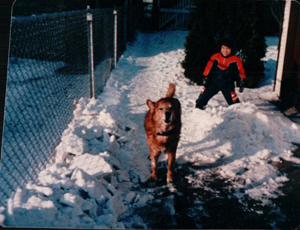
Everyone knew that Irma’s mother was also very friendly with the men in the neighborhood, but only more so than her daughter. She was a single mother raising a son, whom was rarely seen coming or going home, and a daughter. The whole family was exceedingly popular with everyone in the neighborhood except for all the neighbors who lived within a half-block of them. They also had a dog–no one knew her name, but we always referred to her as Irma’s mother’s dog–that would often escape from the apartment and wander the neighborhood, occasionally biting children who wanted to pet it. Their dog also developed a reputation of being overly friendly with the other dogs in the neighborhood, but somehow never had any puppies. One day as I was walking our dog Duke, he approached Irma’s mother’s dog out of curiosity and she tried to bite Duke, but Duke ducked and bit her first. Irma’s mother looked out her window and yelled at me. I tried to explain that her dog tried to bite mine first, but Irma’s mother just started swearing at me. There was no talking to her.

One day, I saw Irma go into her house with her boyfriend. I could hear her lock the door as I sat on the porch with my friend Carlos. A few hours later, her mother came home, and Irma wouldn’t let her in. Her mother started to swear at Irma as she looked down at her mother out the window. She kept saying, “You better let me in right now!” But Irma went inside and closed the windows even though it was hot outside. By then a crowd had started to gather. Irma’s mother kept shouting, “I’m gonna call the police on your boyfriend!” Then one of the women neighbors started arguing with Irma’s mother because of her dog that had gone into the neighbor’s yard. Irma’s mother asked for a reprieve from the argument because her daughter was in the house with some guy, and she couldn’t get in. I was sitting on my bike out in front watching the scene. There were well over fifty people watching.

Then, the woman tells Irma’s mother, “I’m not surprised your daughter’s in there with some guy!” “What do you mean?” asked Irma’s mother. “You daughter’s a whore!” Irma’s mother just laughed. The woman continued, “You’re a whore, too!” We were all expecting for a physical fight to break out, but nothing. Irma’s mother just laughed that off, too. Finally, the woman says, “I’ve seen your dog fucking all the other dogs in the neighborhood! Even your dog’s a whore!”

This was just too, too much for Irma’s mother to take. She grabbed the woman’s hair and said, “You can call me a whore and you can call my daughter a whore, but don’t you ever talk about my dog!” Then Irma’s mother scratched the woman’s face. That’s when the police arrived and broke up the fight. The two police officers wanted to know what the fight was about, and Irma’s mother said that the woman had called her dog a whore. She looked at the police believing that she was justified in attacking the woman.

Eventually, the police said that they came because a girl was locked in the apartment by her boyfriend. They went up to the front door and kicked it open. Both officers went upstairs. Everyone watching was excited because it had been a while since the police had been to their house. Well, Irma’s boyfriend ran out the back door and came out to the front of the house. He saw me on my bike and said, “You have to give me a ride!” He was much bigger than me, so he rode the bike, and I sat on the handlebars. He rode a block away and took off running. I never saw him again.

When I rode back to Irma’s house, the police were out in front talking to Irma and her mother. I don’t know what happened after that because then my mother came outside and made me go ihome.

DDr

Al


On the road somewhere in the USA.

In the 1960s, Chicago was very much a segregated city. Neighborhoods were categorized by race and/or ethnicity. When people moved to Chicago, they pretty much stuck to their own kind. This was in an era before anyone could foretell the coming of Political Correctness and everyone called every race and ethnic group by their corresponding slur.

Sometimes, people would be offended by such name calling, but oftentimes, most people merely accepted it as part of life in Chicago. Those neighborhood boundaries could only be crossed when going to work or when shopping, as long as no one over-stayed their time where they didn’t belong. No one ever commented on these inequities back then. That was Chicago.

When I lived in Back of the Yards, no blacks ventured there except to go shopping at the stores on Ashland Avenue between 45th Street and 51st Street. There was name calling and such, but basically there was never any trouble.

Al at the Sinclair gas station.

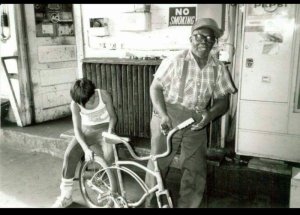
When I lived at 4546 S. Marshfield Avenue, there was a Sinclair gas station, whose logo was a green dinosaur, on the corner across the street. It had one gas pump that was directly in front of the building on the sidewalk. Whenever I needed air for my bicycle tires, I went across the street for it. As a ten year old, I often needed help fixing my bicycle when my father wasn’t home, so I would go to the gas station where Al would help me.

Al had the reputation for being the very best mechanic around, not just in our neighborhood, but anywhere. Everyone respected him for his mechanical skills and brought their cars to him if they needed repairs. Al also dispensed free mechanical advice to anyone who asked for it. After a while, no one even noticed that he was black. That’s right, a black man was working at our gas station beyond the allowable shopping district boundaries. But it was acceptable because he was at work. However, Al was accepted amicably by all the neighborhood residents. He was a hero to all my friends and me because he could fix our bikes no matter what was wrong with them. And he never charged us anything.

Al in action!

I used to like to hang out with him when I had nothing to do. He just seemed like the wisest man on earth because he could fix just about anything anyone brought in. I would ride my bike over and sit on his bench and watch him fix flat tires. He explained everything he did to me every step of the way. I was always fascinated by the machine that removed the tires from the rim. It was loud and menacing, but Al had tamed it to obey his every command. When business was slow, which was rarely, he would sit next to me on the bench and we would talk small talk. “How’s it going, buddy?” “Great! How are you, Max?” We were buddies. Then all Sinclair gas stations started giving out free passes to the Riverview amusement park with a gas fill-up. Since we were buddies, Al gave me enough passes for my entire family and my father took us to Riverview several times. Al was really popular with all the boys after that.

There was an older boy on the block that I often avoided. I always afraid of this boy because he was rotten to the core and he often scared me. He had that look that threatened physical violence to anyone who returned it. Then one day, he told me that Al was black. Looking back, I’m not even sure if I ever even noticed. He was just Al the mechanic at Sinclair to me. He was a very nice guy and he was always very helpful to me.

Anyway, this boy told me that Al was a “nigger.” I didn’t understand what he was talking about. He explained to me that Al was inferior to us because of his skin color. We rode our bikes to the corner and Al was standing in front of the gas station. The boy told me to call Al a “nigger.” I refused because Al was my friend. We stopped our bikes directly across the street from Al and the boy insisted that I shout “nigger” to Al. I just couldn’t. I knew that Al could hear our conversation, but he acted as if he were oblivious to us. Then the boy said he would beat me up if I didn’t call Al “nigger.” He punched me in the arm really hard, he gave me his patented menacing look, and said, “Then call him a Fudgecicle!” I refused at first, but then I was so afraid to get beat up. So I half-heartedly said, “Fudgecicle.” Al didn’t betray any form of acknowledgement that he had heard me. I felt so bad. I was sure my friendship with Al was over. But I didn’t get beat up.

The next day, I felt too guilty to visit Al as I usually did. After a few more days, I went back to the gas station and I tried to act as if nothing had happened. Al greeted me as he usually did. And we had our normal conversation of small talk. As if nothing had ever happened! Al was such a great friend!

DDR

My father


José Diego Rodríguez Rosiles

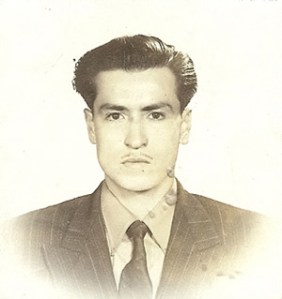
My father is a very unique person who has his own way of doing things. He was a factory mechanic who could work wonders with duct tape. No matter where we were, he always had some tools in his pocket. He was proud of being mechanic. If someone had some sort of mechanical problem, my father would volunteer to fix whatever needed fixing. No problem was too small for him. A squeaky door? He carried a little oil can with him. Door knob keeps falling off? My father would attach it with his tools and extra screws that he always carried with him just in case.

I should write a novel about him: My Father, the Super Fix-It Handyman. Or maybe make him into a comic book superhero who can fix any problem no matter how small. My father was always fixing bicycles, skates, skateboards, and automobiles for everyone on the block. He had just enough mechanical aptitude, talent, and expertise to keep him trapped in the middle class the rest of his life. And, it turns out that I’m not much different than him, although I’ll never be able to make repairs just like my father.

When I was a boy, my father often embarrassed me. He always liked to attract attention to himself by telling jokes in his broken English. I was afraid to bring home friends when my father was home because then he would want to get in on the conversation with them and he didn’t speak English very well. So most of the conversation would involve a lot of repetition because he didn’t understand everything that was said, but he wanted to show that he was eager to learn English. It’s now forty years later and he still does this. He has never stopped trying to learn English. If I talk to him in Spanish, he still insists that I speak to him in English so he can learn English. In fact, if I talk to him in Spanish, he doesn’t understand a word I say.

Another thing about my father was that he was always so Mexican. He could just stand there silently and everyone would know that he was Mexican because he always stood there looking so Mexican. He was about 5’6″, thin, with black hair slicked back with vaselina, brown eyes, and a Cantinflas mustache. Plus, you could see the tools bulging from his pants pockets, along with a small jar of salsa or peppers, just in case.

Whenever we did something together, he would always preface it by saying that he used to do that activity in Mexico when he was a boy. When we played basketball in our backyard at 4405 S. Wood Street in Back of the yards, he told us that he always played basketball with his brothers in Celaya, Guanajuato, Mexico. When I was eight, I actually thought that basketball was a Mexican sport. While playing, my father told me that once I stopped dribbling the ball, I couldn’t dribble it again. I had never heard of such a rule. I told him, “I don’t want to play the Mexican way.” Of course, I didn’t know any better at the time even though there is a rule against double dribbling.

For breakfast, my father would prepare this concoction that he learned to make from his father in, you guessed it, Mexico. He would pour some Mogen David grape wine into a glass, put in a raw egg, and mix it up together.  He would drink the first glass to show me how it was done. Then, he would hand me a glass and I would force myself to drink it. At first I didn’t like it and I told him that I didn’t want a Mexican breakfast, but I eventually learned to like it. I also learned to eat raw eggs right out of the eggshell by poking to holes at either end of the egg. I learned this from my father because this is how he ate breakfast in Mexico. This was long before I had ever heard of salmonella. I guess God does protect children and idiotas. 🙂

DDR

Good Friday


Holy Cross Church, Back of the Yards, Chicago, Illinois

Good Friday always reminds me of many things. I know, I know, it’s Saturday. I’m not late. I’m running on Mexican Time. I once saw that on a T-shirt.

If you ever have a party and invite some Mexicans, make accommodations for Mexican Time. If you want everyone to be at your house by four, tell them the party’s at three. Well, because 3:00 o’clock lasts until 3:59! 3:59 is still 3:00 in the mind of a Mexican. Say 3:59 out loud. Go ahead. Did you hear all three digits? If you did, you’re not Mexican. A Mexican will only hear the initial digit “3” and then block out the rest of the digits. That’s just how Mexicans process time.

Anyway, I forgot all about Good Friday until late last night when Jay Leno mentioned that it was Good Friday. And then I felt guilty. Because I’m a lapsed Catholic who suffers from constant guilt. It’s like being Mexican. You never stop being Catholic–or feeling guilty about something. Well, during the day yesterday, I remembered that it was Good Friday. I thought I should celebrate it in my own lapsed-Catholic fashion to ease some guilt for forgetting about not going to church on Good Friday. So, I had decided to write a blog entry about Good Friday. But then I forgot all about it. Or I blocked it out. And now I feel extremely guilty. That’s why I’m writing this while Good Friday is less than twenty-four hours over. I feel a little less guilty now.

Toluca, México

As Mexican Catholics, we attended a Lithuanian Catholic church in the Back of the Yards. Holy Cross Church was our parish. I also attended Holy Cross School from kindergarten through eighth grade. There was no separation between church and school. We were taught lessons in church, and we prayed in school. In church, we were taught by Lithuanian priests and in school Lithuanian nuns taught us, with the occasional visit by the pastor who would give us holy cards if we answered his catechism questions correctly. We never forgot about religious holidays because we were in school five days a week and in church six days a week. We would be reminded for weeks in advance of an upcoming holy day. Holy Week was one of the most important times of the year for us. It began on Palm Sunday and ended on Easter Sunday.

Mexicans in Chicago commemorate many of these events by reenacting them. I’ve been to reenactments of the Last Supper, Jesus Christ’s procession to Golgotha, and the Crucifixion of Jesus Christ. This always struck many people, who were of the non-Mexican persuasion, as sacrilegious.

To this day, the holy day that I remember the most is Good Friday. That was the day that Jesus Christ was crucified for our sins. And we should never forget that!

We attended school on Good Friday until it was time to go next door to church for the Good Friday service at 3:00 p.m. sharp. All the students sat with their classmates and nuns who were their teachers. We would get to church early so we could pray until the service began. We were supposed to recall all the events of Jesus Christ’s life and how he died for our sins.

I remember when I was about eight years old, the nun told us in school that Jesus Christ died at three p.m. and that every Good Friday it rains at that time for Jesus Christ. I was just a boy and I believed absolutely everything I was taught. During the Good Friday service, the bright sunny church interior suddenly dimmed and then darkened. Just as the priest told of how the Romans were nailing Jesus Christ to the cross, the church became as dark as night. Someone turned some lights on. Then, we saw lightning flashes and a moment later we heard deafening thunder. The church trembled and the lights flickered. The thunderstorm, lightning, and thunder continued for several minutes. The priest stopped to genuflect and bless himself. That was a defining moment in my development as a young Catholic. I became a true believer at that precise moment. From then on, I always believed everything that the priests and nuns told me.

DDR