Helen Hicks


I used to type on a manual typewriter, but then I bought an electric typewriter.

When I was in the Marines, I was stationed in California for my entire three-year enlistment. I wanted to get an education, so I started reading all kinds of books from the base library at Twenty-Nine Palms and Camp Pendleton. I spent every free moment reading. I even bought the Great Books collection and eventually read them all.

Since I had dropped out of high school, I always felt that I needed a formal education, a college degree, to validate my writing. While at Camp Pendleton, I enrolled at the Fallbrook Community College and took an English composition course that the college offered on base. I really thought I was a great writer and I truly believed that the instructor would absolutely love everything that I wrote.

Looking back, my writing was mediocre and forced. Well, I’ll be honest, it hasn’t really changed all that much. When I turned in my first composition, I was disappointed to get a B-. I was really expecting an A+++! Every time I see A Christmas Story and I see Ralph turning in his composition asking for the Red Rider BB Gun for Christmas, I remember feeling similar feelings of elation and expecting A when I turned in my first composition. Well, I guess I hadn’t developed as a writer because I couldn’t take the constructive criticism that my instructor gave me. I eventually stopped showing up to class.

But because of the college catalog, I learned that there was a writer’s group that met in Fallbrook, just west of Camp Pendleton. I would drive past the bombing range to exit out of one of the lesser used gates. As I entered Fallbrook, I always enjoyed reading the sign, “Welcome to Fallbrook. Avocado Capital of the World.” Nothing inspires me to write more than avocados! I always looked forward to these writer’s club meetings because I knew I would be surrounded by avocados. Maybe I’m just too Mexican.

Anyway, Helen Hicks ran this writer’s club in Fallbrook. She was a published writer who had written a few TV scripts for Bonanza and Little House on the Prairie. She really knew how to inspire writers by example. She was writing Gothic novels when I was a member. What I really learned from her was how to take constructive criticism. She could really dish it out, but I respected her opinion and I always tried to follow her suggestions.

Of course, she wasn’t always right, but she was a published writer and that counts for something. I remember one woman wrote an essay that began as one of our writing exercises. This woman was a flight attendant, but she had always wanted to be a published writer. Well, this woman read the essay to us and some writers really liked the piece. Helen offered her usual constructive criticism. But then she said she wasn’t sure who would publish it just as it was written. Undaunted, this woman kept writing and kept reading to our group. About two months later, she came in with a magazine that had published her piece almost as originally written. She was so proud of her accomplishment and wanted Helen to know it. Helen congratulated her and we all applauded her. And the moral of the story? Well, just keep plugging away and someday you’ll succeed.

When I returned to Chicago after my honorable discharge, I wrote to Helen to tell her that I missed her writer’s club. She wrote back and told me to start my own club in Chicago. She also told me to keep on writing.

DDR

Writer’s Desk


IBM Selectric

Back in the 1980s, my brother Jerry told me about a writer’s group that met every third Tuesday in the Beverly neighborhood at 107th and Hale. So I joined the group because I really enjoyed writing, and reading my works for this group motivated me to write. I met a lot of interesting people and I always looked forward to every meeting.

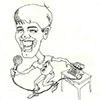
One of the poets, introduced me to her sister who just by chance had married a Mexican whose last name was Navarrete, just like one of my aunts in Mexico. The poet’s sister just happened to be a commercial artist. Eventually, she drew a caricature of me for my comedian’s business card. (It’s the caricature you see below.) I remember that she was afraid to show it to me because I might think that she was making fun of me. I really loved it! It was exactly what I wanted. I was always proud of my business card.

Elizabeth-Anne Vanek was the president of the group and she was a published poet. She was the heart, soul, and muse of the group. Without her, the group would have disintegrated. I also met Marc Smith before he became famous for his poetry slams at the Green Mill. He came to many meetings and would read his latest poetry for us.

I also remember Frida who came to every meeting religiously and listened to everyone’s work patiently and then commented with objective criticism. She was a writer who didn’t actually write anything. She couldn’t write anymore. Her muse had abandoned her.

I also brought my friend Tony Trendl from the Marquette Park Track Club for a couple of meetings. I must admit that I did the most writing in my life while I belonged to this group. It was then that I started writing for The Finish Line and the Illinois Runner. However,  I never published any of my short stories that I read to the group. My writing improved immensely while I was a member of the Writer’s Desk.

And in another one of those cosmic coincidences that frequently occur to me. I now live right down the block from where the Writer’s Desk used to meet!

DDR

Matilde y el martillo


Mi tío Samuel y mi tía Matilde

My tía Matilde was quite a character. Once when we were visiting México, we stayed with my abuelita who was blind. All our relatives would always visit abuelita, especially when we came from Chicago. Matilde was still single at the time, so she lived with my abuelita.

While we were there, my mother decided to fix up my abuelita’s place a little. That meant everyone there had to work, vacation or not! We cleaned and painted, and when my mother saw the freshly painted walls, she decided to hang up some family pictures. Only one problem. My abuelita didn’t have a hammer. So, my mother sent tía Matilde to get a hammer from a friend’s house.

That sounds easy enough, no? Well, not to a Mexicana. Somehow the simplest errands became a complicated quest. Tía Matilde sets off on the simple errand of bringing back a hammer so my mother could hang up some pictures. My aunt should have returned in ten to fifteen minutes tops. Well, a half hour went by and tía Matilde didn’t return.

My mother looked down the street and saw no sign of her sister. An hour passed, then another, and still no sign of tía Matilde. My mother sent me to the friend’s house to see if Matilde ever went there. No, they hadn’t seen her all day. No one really worried about her because in México sometimes people get distracted and forget their original mission, in this case, the quest for the hammer.

Tía Matilde finally returned about three hours later! My abuelita and my mother started interrogating her. “Where did you go? What took you so long?”

Well, she met this certain Samuel. He was standing on the corner playing the guitar and he started serenading her. They went for a walk and before she knew it, three hours had passed. Then, she remembered about the hammer! She returned, finally, but without the hammer!

My abuelita and mother were mad at my tía Matilde, but they also couldn’t help laughing at the whole situation. Matilde and Samuel eventually married and had six children.

DDR

Why study Spanish?


I’ve been teaching college Spanish for twelve years now. Every student has his or her own reason for studying Spanish.  Most college students take Spanish because of the foreign language requirement. I remember one of these students who barely passed the course. When I corrected the first exam, I felt bad for her because she had only earned a D. When she saw her exam grade, she shouted, “Yes!” I was worried that perhaps I had given her the wrong grade. The entire class turned to look at her. She then shouted, “Yes, I got a D!” She was so proud of herself. She went through this ritual after every exam. I gave her a final grade of D for the course. The next semester, I saw her in the hallway, and I was hoping she wouldn’t see me because I thought she was unhappy about her grade. But alas, she saw me and approached. Suddenly, she smiled and said, “Thanks for the grade you gave me!” And she was genuinely happy about it. Then, she added, “I had a lot of fun in your class.” I was shocked by all this, but I must admit that it was all very rewarding.

So, I was thinking of other reasons that my students took Spanish. Here are some:

  1. I’ve always wanted to learn Spanish.
  2. My wife speaks Spanish.
  3. My husband speaks Spanish.
  4. It’s a beautiful language.
  5. I want to go to Mexico on vacation.
  6. Most of my customers speak Spanish.
  7. My parishioners speak Spanish.
  8. I want to move to Mexico.
  9. I want to go to a Mexican restaurant and order food in Spanish.
  10. I want to see Penelope Cruz movies in Spanish.
  11. There are so many Mexicans here, we’re all going to have to learn Spanish anyway.
  12. I want a sexy Mexican girlfriend.
  13. I’m Mexican and I can’t speak Spanish.
  14. I think the cooks in the kitchen are talking about me.
DDR

Salsa


Photo by cottonbro studio on Pexels.com

My father loved his salsa. In fact, he always carried a jar of salsa in his coat pocket just in case of an emergency. By an emergency, I mean that rare event when we ate a non-Mexican house or restaurant that had never even heard of salsa, peppers, or even Tabasco sauce. My father was always at the ready with his jar of salsa. He was prepared for any disaster of this type.

At Burger King, when they asked him if he wanted everything on his Whopper, he said, “Yes, everything. And salsa!” When they would tell him that they didn’t have salsa, he would say, “That’s okay! I brought my own!” And he would pull out his jar of salsa from his pocket. He loved watching their facial expression when they saw that he had a jar of salsa. Some days, he felt that one jar of salsa alone would not suffice, so he would also bring a jar of jalapeño peppers. He ate jalapeño peppers like some people eat olives.

At home, my father tried to instill in us the values of our Mexican heritage. Number one on the list was teaching us how to eat salsa or peppers at every meal with every food that we were served. We always put up an argument every time. He even wanted me to put salsa on my corn flakes once! He loved to make his own salsa, but no one else liked it, not even my mother.

Once he made some salsa and I saw him put a spoonful in his mouth. He had made it extremely hot. It was too hot even for him. He drank a tall glass of water, but it took a while before he cooled off. Then, he offered me some. I said no, of course. But then he gave me the “What kind of Mexican are you?” speech and I felt compelled to try some of his salsa. My father had tricked me into tasting it by telling me that it wouldn’t be that spicy. I did taste it, but grudgingly. He told me to try a piece of diced potato that had been floating in the liquid of his homemade salsa jar. I think, how hot can it be? It’s just a potato. Wow! I bit into this potato, and it was hotter than any jalapeño pepper I had ever tasted.

When I was growing up there were people starving all over the world, but our parish and school decided to collect alms for the starving children in Biafra. They showed us pictures of these Biafran children who were nothing but skin and bones with bloated stomachs. On the one hand, these children so evoked our sympathy for them that we donated our candy money to feed these starving children in Biafra. On the other hand, some boys soon forgot about the starving Biafran children and invoked the name of Biafra for other purposes. In fact, they started calling the skinniest boy in the school Biafra. Biafra, I mean the skinniest boy in the school, happened to be in my class. And whenever someone wanted to poke fun at this skinny boy, he would go up to the Biafra collection can on the nun’s desk, drop a coin in the can, and say, “This is for Biafra.” Of course, he would then take a long look at the skinniest boy in the school.

I’ll never understand why the skinniest boy in the school just took it, instead of exploding and just start pounding someone. Anyway, back to my father and his salsa. Nice segue, no? Sometimes my father would cook our food and put the salsa in it while he cooked, as if we wouldn’t notice the flavor of salsa in the food. And as a diversion, he would put a big jalapeño pepper on the plate, too.

One day, my brothers and I were just sitting there staring at our food on our plates. We were starving, but we couldn’t eat it. Then my father got angry at us and said, “You should be grateful you have food to eat. There are starving children in Biafra!” I said, “Well, why don’t you send the food to them?” But then I realized that no matter how hungry someone was, he or she wouldn’t eat my father’s food anyway. I tried to imagine a skinny boy in Biafra receiving my father’s care package and seeing my plate of food with a big jalapeño pepper on top of the food. How hungry would he have to be in order to eat my father’s spicy cooking? No, I never could imagine a Biafran boy eating my father’s food.

And what did I learn from all this? Well, I learned a valuable lesson that I sometimes share with my own sons. It’s part of our family tradition. So, when my sons are sitting around the table complaining about the meal, sans salsa, that I cooked for them, I tell them, “You don’t know how lucky you are! There are starving children in Africa who would like to have an X-Box 360 Elite!”

DDR