Translation from one language to another always poses a problem. Dictionaries alone aren’t enough. They never have the latest technological terms. New products aren’t in there, either. For new products, I looked at the sales inserts of our local Spanish papers and most of the time I found the term I needed.
Now, with the Internet, there are all kinds of translators available. Sometimes students use them for their Spanish compositions. They write the composition in English first and then have the translator translate it for them. I can always tell when they use the translator because the composition looks as if it’s written in Spanish. However, the text is unintelligible. Yes, every word is in Spanish, but the wrong words were chosen, and the syntax is all wrong. The students write a better composition if they write entirely in Spanish. Even when they make mistakes, I can still decipher their intended meaning.
Occasionally, when I need to translate a word that’s not in one of my many dictionaries, I go to the internet and use an online translator for a word or two. Not all the translations are satisfactory. I’ve discovered that Wikipedia.com makes a great translator. A student needed to translate “jigsaw puzzle” into Spanish, and none of my dictionaries had it. So, I looked up jigsaw puzzle on Wikipedia and then I chose to read the article in Spanish got rompecabezas. For years, I’ve meaning to translate Daylight Saving Time into Spanish unsuccessfully. Today I looked it up on Wikipedia and got el horario de verano. This method would work for many languages because most of the Wikipedia articles are translated into many languages.
Standing: Patrick McDonnell and Adam Méndez. Sitting: My sister Delia, David (Me), and my brother Rick at my twelfth birthday party in Chicago’s Back of the Yards neighborhood.
Patrick McDonnell was my best friend in the second, third, and fourth grades at Holy Cross School. He was the smartest kid I ever knew. He had moved to Back of the Yards in Chicago from Ireland with his father, his brothers James, Leon, and Michael, and his sisters Cora and Margaret. His mother had died in Ireland before they came to Chicago. They lived next door to the firehouse on the corner of 45th Street and Marshfield.
I loved going to his house after school because we had fun visiting the firemen. Since he was a year behind in school because of his move from Ireland, he was older and wiser than me. Whenever I needed the mysteries of the universe explained to me, Patrick was there to explain them to me so that even I understood them.
Once, we were standing in the crosswalk on the corner of 46th Street and Paulina. I was about to cross the street when he stretched his arm across my chest to prevent me from crossing. Much to my surprise, a car drove right in front of our path. I was so amazed that he knew the car was coming our way. “How did you know the car was turning?” I asked him. “I saw his turn signal,” he said. “What’s a turn signal?” I asked. And he explained the Rules of the Road to me, edifying me about another one of the mysteries of the world, as only Patrick could. He performed a visual reenactment of our incident with him as the car and his eyes as the turn signals. He said he knew the car was turning left because he saw a left turn signal. He then winked his left eye repeatedly to represent the car’s left turn signal. For some reason, I always remember Patrick’s freckled face reenacting the left turn signal.
When his family finally moved to the suburbs—I don’t remember which one—he came to my house to say good-bye to me one last time. In retrospect, I should have gotten his new address and phone number. On the other hand, he didn’t ask me for mine, either.
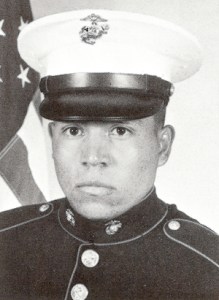
I met Leslie Cloud when I was in the Marine Corps Boot Camp in San Diego, California. He was proud of the fact that he was a Chippewa Indian from Wisconsin.
In boot camp we only knew our fellow Marines by their surnames because first names were unimportant. However, if we took a liking to someone, we introduced ourselves. Leslie approached me first. He said, “Hi, my name is White Cloud.” I started laughing because I immediately thought of the toilet paper by the same name. When I noticed he was staring at me with a menacing look, I stopped laughing. Then he laughed and said, “My name’s really Leslie.” I felt an immense sense of relief because for a second there I thought he would pound the laughter out of me.
We shared the same set of bunk beds, so that made us partners for many of our boot camp activities. In reality, he picked me for his bunk partner, although I’m not sure why. He said that I had to sleep on the top bunk, and the way he said it, I knew I didn’t have any other option.
I never really learned too much about his personal life, but occasionally he would say something that revealed his past. I was a regular Marine, and he was a reservist who would return to his reservation after boot camp. Sometimes he would reminisce about his life on the reservation, how he could hunt whenever he wanted. But other than that, he remained a mystery to me.
He had a sense of humor that today would be considered politically incorrect, but he always made me laugh. There were moments when I thought he was the funniest man in the world. Unfortunately, laughing was not allowed in boot camp. So, he tried to make me laugh at the most inappropriate moments. In the morning, we had to make our bunks and stand at attention. The goal was not to be the last one done, or you and your partner would be ordered to do pushups or another callisthenic exercise. The first day we were bunkmates, I thought I was making my bunk at breakneck speed. By the time I had finished tucking the hospital folds of the bottom flat sheet, Leslie began helping me with the top sheet. When I looked at his bunk, I was amazed that he had already made it. It was so perfectly made, too, that it passed the quarter-bouncing test when the drill instructor bounced a quarter on the bed to see if the sheets were tucked in tightly enough. “Where did you learn to make a bed like that,” I asked. With a wink of an eye, he said, “It’s an old Injun trick!” Then, he got serious and said that he had grown up in an orphanage.
When we were in infantry training, we shared a tent that we put up faster than any other team in the platoon. I realized that I had only assisted him while he did most of the work. We stood at attention for what seemed an eternity waiting for the next team to finish setting up their tent. While we were standing there, I asked, “How did you put up the tent so fast?” He looked at me with a straight face and said, “Injun-uity!” I had to contain my laughter so as not to be punished for not being at attention. The incident I remember most? I was looking at picture from my last trip to México immediately before entering boot camp. I had a picture of my grandmother with her long black hair with traces of gray in the traditional Mexican braids and her deep brown skin and broad cheeks. I saw Leslie looking at the picture, so I told him she was my grandmother. He solemnly said, “So you’re one of us.”
Toward the end of our boot camp training, we were informed that we had both been meritoriously promoted to Private First Class (PFC). He began calling me PFC Rodriguez, and I called him PFC Cloud. Those titles sounded so prestigious in boot camp when most recruits were only privates. However, during the promotion ceremony, I was promoted but not Leslie. He showed no outward indication of disappointment. I never found out why Leslie didn’t get promoted. When we said our good-byes after boot camp, I asked him for his address so we could stay in touch. He said no because he wouldn’t write to me anyway. And that was the last I ever heard of him.
I can’t remember Sergio’s last name. We met when we lived at the house at 4405 South Wood Street in the Back of the Yards neighborhood. We must have been ten years old back then. He thought I was the funniest kid in the neighborhood, so he always laughed at all my jokes.
What made him unusual in my eyes was that he was Mexican, but not Catholic. I always assumed everyone in our neighborhood was Catholic regardless of his or her ethnic origin. I never thought of asking about his religion until he went to Sunday mass with me once. As an outsider, he was more of aware of the Catholic rites than me, perhaps because I performed them as a matter of habit that was so ingrained in me. After we sat in the pew, Sergio watched the parishioners as they entered and blessed themselves with holy water. Then, he asked me why I didn’t stick my fingers in the water basin. As is my custom, I often forget to do things that have become so habitual.
One time, I mentioned that we had a red cat. He insisted that there was no such thing as a red cat. I insisted that we had one. The rest of the boys looked at me as if I were crazy. Eventually, Sergio bet me a quarter that I didn’t have a red cat. I took him on. We did the official shaking of the pinky fingers that made our bet legally binding in the Back of the Yards parlance. The loser had to pay up. He asked for proof that I had a red cat. I went home and pulled out a toy red plastic cat with wheels that I pulled by a string to Sergio. When he saw the cat, he laughed and laughed. He continued laughing for minutes. Then, he paid me a quarter as he continued to laugh.
Rudy was the consummate pitchman. The last time I met him was at his mother’s funeral when we were both adults. He was telling about his job as a brake pad salesman, and I was thoroughly impressed by his knowledge of brake pads.
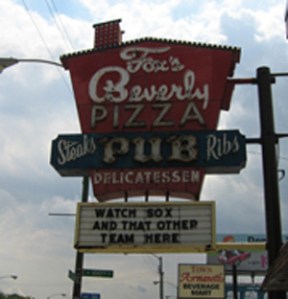
However, I shall always remember how he tried out as pitcher for the Chicago White Sox every spring. He was a Southsider, after all. The coaches always told him to keep working out. In the traditional Chicago fashion, Rudy always reassured us with the words, “Wait till next year!” One of the main reasons he never made the team was because he focused more on spending time with his drinking buddies.
He was a great storyteller who always attracted the attention of everyone within hearing range. He was a very likeable guy who was fun to have around. We spent much more time in bars than on the baseball field. Although he lost interest in his workout plan for much of the year, he never lost the hope of making the team. Come springtime, he would get all worked up again for the open tryouts. After a few years we lost touch, but I always kept watching baseball with the hope that I would see him on the mound someday.
When I saw him again at his mother’s funeral. He still had not lost the hope of playing in the pros even though he was well past the age of a rookie pitcher. He had planned to try out with one of the Texas teams where he was now living. He was a great brake shoe salesman due to his outgoing personality and doing quite well working on commission. After explaining the virtues of his brake shoes in comparison to the competition, I was sold on his. Then I recalled why I always believed he would one day become a Major League Baseball pitcher. He could make you believe in whatever he was pitching.