When I was driving on the highway in Mexico, I suddenly noticed that my tire pressure warning light came on. This handy little invention saved me from changing a flat tire twice before.
But now, on the highway in the middle of nowhere–or so it seemed in my panic when I saw the warning light–I knew I had little time to get to a gas station to check the tires. I didn’t want to have to change a flat on the highway, especially since it had been miles since I saw anything resembling a shoulder where I could pull over.
Luckily, I saw a Pemex gas station a few minutes later. I had the attendant check my tires and he told me that my front driver’s side tire was low on air. Suddenly, I remembered driving into a pothole that swallowed my entire tire in Celaya. Then he pointed out a hole in the sidewall.
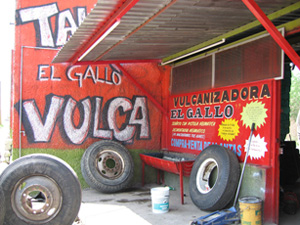
When you go to the tire shops in the U.S., damage to the sidewall automatically means that you have to buy a new tire. I asked the attendant if there was a tire repair shop nearby. He told me to keep going a couple of more blocks until I saw the sign that read, “Vulca.” As I pulled up, I didn’t see any new tires. I pointed to the hole in the sidewall and asked the vulcanizador if he could repair it. He nodded and immediately jacked up my car and removed the tire. He took the tire off the rim and patched the hole from the inside. He repaired my flat in about ten minutes. And he only charged me thirty pesos, which was about three dollars.
I was so grateful to have averted changing a flat tire that I tipped him twenty pesos. We were both extremely happy by the transaction. Well, I drove more than two-thousand miles on that repaired tire. I’m still driving on it! That makes me wonder about all those previous new tires I bought because I was told that sidewall damage couldn’t be repaired!