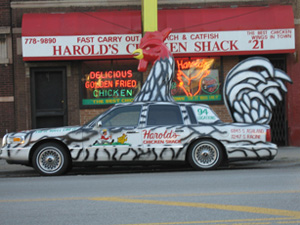
One of my favorite fried chicken places in Chicago is Harold’s Chicken.
The first time I ate at Harold’s was about twenty years ago. I wasn’t sure what to expect, but I was pleasantly surprised. I don’t even remember which one I went to the first time. It was somewhere on the south side, perhaps around 71st and State. I ordered the 1/2 chicken dinner. They literally gave me half a chicken. When they asked me if I wanted hot or mild sauce, I asked for the mild sauce because I wasn’t sure how hot the hot sauce would be or if I would even like it. I watched as they prepared my order. I got my half chicken with French fries on a slice of white bread and a small Styrofoam cup of cole slaw that was warmed by the chicken–I’m used to eating my cole slaw cold. Then the cook put the mild sauce on the chicken, the fries, and the bread with a two-inch paintbrush. Yes, the kind you and I use to paint a house. I suppose it’s sanitary if they only use it for putting hot or mild sauce on chicken. I loved how good chicken tasted that I often went back to Harold’s Chicken to eat. I think the paintbrush added that je ne sais quoi.
The first time I ate at Harold’s, I thought the slice of bread was a rather peculiar addition to the meal. I mean, it was underneath the chicken and the fries, so the sauce dripped all over the white bread. But when I ate the slice of white bread, it was delicious! Now, I look forward to the slice of white bread.
Over the years, I have eaten at other Harold’s Chicken restaurants. And I always order the half-chicken dinner with fries, warm cole slaw, and one slice of white bread. When I taught at Columbia College Chicago, I often ate at the Harold’s on Wabash and Balbo. You could actually sit down and eat there, but it was always so crowded and homeless people would always ask for money. After a while, they just ignored me–probably because I just ignored them. My only real complaint about this Harold’s Chicken was that they didn’t put mild or hot sauce on the chicken with a paintbrush.
I love music! But I don’t know very much about music. In fact, thousands upon thousands of music books have been written about everything that I do NOT know about music. And I am proud to say that I have never read even one of those books! Even though I love music so much.
I really do love music. I listen to music almost every waking moment. But I listen to different kinds of music, depending on where I am. When I’m at UIC, I listen to rock on my iPhone. When I’m driving, I listen to the oldies. However, whenever I’m home, I listen to 98.7 WFMT. All the time! Even when I’m sleeping. And I always crank up WFMT all the way to eleven. Except when I’m sleeping. Listening to classical music allows me to read or write, or even correct Spanish compositions. I don’t know much about classical music either, even though I listen to it all the time.
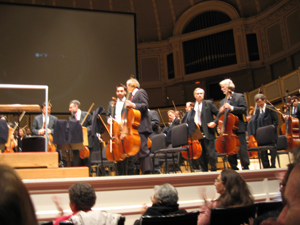
Even though I’m not qualified to critique music, I would like to tell you about a concert I attended at the Chicago Symphony Center. I went to see Beyond the Score that explained the structure and meaning of Sergei Rachmaninov’s Isle of the Dead. The orchestra played the works of other composers who influenced Rachmaninov for this piece. It was a multi-media presentation, so there was a giant screen to show pictures of the painting Isle of the Dead that also influenced this piece as the story was narrated. I sat in the third row right in the middle of the screen. When the conductor Vladimir Jurowski came out, he stood right in the middle of the screen, illuminated by it from behind. This ominous sight made such an impression on me that I wanted to take out my camera and take a picture. But I managed to refrain myself. I regret it now. I should have lived a little more dangerously and taken the picture anyway!
So why do I love music so much? I’m not really sure. Why do I especially love classical music even though I don’t understand it? Okay, you really got me on that one!
However, if I think really hard, I picture Sister Cecilia from my grade school days at Holy Cross. Sister Cecilia was the music director for our school. She would teach the school songs for Sunday mass, for Christmas, and–her favorite holiday–the pastor’s birthday. For Father Edward’s birthday, the school would meet in the assembly hall at least twice a week and we would sing a special birthday song that Sister Cecilia prepared just for him. She would take a current top forty hit and change the lyrics just for Father Edward. For example, one year, she took “Georgie Girl” and we sang “Hey there, Father Edward …” Another year, “What’s It All about, Alfie?” became, “What’s It All about, Father Edward?” Pretty clever, huh? Unfortunately, I can’t remember the rest of the lyrics to these wonderful songs or any of the other songs we sang for Father Edward’s birthday.
Sister Cecilia went through great pains to teach the entire school these songs. When we met to rehearse, she would pass out the sheet music with her new, improved lyrics. She was very demanding. We would stand at attention while we sang, and she would walk among our ranks ensuring that everyone sang. She would tell us, “Open your mouth wide when you sing! I should be able to put a silver dollar in your mouth when you sing!” Things didn’t always go smoothly. Sometimes she would yell at us if too many students sang out of key. She would yell, “Look at the music! If the note goes up, your voice goes up, too!” I always sang at my best when she stood directly in front of me. The rest of the time I merely lip-synced the words. I was ahead of my time.
When we got a new pastor, Father Mikolaitis, she didn’t seem that enthusiastic about his birthday celebration. In fact, we never called our new pastor by his first name.
In the seventh and eighth grades, we took a music appreciation class, taught by none other than Sister Cecilia. I actually enjoyed this class. I don’t remember much from this class. Well, I do remember f – a – c – e and every good boy does fine, but other than that, not much. My favorite part of the class was learning about the orchestra. She would place the phonograph that came in a box that always reminded me of a traveling valise. She would put it on her desk and play a 78-rpm record. The narrator described all the instruments of the orchestra one by one. Each instrument would demonstrate its range and what it could play. I was truly fascinated by this information. To this day, I recognize most of the instruments of the orchestra. Sometimes, I like to amaze my friends with my knowledge of music while we listen to classical music, despite them insisting that we listen to something else. Ever the veritable font of wisdom that I am, I will correctly point out, “Did you hear that instrument? THAT was a triangle!” And they’ll stare at me with their mouth gaping. Because I know that they’re utterly amazed by my knowledge of classical music and the orchestra!
Chicago and Illinois residents awoke this morning to a new set of Chicago ordinances. Mayor Daley called an early morning secret meeting of the Chicago City Council. New city ordinances were enacted under the cover of night, surprisingly reminiscent of the Meigs Field Airport closing. The new Chicago ordinances take effect immediately.
All reporters are hereby prohibited from using the words “clout” and “bribes” in the same sentence with the name of Da Mayor or any council member.
Parking ticket books will be issued to all Chicagoans who purchase a Chicago city sticker.
Richard J. Daley is now formally recognized as one of Chicago’s founding fathers.
Illinois is now officially a suburb of the city of Chicago.
Lawsuits against the city of Chicago will immediately be dismissed if not filed by an attorney with Machine clout.
Four-day school week will become the law for teachers. Students will continue to attend school five days per week.
Old police motto of “To Serve and Protect” on police cruisers will be replaced with “To Curb and Collect.”
O’Hare Airport passengers are now officially Chicago citizens and must pay property taxes while at O’Hare.
Lake Michigan is now Lake Chicago.
St. Patrick’s Day will only be celebrated on March 17.
Days of the week beginning with the letter “R” or “D” are now parking meter holidays.
Alternate Leap Days will be designated “The City that Works” Day, whereupon all city workers must work a full day.
Yesterday’s problems will be deferred to future generations.
As a lifelong Chicagoan, Mayor Daley has always been part of my life. And by Mayor Daley, I mean both Richard J. Daley and Richard M. Daley. As a boy I lived under the reign of Richard Da First. In Back of the Yards, everyone knew Mayor Daley because his name always appeared on some of our neighborhood programs and in daily conversation. At Holy Cross, the Lithuanian nuns told us how Mayor Daley went to mass every day and was therefore a good Catholic and Chicagoan. Mayor Daley was a man of mythic proportions.
When Mayor Richard J. Daley died in 1976, I, along with many of my family and friends, were in shock. Mayor Daley was the only man we had known as The Mayor of Chicago. The last time I had such a feeling was when President Kennedy was assassinated. There was a period of alienation for Chicagoans during the interregnum until the next Mayor Daley was elected.
All true Chicagoans rejoiced when Richard M. Daley was elected mayor. The present Mayor Daley (Richard Da Second) is always highly criticized and panned for his politics and poor diction (like father, like son), but he always gets reelected, in part because of his father’s fame and reputation as good Chicagoan.
My life has crossed paths with the Daley family on many occasions. And I’m extremely thankful for that connection. Even when I’m not thinking about the Daleys, they remind me of their existence in some surprising way. Of course, there are all the signs at the Chicago airports to which Mayor Daley welcomes you. Then when I least expect it, I see another reminder somewhere totally unexpected. Once, when I was studying at the Saint Xavier University Library, I went to admire a stained glass window. I then noticed a small plaque that dedicated this window to Joseph Daley, father of Richard J. Daley who donated the window.
By good fortune, I was assigned to guard the home of Eleanor “Sis” Daley, the widow of Richard J. Daley, when I was a police officer. No police officer wanted to work the detail because it was perhaps the most boring assignment on the job, so as the rookie, I was assigned to sit it front of the house. I was attending UIC and I used to study while in the unmarked car. No one complained because I was always alert and awake and actually guarding the house. Sis once asked me if I was bored out there, so I told her I was going to school and the guard duty allowed me to catch up on my reading. When I finally graduated, somehow I made it into the Chicago Sun-Times for a Robert Herguth profile. Sis saw my profile and asked me to come into her house. She told me that she was proud of me. She said that her husband wanted to build a university in Chicago for students just like me and that was why UIC existed. She said that UIC was Mayor Daley´s greatest source of pride!
I thought it was a momentous occasion when Mayor Richard J. Daley’s writings went to the UIC library and the library was named after him. Yet another way that Mayor Daley impacted my life!
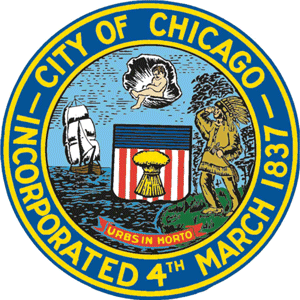
The City of Chicago was incorporated on March 4, 1837, and the world has never been the same since. Chicago helped shape American history. No one in Chicago actually celebrates this birthday, but true Chicagoans are always aware when March 4 comes and goes without any fanfare.
The City of Chicago Seal was adopted officially in June of 1837. I will try my best to explain the symbols in the seal. I will rely on my memory, which isn’t always exactly accurate, to recall facts and myths I have heard or read. I remember a little from the Chicago History course I had to take way back in the fourth grade. The Lithuanian nuns at Holy Cross School were simply crazy about Chicago History. I’m not sure if there’s even an official explanation of the seal anywhere, but I will try my best to explain its symbolism.
The shield represents the United States of America. The colors of the American flag are represented as are the original thirteen American colonies by the thirteen stripes. The sheaf of wheat represents our abundant agriculture and fertility. The ship represents either Columbus, the Europeans, or the Pilgrims arriving in the New World. The ship is seen and/or greeted by a Native American. In the fourth grade they were called Indians, but we all know that Indians is a misnomer because Columbus never did reach India as he had planned. Well, Native American isn’t a particularly good term, either. America was named after Amerigo Vespucci who did a better job of selling and publicizing the New World to the Spanish Catholic Monarchs.
The baby in the seashell represents a new beginning. I suppose it also has echoes of Botticelli’s The Birth of Venus. I remember during Mayor Harold Washington’s reign, some of the African American alderman wanted to get rid of the white baby because it was a racist symbol. The baby might have been legislated out of the seal, but then someone projected the cost of removing the white baby from every place it appeared in Chicago into the millions of dollars. And so, the City of Chicago still has a white baby. We have learned to live quite well with the white baby.
At the very bottom is the Chicago motto: Urbs in horto, which means city in the garden in Latin. Well, we are a city, but we are no longer in the middle of a garden. And you can thank urban sprawl for that!



 Chicago USA