Bridgeport welcome


Bridgeport, Chicago, Illinois

Bridgeport is a neighborhood unlike any other in Chicago. Actually, there are two Bridgeports: the mythical, political Bridgeport that every Chicagoan hears about since starting school and the earthy, gritty Bridgeport that contrasts sharply with the mythical, political version.

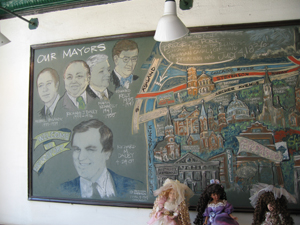
In grade school, we learned all about Bridgeport, which is the birthplace of five Chicago mayors, including the present Mayor Richard M. Daley (Richard da Second). Bridgeport didn’t invent machine politics; they merely perfected machine politics, reaching its apogee in Mayor Richard J. Daley (Richard da First). Bridgeport is also very near the geographical center of Chicago. Many south siders often went to the White Sox games at Comiskey Park in Bridgeport. When I was a student at Holy Cross School, no school field trip would be complete without first driving past Mayor Daley’s bungalow at 3536 S. Lowe Avenue. Bridgeport was the Mecca of the south side. Every Chicagoan made a pilgrimage to Bridgeport at some point in their life.

When I told my mother that I was planning to buy a house in Bridgeport, she cringed and told me that I would regret it. For some unknown reason, I was drawn to Bridgeport. Besides, this was the location of the only house I could afford using the GI Bill. But before I bought this house, I checked out the neighborhood first. I drove past the house several times, at different hours of the day and night. Every time I drove past my future home, the block was extremely quiet. I never saw any movement in this vicinity at any time. I was sure that I was moving into a good neighborhood. After all, this was Bridgeport. So, I bought the house, much to my mother’s disappointment, and I moved in.

This was when I saw the earthy, gritty side of Bridgeport for the very first time. You don’t really know a neighborhood until you move in, and you live there 24/7/365. It was only then that I saw the seedy side of Bridgeport. My house was situated next to an alley that ran alongside the length of my house, an alley that everyone in the neighborhood used as a shortcut. I always heard whoever walked through the alley talking, at all hours of the day. Then one day, I noticed that Bridgeport had a gang problem, and my house was right on the border between two gang turfs. My neighbor always tried to start a fight with me by pointing to my camouflage shirt, a remnant from my Marine Corps enlistment, and tell me, “Hey, man! The war’s over!” I would ignore him and walk past him quickly. It was about that time that I learned that there were two sides to Bridgeport. And I lived on the wrong side of Bridgeport! I lived on the side where the public housing projects were located, the only white projects in the whole city of Chicago!

While I lived in the Marquette Park neighborhood, I had developed certain habits and I thought I could continue them when I saw all the stores, shops, and restaurants that were available in Bridgeport. I really thought that I would enjoy all these places that were within walking distance of my house. I went to Lina’s Italian restaurant that was less than one block from my house because they served authentic Italian food. Or so I thought. When I entered the restaurant, I was greeted by Lina herself. I asked for the beef ravioli because I love authentic beef ravioli. Lina said, “It takes too long to make.” I said, “That’s fine. I’m not in a hurry tonight. I brought a book that I can read while I wait.” “Well, I’m not going to make ravioli just for you. Why don’t you order something else?” So, I did. But I went back a few times hoping to eat ravioli, but she always refused to make it.

I once needed a button sewn on my winter wool coat, so I went to a tailor on Halsted Street. The tailor said, “You want this button sewn on? Why don’t you buy yourself some needle and thread and sew it on yourself?” He didn’t understand that I didn’t want to sew it on myself and that I was willing to pay him to sew the button on for me. He continuously refused, so I left.

I went down the block to the barbershop that appeared to be in a continuous state of disrepair, since at least the 1960s, judging by the newspaper clippings on the wall. There were no customers in the store, so the barber was sitting in a chair. When I entered, he stood up and said, “How may I help you?” I told him that I wanted a haircut. Well, he wasn’t giving haircuts that day. So, I left.

Then, I went to the 11th Ward Office because I needed garbage cans for my house. They refused to give me garbage cans because I didn’t appear as a registered voter within their ward even though I had just moved there. I left without garbage cans. This was certainly a fine welcome to Bridgeport. I eventually adjusted to life in Bridgeport. You just had to learn not to have too high expectations.
DDR

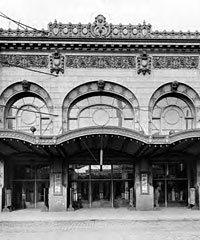
Peoples Theater


Peoples Theater, Back of the Yards, Chicago, Illinois

Growing up in the Back of the Yards neighborhood had many advantages. One of them was the Peoples Theater at 1620 W. 47th Street where we went almost every weekend to see movies. I was really impressed by the theater because it seemed so classy to me. There were marble floors, marble walls, and even the restroom looked elegant with its marble floor and walls. The incongruous thing about the restroom was the fact that the rolls of toilet paper were securely bolted in place. Otherwise, people would either steal the whole roll of toilet paper or dump it into the toilet. I could never understand why anyone would dump a perfectly good roll of toilet paper into the toilet, but other public restrooms in the neighborhood that didn’t take such precautions actually had rolls of toilet paper in their toilets.

However, in my circle of young friends, there was an unwritten rule that you never used the sit-down toilets of a public restroom. Never! Never ever! Under no circumstances. You were supposed to hold your number two in and run home to the comfort of your own bathroom, hopefully in the nick of time.

In the auditorium of the theater, there were a lot of terra-cotta decorations. I used to stare at them while waiting for the movie to start. I was always fascinated by the ceiling way over my head. There was a giant oval recess that was always lighted. I would imagine different things while looking at it. But what I usually saw was the underside of a giant turtle. I imagined that it was in a huge overhead aquarium and I was always afraid that it break open from the weight of the giant turtle and that we would all drown under the huge waterfall. As you may have already divined, I now tell this story because no such disaster ever befell upon me!

For Christmas, Holy Cross School would have a special day for us to go to Peoples Theater to see a Christmas movie. We would get out of school for this special field trip a whole two blocks away from the school. We loved any event that allowed us to miss class!

During the week in the summer, my mother would take my younger brothers and me to Peoples Theater while my father was working. She used to like watching those romantic movies, which I found so boring when I was little. I believe we saw Gone with the Wind, Dr. Zhivago, and From Here to Eternity. Whenever the couple kissed, I thought the movie was over and I would pull my mother’s arm so we could go home. My mother only took us to the show when she wanted to see a movie. My father would take us even if it were a movie just for kids. Of course, he would sleep through the entire movie because he worked the midnight shift at Curtiss Candy, a candy factory underneath the old S-curve at Lake Shore Drive and the Chicago River that manufactured Butterfinger and Baby Ruth candy bars. The only time he really wanted to see a movie was when they showed Cecille B. DeMille’s Ten Commandments. Of course, he fell asleep through those movies, too. We usually only went to the matinée show on Saturday because the tickets were only fifty cents.

When I was a little older, I started going to the movies with just my brothers and no parents. As the oldest, I was in charge of taking care of them. When my brothers were older, we all went to the theater separately with our own friends. I went a lot with Adam Mendez or Patrick McDonnell. One day, Patrick invited me to go with him during the week. I told him I couldn’t go because I couldn’t afford the full price of the ticket. He told me that he had free passes for the theater. His father had told him where to get them. There was an insurance sales office near the theater that gave free passes to customers. Patrick, who was wise beyond his years, showed me where to go to get the free tickets. He made small talk with one of the insurance agents who asked how Patrick’s father was and he gave us two free passes to Peoples Theater. After that, we went to a show once a week during the week when the tickets cost full price and sometimes, we were able to sneak in to see some adult movies. However, they caught us when we tried to see Bonnie and Clyde with Warren Beatty and Faye Dunaway, and they made us leave.

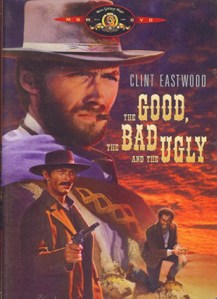
One day when we went to the insurance office, the manager told us that they were going out of business, so he gave Patrick the whole packet of movie passes. If we liked a movie a lot, we would see it at least twice, oftentimes, more. When Patrick moved away, I inherited the packet of passes from him. Then, I used to go Peoples Theater with my brothers and my friend Adam. I remember that Adam and I really loved the movie The Good, the Bad, and the Ugly so much that we saw it everyday for two weeks. And we never got tired of it. I saw many of my favorite movies there: The St. Valentine’s Day Massacre, Born Losers (a biker movie), Flipper, and others that I can’t recall now.

I just had to buy the DVD!

When I was older, my mother sent me to see Irma Serrano at the Peoples Theater. My mother went to Mexico when Irma Serrano came to Chicago. She told me to tell Irma I was Carmen Rodriguez’s son. When I did, Irma invited me backstage, and I took pictures of her. I never did learn how my mother got to know Irma Serrano

Alas! Peoples Theater is no more! There is a Walgreen’s on the site now. But I will always remember Peoples Theater for all its terra-cotta decorations and marble walls and floors, even in the restroom! It was kind of like going to church every week.

DDR

La Humita


The flag of Ecuador.

After the play last night, I ate at La Humita, which serves Ecuadorian cuisine, at 3466 N. Pulaski Avenue, 773.794.9672. I had never eaten Ecuadorian food, or at least I don’t really remember if I did. I ordered the pork chops, and they were delicious. So were the vegetables. They have live music on Fridays and Saturdays and karaoke on Thursdays and Sundays. Okay, so my review is a bit terse. Now you know why I don’t write restaurant reviews. Anyway, here is their website:

www.lahumita.com

DDR

Vain


My Spanish study group!

Last night, I went to Vain, a night club at 2354 N. Clyburn, for a birthday party for one of my Spanish students, Binh. This is a really nice club with really good music. Two of my Spanish students insisted that I go to this birthday party and few other students in the class said they would also go. Well, I had a lot of fun, with the exception of waiting in line for a half hour just to get in. The bouncer carded me even though I have gray hair. I just rolled my eyes and let out a sigh of exasperation as I handed him my ID. At times like this, I wish that I had a fake ID with the name McLovin on it. I’d like see how a bouncer would react to that. Anyway, my students were very surprised that I even showed up. And they laughed at me when I was carded. I mean, look at my picture! Well, I was the oldest one at the party, but many were UIC students, past and present. I was surprised to learn that everyone at the party knew who I was: Binh’s Spanish teacher! Most of them greeted me enthusiastically and spoke to me for a while. I even have pictures to prove it! You can see them on Facebook. A few students said that they tried to get into my Spanish class, but it was already full. I met a couple of former students from four years ago. Anyway, we had a lot of fun at the club. I gave the birthday boy Binh a birthday card in Spanish and a Tatiano Bolaños CD for his birthday. Hey, I am a Spanish teacher, ¿no?

DDR

Labas


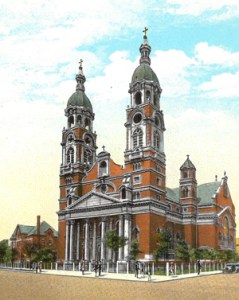
Holy Cross Church

Labas. That’s right. Labas. To all my Lithuanian friends: Labas! In fact, I’d like to greet everyone reading my blog: Labas! That’s hello in Lithuanian. My Lithuanian friend Vito taught me that word because he always insisted that we greet each other by saying Labas. Now, I always greet Lithuanians with Labas and they always smile. I especially love to greet them with Labas especially if they didn’t think I knew they were Lithuanians. I’m not sure why, but they’re always thrilled to hear me say Labas. So, to all my Lithuanian readers: Labas! I guess sometimes I go on and on, don’t I? Well, my friend Vito taught me another Lithuanian word: tylėk. Sometimes we would go to the show, I would just keep on talking even after the movie started. He would keep telling me tylėk until I finally shut up. That’s right, tylėk means shut up in Lithuanian. But I never did. And I never will.

For as long as I can remember, I have always lived near Lithuanians in Chicago. In Back of the Yards, Holy Cross was the Lithuanian church I attended. At Holy Cross School, the nuns always praised The Jungle by Upton Sinclair because the protagonist was Lithuanian, and the novel was set in Back of the Yards. When we moved to Marquette Park, 2509 W. Marquette Road, many Lithuanians lived there, and they even had a street named Lithuanian Plaza Court. In fact, that neighborhood was the unofficial capital of Lithuania during the Soviet era. Maria High School, run by Lithuanian nuns, was at Marquette Road and California Avenue. Right on the same campus was the retirement convent for the Sisters of Saint Casimir at 2601 W. Marquette Road. The Lithuanians also had their own Holy Cross Hospital at California Avenue and Lithuanian Plaza Court. I met my friend Vito when I lived in Marquette Park. Vito and I used to eat at the Lithuanian McDonald’s at 68th and Pulaski. I don’t know if it was actually Lithuanian, but Vito told me that the tiles on the wall were typical Lithuanian colors, so it became a Lithuanian McDonald’s in my mind. When I moved to Bridgeport, there weren’t that many Lithuanians there anymore, but they did have a street named Lituanica Avenue. My favorite restaurant in Bridgeport was a Lithuanian restaurant named Healthy Foods at 3236 S. Halsted Street. When I saw the movie Chariots of Fire, I was thrilled to learn that the family of Harold Abrams were Lithuanian Jews.

When I was a student at Holy Cross, my best friend was Patrick McDonald, but when he moved away, I became friends with Adrian Stanislovaitis and Anthony Kivenas, both Lithuanians. Whenever I was with them, we spoke English, but when they were with their parents, they spoke Lithuanian. I never understood what they said, and it didn’t bother me at all. However, I never even learned one Lithuanian word from them. And when they came to my house, I spoke Spanish with my parents and grandmother. I envied Adrian and Anthony because they got to go to Lithuanian classes on Saturday morning. I wanted to go with them. I wished Mexicans would have Spanish classes for Mexicans. Anyway, Adrian and I spent a lot of time together. For school holidays, we used to take the bus downtown and just wander around, but he showed me a few points of interest, such as the Prudential Building because it used to be Chicago’s tallest skyscraper.

When we moved to Marquette Park, we met more Lithuanians. Marquette Park has a monument for Lithuanian aviators Captain Steponas Darius and Lieutenant Stasys Girenas. This is where I met Vito and other Lithuanians. I went to Lithuanian restaurants and bars with Vito. At one bar on Lithuanian Plaza Court, it might have been Knight’s Inn, we met a Lithuanian improv group that was named Second Village, which is Antras Kaimas in Lithuanian. It was inspired by the name of Second City. We talked to them for a while, and Jim, Vito, and I told them that we performed standup comedy. We ended up making a little skit/song/dance for them sung to the tune of “Skip to My Lou.” I still remember it, but don’t know how to spell it because it was in Lithuanian. Vito wrote most of the song. My contribution to the song? Labas and tylėk! No surprise there!

We once went to a Lithuanian festival on Western Boulevard near the Lithuanian V.F.W. Hall, which if I remember correctly was named after Darius and Girenas. Anyway, there were all kinds of Lithuanian food. One vender was selling empanadas, which really surprised me because as far as I knew, empanadas were Mexican food. The Lithuanian cook tells me that empanadas were invented by Lithuanians. He could tell that I didn’t believe him. He pressed on with his explanation and tried to convince me that I really didn’t know Mexican food. He was so convincing that I almost believed him. Almost, but not quite. Finally, he told me that he learned to make empanadas in Argentina. During WWII, his family went to Argentina before they came to America.

That’s how I think of Lithuanians. They’re always ready to play a friendly practical joke on you. Vito was always the joker and had a great sense of humor that not everybody got. I could tell he got it from his father. Once I went to Vito’s house so we could go to the show. His father answered the door and I asked for Vito. He knew very well that I was asking for his son, Vito, my friend, but he said, “You’re talking to him.” I said, “No, Vito Junior.” He said, “I am Vito Junior!” This went on much longer than was comfortable for me, but Vito’s father was really enjoying this. Finally, he said, “Vito’s not home.” Why didn’t he just tell me that in the first place? Well, he wanted to play a joke on me. I laugh now that I think of it. But that day I learned that both Vito’s father and grandfather were named Vito. What really made me uncomfortable about them was how they greeted each other and how they said good-bye. Vito would always kiss his father on the lips. Talk about culture shock! For a while, Vito lived with his grandfather Vito. Before we would go out, Vito would kiss his grandfather on the lips before he went out. It wasn’t as shocking since I had finally gotten used to him kissing his father. But one day we were talking, and Vito told me that his father was adopted. Suddenly, it hit me. “Vito, you kiss your grandfather on the lips, and he’s not even related to you!” He thought nothing of it. I still can’t get over it!

DDR