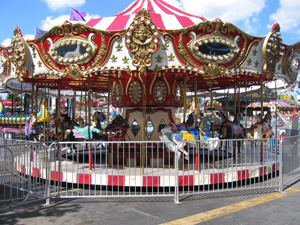
Most Holy Redeemer Church Carnival, Evergreen Park, Illinois
Riverview will always remain my all-time favorite amusement park! Of course, nostalgia has a lot to do with it. Every time I recall Riverview, I always remember the best days of my childhood.
This was an amusement park right in the city of Chicago and it was easily accessible by car or public transportation. What I remember most about it is the circus atmosphere about it, something today’s modern theme parks seem to lack. They had a tattooed lady, a bearded lady, world’s smallest man. But we never actually went in there because my father said that we couldn’t afford the tickets.
There was Aladdin’s Castle fun house with its distortion mirrors and the maze that scared the heck out of me when I was six. And half the fun was getting there. My father usually drove us to Riverview, but occasionally, we would take the bus and El to get there. When I was older, I realized that my father took us way out of the way just so we could ride the El, but we always had fun. Of course, my mother never went when we took public transportation. I think my father had the most fun on these trips.
My little brother Dicky was about four the first time he went to Riverview. He got scared when we rode the El and realized we were about two stories off the ground. We thought he wouldn’t have fun at Riverview because he would be too scared for all the fun rides. We took him on the age-appropriate Merry-Go-Round, but he cried. Then we took him on the Caterpillar, which was basically like train on the Tilt-a-Whirl tracks. During the middle of the ride, a canopy covered all the cars. Dicky started screaming and kicking when we were under the canopy. I tried to calm him down, but he didn’t stop screaming until the ride was over. I thought we wouldn’t have any fun at Riverview.
I tried to think of rides that he would like, but I was sure they would all scare him. Back then, there were no size restrictions, such as having to be a minimum height to get on a ride. So even though Dicky was only four, he was able to ride the Silver Flash roller coaster that went around the amusement park. I thought for sure that Dicky would start crying immediately, but no, he loved the ride and laughed his head off the entire ride. So we rode roller coaster the rest of day, even though I would have liked to ride the Caterpillar a few more times. I never could figure out Dicky. On the way home, he was no longer afraid to ride the El.
I met Tony Jr.–his full name was Anthony Borkowski Jr.–when I worked at Derby Foods, 3327 W. 47th Place, home of Peter Pan Peanut Butter and Derby Tamales. His father, Anthony Borkowski Sr.–also called Tony–wanted his son to work while he attended school at DeVry. Tony Sr. thought his son was getting too lazy by just going to school and not working. Tony Jr. was already twenty-two, but still had not graduated from college. He was a student at the University of Illinois Circle Campus–before it became the University of Illinois at Chicago (UIC)–and belonged to a fraternity, so he partied a little too much for his father’s liking. So Tony Jr. transferred to DeVry and started working at Derby Foods.
Tony Jr. towered over me whenever we talked. He had dark blond hair and wore round wire-rimmed glasses. He looked flabby, but was actually rather muscular. He could do any job at Derby Foods, including unloading the 135-pound bags of raw peanuts from the railroad boxcars (something I could only do for more than a few days at a time because that job exhausted me). He was always on time for work because his father always woke him and they went to work together, even if Tony Jr. had been out partying all night. Tony Sr. would pull off the blankets and announce, “Time to go to work!” with his heavy Polish accent. If Tony Jr. still didn’t get up, his father would push him out of bed and shout, “If I have to go to work, you have to go to work!” Some mornings, Tony Jr. was a walking zombie.
Tony Sr. was a miniaturizad version of his son who never missed a day of work because he loved his job. He was quite a character in his own right, a man who was quite liked by everyone because he was friendly, had a good sense of humor, and could take a joke. Of course, people often tired of his standard greeting that always made him laugh, but no one else. In the morning, he would greet the women by saying, “Hey, good looking! What you got cooking?” No one ever responded to his question, so he would answer it himself with either, “Chicken! You wanna neck?” or “Bacon! You wanna strip?” The first time someone heard Tony Sr. say that, they laughed. Then after about the third time, they were just tired old jokes. After about the hundredth time, those lines became funny again when he used them on new employees. But everyone humored him because he was such a friendly guy.
On the other hand, he was disliked because he was a foreman and always wanted to earn his annual bonus by increasing productivity on the peanut butter production line. Number one on his agenda at work was that his peanut butter production line produce at least 100%. Sometimes, he would work harder than his workers rather than just stand there idly and merely supervise. He also was concerned about job security–so much so that he never told anyone how to start up the peanut butter processing machinery. He was so afraid that he would be replaced if someone else learned his trade secrets, so he would come in early Monday morning before anyone was at the factory to start everything up. He even did this while he was on vacation.
But back to Tony Jr. who was promoted from laborer to mechanic because he was intelligent, a DeVry student, and had great clout because his father was a foreman. He would have preferred to remain a laborer while he was in school, but his father insisted he get ahead at Derby Foods in case he wanted to make a career of it. Because of his father’s encouragement, Tony Jr. spent less time drinking and more time studying. It was about this time that Tony Jr. and I became fairly good friends at work. Sometimes we would go out to lunch together. The very first time we went, I had to laugh for two reasons. First, he said we should drive to the hot dog stand that was a block away, but he pointed out that we only had thirty minutes for lunch, so it was actually a very practical suggestion. Second, I laughed when I saw his car. He drove this tiny little Honda Accord. When I explained to him why I laughed, he told me that since he was so tall and husky, he had to shop around for car in which he would fit comfortably. The Accord offered him the most room. He was always very practical like that.
Once he was so deathly ill that he didn’t come in at 3:30 a.m. as he usually did. The shift started at 7:00 a.m. and there was no sign of Tony Sr. who had not called in sick. Since he had never missed a day of work, not even due to illness, everyone thought he had died. Even Tony Jr. was MIA. The assistant foreman drove to the Borkowski home and Tony Jr. answered the door. His father was so sick that he had overslept. Tony Sr. immediately got dressed and went to Derby Foods rather than reveal how to start up the machinery to his assistant foreman. The plant was then up and running, albeit a little later than usual.
And no one learned how to start up the machinery until about two months before Tony Sr. retired. Tony Sr. insisted that it would take a lifetime to learn what he would attempt to teach in a mere two months. In order to avoid another plant startup fiasco due to illness, the plant superintendent decided that Tony Sr. would train three people to learn the startup procedure. Tony Sr. then started bragging, “See how important I am at Derby Foods. It takes three people to replace me! Maybe I shouldn’t retire.” But everyone insisted that he retire.
One day, Tony Jr. asked me for help with a composition he was writing for his composition class. I was surprised he asked me because I was not known for my intelligence at Derby Foods. In fact, everyone thought of me as the kid who dropped out of high school in order to work in a factory. Anyway, I told Tony Jr., “Why do you want my help? I only have a GED! You’re a college student!” I really thought I had him there! But no! He said, “You’re a published writer!” Okay, he had me there. I had some local publications. Whenever I was at Derby Foods, I often forgot about my accomplishments. But the main reason he wanted my help was because he had once seen me reading a grammar book. I can read grammar books the way most kids read comic books. This really impressed him, so he asked me for help. Needless to say, he got an A on his composition!
In the 1960s, Chicago was very much a segregated city. Neighborhoods were categorized by race and/or ethnicity. When people moved to Chicago, they pretty much stuck to their own kind. This was in an era before anyone could foretell the coming of Political Correctness and everyone called every race and ethnic group by their corresponding slur.
Sometimes, people would be offended by such name calling, but oftentimes, most people merely accepted it as part of life in Chicago. Those neighborhood boundaries could only be crossed when going to work or when shopping, as long as no one over-stayed their time where they didn’t belong. No one ever commented on these inequities back then. That was Chicago.
When I lived in Back of the Yards, no blacks ventured there except to go shopping at the stores on Ashland Avenue between 45th Street and 51st Street. There was name calling and such, but basically there was never any trouble.
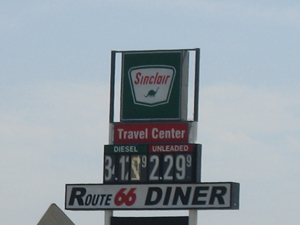
Al at the Sinclair gas station.
When I lived at 4546 S. Marshfield Avenue, there was a Sinclair gas station, whose logo was a green dinosaur, on the corner across the street. It had one gas pump that was directly in front of the building on the sidewalk. Whenever I needed air for my bicycle tires, I went across the street for it. As a ten year old, I often needed help fixing my bicycle when my father wasn’t home, so I would go to the gas station where Al would help me.
Al had the reputation for being the very best mechanic around, not just in our neighborhood, but anywhere. Everyone respected him for his mechanical skills and brought their cars to him if they needed repairs. Al also dispensed free mechanical advice to anyone who asked for it. After a while, no one even noticed that he was black. That’s right, a black man was working at our gas station beyond the allowable shopping district boundaries. But it was acceptable because he was at work. However, Al was accepted amicably by all the neighborhood residents. He was a hero to all my friends and me because he could fix our bikes no matter what was wrong with them. And he never charged us anything.
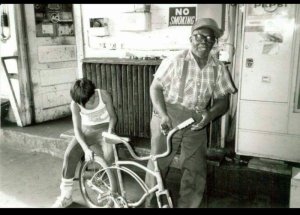
Al in action!
I used to like to hang out with him when I had nothing to do. He just seemed like the wisest man on earth because he could fix just about anything anyone brought in. I would ride my bike over and sit on his bench and watch him fix flat tires. He explained everything he did to me every step of the way. I was always fascinated by the machine that removed the tires from the rim. It was loud and menacing, but Al had tamed it to obey his every command. When business was slow, which was rarely, he would sit next to me on the bench and we would talk small talk. “How’s it going, buddy?” “Great! How are you, Max?” We were buddies. Then all Sinclair gas stations started giving out free passes to the Riverview amusement park with a gas fill-up. Since we were buddies, Al gave me enough passes for my entire family and my father took us to Riverview several times. Al was really popular with all the boys after that.
There was an older boy on the block that I often avoided. I always afraid of this boy because he was rotten to the core and he often scared me. He had that look that threatened physical violence to anyone who returned it. Then one day, he told me that Al was black. Looking back, I’m not even sure if I ever even noticed. He was just Al the mechanic at Sinclair to me. He was a very nice guy and he was always very helpful to me.
Anyway, this boy told me that Al was a “nigger.” I didn’t understand what he was talking about. He explained to me that Al was inferior to us because of his skin color. We rode our bikes to the corner and Al was standing in front of the gas station. The boy told me to call Al a “nigger.” I refused because Al was my friend. We stopped our bikes directly across the street from Al and the boy insisted that I shout “nigger” to Al. I just couldn’t. I knew that Al could hear our conversation, but he acted as if he were oblivious to us. Then the boy said he would beat me up if I didn’t call Al “nigger.” He punched me in the arm really hard, he gave me his patented menacing look, and said, “Then call him a Fudgecicle!” I refused at first, but then I was so afraid to get beat up. So I half-heartedly said, “Fudgecicle.” Al didn’t betray any form of acknowledgement that he had heard me. I felt so bad. I was sure my friendship with Al was over. But I didn’t get beat up.
The next day, I felt too guilty to visit Al as I usually did. After a few more days, I went back to the gas station and I tried to act as if nothing had happened. Al greeted me as he usually did. And we had our normal conversation of small talk. As if nothing had ever happened! Al was such a great friend!
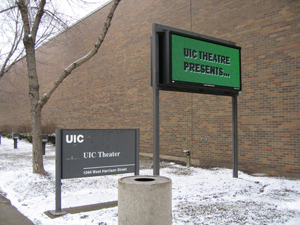
Today I went to the UIC Theater to see Tom Stoppard’s Rosencrantz and Guildenstern Are Dead. I really wasn’t sure what to expect because I had no idea what the play was about other than I knew that the title characters came from Shakespeare’s Hamlet.
Well, last week I saw Hamlet at the UIC Theater and I liked the production so much that I decided that I would see Stoppard’s play today. Okay, so I’ll never make a living writing reviews, but I thought today’s play started out rather slowly. There were some witty interchanges between Rosencrantz and Guildenstern, but sometimes it didn’t hold my interest. Well, I actually dozed off for a couple minutes in the beginning of the play.
I supposed it wouldn’t have been so bad if I weren’t sitting in the very front row in the middle right in front of the actors. So there I was front and center. When I woke up, Rosencrantz was staring at me. I felt so embarrassed! After that I tried not to fall asleep again. But I dozed off again–at least two more times. However, no actor noticed me this time.
So about the play, well, since it is a spinoff of Hamlet and it was also produced by the UIC theater department, I was happy to see the same actors reappear. Some of Hamlet’s scenes were repeated for Stoppard’s play. It was very interesting, even though I fell asleep a few times.
Cougar. No, not that kind of cougar! Read on see what I’m talking about.
Despite the lopsided score, the winners continued their losing streak in Chicago. That’s right. The police were criticized for shooting the cougar in a residential neighborhood, not far from Lincoln Park Zoo. Well, the police are up against overwhelming odds in situations like this.
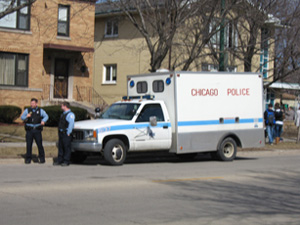
In Chicago, when all other city agencies refuse to answer to calls that are technically their responsibility, the 911 center dispatches a police car to assess the situation. The police department is Chicago’s last line of defense–basically, to protect the city against civil law suits. All other city agencies may refuse to respond to calls, including the fire department, but the police have to respond to every single call they receive regardless of how absurd it may seem to the average citizen.
I’m sure many residents who saw the cougar in their neighborhood called 911 to report it. And I’m sure they were surprised to see the police responding to the scene. Where was the Animal Control Unit? Certainly nowhere near the cougar. So the police show up, but it’s not like they could call the Animal Control Unit on their police radio to report a stray cougar because they are on a different frequency, in more ways than one.
When I was a police officer, several citizens reported some kind of wild cat on the lakefront in a residential area near some railroad tracks. I actually saw it running at a distance, but I couldn’t tell if it was a bobcat or a lynx or a lion, for that matter. There was nothing I could do as a police officer other than call the Animal Control Unit. When someone there answered their phone, they gave me the third degree over the phone. They wanted to know what I had seen. I said that it was either a bobcat or a lynx. But, no, they wanted to know exactly what kind of cat it was. I didn’t know. So they didn’t take me as seriously. Then they told me that they wouldn’t come out until I had secured it. What? How was I supposed to secure it? I even asked them to tell me how to secure it thinking they would actually know since they do work for Animal Control. Well, they never responded to the scene because I couldn’t secure the cat, or whatever it was.
Another time, some citizens called 911 and the police responded because there was a stray raccoon wandering around–but not just anywhere! This was in Mayor Daley’s neighborhood! This time I actually saw the raccoon up close on some rooftop patios right next door to the Mayor’s house. As I approached the raccoon, I could tell he was up to no good because he was wearing a mask. I cornered it, but I had to let it run past me because he tried to bite me. I cornered it again, but this time I didn’t approach it. I called Animal Control on my cell phone. Once again, they asked me to describe the raccon and they wanted the raccoon to be contained so they could just come by, scoop it up, and take it away. Then, I thought that they would come out sooner if I told them that the raccoon was next to the Mayor’s house. The voice at the other end immediately told me that they weren’t coming no matter what, especially now that they knew Mayor Daley lived close by. Once again, they refused to respond.
Why? Because their union was in negotiations with the city and the city wouldn’t give in on some of the issues. Well, I let the raccoon go because I sure wasn’t in the mood to get bitten by a raccoon that day, especially after that unpleasant interchange.
So, I can just imagine what the police were up against when they received this call about the stray cougar. The officers probably asked for the Animal Control Unit to come to the scene, to no avail. They probably asked the dispatcher to call the nearby Lincoln Park Zoo to send a zookeeper with a tranquilizer gun to the scene of the cougar, all for naught. Then, suddenly, an officer sees the cougar rapidly approaching him, so he opens fire, sadly, in self-defense. The officer had no other recourse but to shoot or possibly, nay, more than likely, be attacked.
Of course, the news cameras interviewed several residents who questioned why the police didn’t shoot the cougar with a tranquilizer gun. Well, because it wasn’t possible, citizens! The police are not issued tranquilizer guns! Not in Chicago, the City That Works.