Devil in the White City


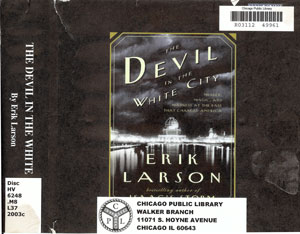
The audio book I borrowed from the Chicago Public Library.

I just finished reading this terrific book about Chicago and the 1893 Columbian Exposition. And when I say reading, I mean “reading” as in I didn’t actually read the book. Rather, I listened to the audio version of it on CDs while I drove. So, I’ve been doing a lot more “reading” lately because I’ve been doing a lot more driving (No quotes! I was physically driving.) lately. And that’s all thanks to these audio books on CD. For some reason, I didn’t like listening to audio books on cassette and I only listened to a few. Cassettes just seemed like too much work. For a while, I wasn’t reading as much because I was always on the go. But now I can do both at the same time! I love audio books on CD!

I had heard about this book years ago and I had always meant to get around to reading it, but somehow, I never had time. A few weeks ago, I was in my local library, and I saw this book prominently displayed on the shelf. I love reading books about Chicago! This book focuses on the Chicago World’s Fair of 1893, which is represented by one of the red stars of the Chicago flag below. (Note to self: Write a blog entry about the symbols of the Chicago flag.) I learned so much about Chicago history through this one book alone. First modern serial killer was H.H. Holmes who got his start during the World’s Fair.

By being awarded the World Fair, Chicago felt compelled to top the previous World Fair that was hosted by Paris, France, which had set attendance records for a peaceful event. And they also introduced the world to the tallest man-made structure ever built: The Eiffel Tower! Chicago was undaunted in trying to top Paris. From the ashes of the 1871 Chicago Fire, not only did Chicago rebuild itself, but it also topped the Paris World’s Fair. The engineering marvel that topped the Eiffel Tower was the Ferris Wheel that was then the tallest man-made structure. And people could ride it to the top and witness breath-taking views. To this day, most carnivals still have a Ferris Wheel. (In Spanish, it’s call la rueda de fortuna.)

The Chicago World’s Fair, or the World’s Columbian Exposition as it was also known, helped shape Chicago as a modern city and introduced the world to many modern inventions, including electricity on a wide scale at the White City. The main feature of the fair was the White City that was constructed by Daniel H. Burnham and company. This provided the creative spark for the Emerald City of Frank L. Baum when he wrote The Wizard of Oz. And the White City also influenced Disneyland and other amusement parks. The White City is also mentioned in “America, the Beautiful,” as “alabaster cities.”

DDR

Vote, vote, vote


My receipt for voting.

Lucky us! We get to vote on Ground Hog’s Day! So, if a candidate sees his shadow … Oh, never mind. Ground Hog’s Day is such a silly holiday, anyway!

I got a phone call to vote for Jim Ryan for judge. When I said I would vote for him, the caller asked if I would like to put Ja im Ryan sign on my lawn. Then, last week, I got two unusual calls from politicians soliciting my vote for David Hoffman. One was from Paul Vallas who doesn’t even reside in the state of Illinois anymore. And the other was from Miguel del Valle who also solicited my vote for David Hoffman in Spanish. I must admit he spoke Spanish very nicely. I’m not sure if Paul Vallas really wanted me to vote for David Hoffman. Or if, as I suspiciously tend to believe, he wanted to remind me that he still existed so that I would vote for him upon his imminent return to Illinois politics. But that’s just me.

I also received voting instructions for early voting in English, Spanish, and Mandarin Chinese. Okay, I’m not actually sure if it’s Mandarin Chinese, but I wanted to sound knowledgeable. Everyone wants to sound knowledgeable around election time, no? In Chicago, all the polling places are multilingual. If you’re an American citizen, you’re entitled to vote even if you don’t speak English! But this is typical of every election in Chicago.

The Chicago election is always very confusing. For whom do I vote? There are always a few obvious candidates for me. But others, I never even heard of them! I know we’re supposed to vote for candidates intelligently. However, I only seem to be aware of candidates who raised enough money to pay for radio and TV ads. So how do I vote for everyone else? Including the completely unknown candidates? I vote for the Chicago Way! I voted for all the candidates I knew from before election day would get my vote.

What happens to my votes for the rest of the candidates? In a general election, if I’m not sure for whom to vote, I vote the straight Democratic ticket. It’s the Chicago Way! In a primary election when I must declare myself a Democrat, I vote for all the Irish candidates. It’s the Chicago Way! Of course, I once met a Judge Cunningham who was elected as judge because of his Irish name. Judge Cunningham was African American! So, I guess voting for an Irish or Irish-sounding candidate is very egalitarian. It’s the Chicago Way! Next in the pecking order are female names. If it’s a female candidate with an Irish name, so much the better. That was in the old days. Now that we have more Hispanic candidates, I automatically vote for a Spanish name. The election slate is so long for some elections that very few people would know every candidate very well. However, I want to exercise my Constitutional right to vote! Even if it’s the Chicago Way!

DDR

UIC SOS


The international symbol of distress.

Teaching is very rewarding in many ways, but just not financially. My alma mater and present employer, the University of Illinois at Chicago (UIC), is suffering from budget problems. Well, the whole country is suffering from these hard economic times. UIC is suffering because the state of Illinois isn’t paying UIC what it is owed and therefore hirings of new faculty and staff have ceased. Faculty and staff must take unpaid furlough days to meet the budget shortfall–in addition to the budget recissions already implemented over the past few years. Illinois has one of the worst budget crises in the country, second only to California.

Of course, my job security is also on the line. My contract as a Spanish lecturer with UIC expires on May 15, 2010. Will I be rehired next year? No one knows with any certainty. We’ll see. The good news for me is that I don’t have to take any unpaid furlough days. The bad news is that I don’t earn enough to take furlough days. I feel the budget cuts in so many ways. I can’t call anyone on my office telephone outside of the Chicago area codes. Every year I’m allowed to make fewer and fewer copies of student handouts. Luckily for me, Spanish is the foreign language most in demand at UIC. Unfortunately, gone is the golden age when everyone who earned a Ph.D. would more than likely get a job in academia!

DDR

¡Yo soy mexicano!


Mi familia

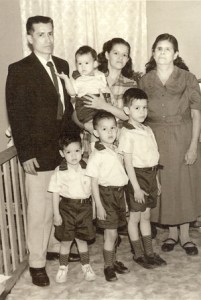
Cuando era niño, vivíamos en Chicago y viajábamos a México cada año. Íbamos mi mamá, mi hermano Daniel y yo. Una vez que fuimos, mi mamá estaba embarazada. Todo mundo le decía que no fuera a México hasta después del parto. Como mi mamá era muy cabezona, nos fuimos a México de todos modos. Pues, mi hermanito Diego nació en Celaya, Guanajuato, en la casa de mi tía. La próxima vez que mi mamá se embarazó, nos quedamos en Chicago y mi hermano Ricardo nació en nuestro apartamento.

Cuando yo tenía doce años y ya todos asistíamos a la escuela, yo, por ser el mayor, cuidaba a mis hermanitos mientras nuestros padres trabajaban. Los vestía para la escuela, los acompañaba a la escuela y los acompañaba a casa después de la escuela. Siempre jugábamos juntos y a veces nos peleábamos como suelen hacer los hermanos. A Diego le daba tanto orgullo de ser mexicano de 100% por haber nacido en México. Siempre nos decía, «Yo nací en México. ¡Yo soy mexicano! ¡Ustedes no son mexicanos como yo!». Según él, Daniel, Ricardo y yo éramos gringos por haber nacido en los Estados Unidos. Diego siempre decía «¡Yo nací en México!» con mucho orgullo.

Pues, cuando volvíamos a casa después de clase, no siempre íbamos directamente a casa. A veces cada uno iba con su amigo y luego nos encontrábamos en casa antes de que llegara mi mamá del trabajo. Pero una vez, no llegó Diego para la hora fijada. Me puse nervioso porque sabía que mi mamá me daría una paliza por haber perdido a mi hermanito. Lo fui a buscar por todo el barrio, pero no lo encontré. Cuando mi mamá llegó, me preguntó, «¿Ya están todos?». Le mentí y le dije que sí en una voz muy tímida. Mi mamá se dio cuenta de que alguien faltaba. «¿Dónde está Diego?» me preguntó. «No sé» le dije esperando una paliza.

Mi mamá nos abrigó y salimos en el coche para buscar a Diego. No lo encontramos. Volvimos a casa y mi mamá hizo varias llamadas a parientes, vecinos y chismosas. Nadie sabía dónde estaba mi hermanito. De repente, vimos por la ventana que se estacionaba un coche grande y negro frente de la casa. Salieron dos hombres de traje negro con mi hermanito. Resulta que Diego volvía a casa solo después de visitar a un amigo cuando los oficiales de la migra lo vieron. Le preguntaron, «¿Dónde naciste?», y mi hermanito naturalmente contestó con mucho orgullo, «¡Yo nací en México!» y se lo llevaron. Después de varias horas, lo trajeron a nuestra casa y mi mamá les enseñó documentos para comprobar que Diego estaba en los Estados Unidos legalmente. Luego mi mamá regañó a Diego y le dijo, «¡Ya no le digas a nadie que naciste en México!». Me salvé de una paliza por el susto que sufrió mi mamá. Hasta hoy en día, mi hermano nunca le dice a nadie que nació en México.

One dollar!


Some light Sunday morning reading

Reading the newspaper just isn’t what it used to be. I get the Sunday Chicago Tribune and it’s very thin now. I remember when it was two inches thick. Now, every section contains fewer articles. I used to spend at least four hours reading the paper on Sundays. Now, there’s not much left to it. And most of the stories I read, I discover that I have already read them on the Internet the previous day. Even the sales inserts are very skimpy. So I was surprised to see that Dollar Tree had a sale insert today. Was the Tribune so desperate for advertising dollars that they reduced their advertising rates to attract dollar stores? But why would Dollar Tree, or any dollar store, have to advertise when all their products are sold for only one dollar? Why do they need to advertise at all? What’s the point? Won’t everything still cost one dollar even with the sale? If they reduced the price to 99 cents, they couldn’t call themselves a dollar store! So I inspected the sales paper and … everything only costs one dollar!

DDR