Experiment


1982

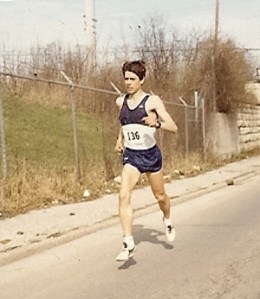
 When I was running and racing regularly, I was in exceptionally decent shape, even though many people thought I was extremely skinny. I lived and breathed for running. Occasionally, I did all three at once.

For a while there, I ran a lot of races. I was obsessed with racing because I wanted to become a good enough runner to get an athletic scholarship to a university. Unfortunately, I never improved enough for a scholarship, but I did begin writing for running publications, which I really enjoyed.

Once I went to Vertel’s, a running shoe store on North Wells Street, to pick up my race packet. As I was leaving the store, I saw a sign that read, RUNNERS WANTED FOR EXPERIMENT. My heart raced and I immediately wrote down the phone number because this sounded like something I really wanted to do. Perhaps this experiment would improve my running so I could get that running scholarship. I could just imagine myself in a running laboratory with all kinds of scientific equipment to measure my enormous runner’s ability.

Yes, count me in, I thought. I imagined myself running on a treadmill, wearing an oxygen mask that would measure my excellent runner’s oxygen uptake, my wired chest sending electrical impulses to the ECG machine that would record my highly athletic heart rhythm, and me drinking experimental electrolyte replacement beverages, even though my finely tuned body didn’t need them, and then reporting which one made me run the fastest. I was really excited about this experiment!

I was afraid to get left out because I was too late, so I called as soon as I got home. The woman who answered the phone was happy that someone had finally called her about the experiment. Apparently, she had put up her notice at many other races and I was the first runner ever to respond. Then she dropped the bombshell on me. She was not a doctor, not even a nurse. In fact, she had never even taken a first aid course. She was a polka dancer!

She and her husband were national polka champions, and they toured the country dancing at all kinds of festivals, parties, and picnics. So, what was the experiment? You better sit down. I wish I had been sitting down when she told me. She wanted runners to learn to polka! Why runners? Well, runners would be able to learn to polka faster because they had incredibly good endurance. This was not at all what I had expected when I read the sign at Vertel’s! She finally persuaded me to sign up for polka lessons. Luckily, they were free. So, I agreed to be her guinea pig since I had always wanted to learn to dance, and I really didn’t have any plans for the next two months anyway.

On the very first day, she paired me up with a nice Polish girl named Andrea. We would be partners throughout the “experiment.” In her mind, my polka lessons never ceased to be an experiment. Well, I had no rhythm and I kept stepping on Andrea’s toes. She said something in Polish to the teacher/dancer/mad scientist that I didn’t understand and then smiled at me. I smiled back, but I could tell Andrea was complaining about me. I apologized to her and told her that I couldn’t help stepping on her toes because I had two left feet. She suggested that I find someone with two right feet.

The polka woman came back to us and said something in Polish to Andrea and she continued to dance with me. The dance lesson went on for about two hours, and because I was a fine specimen of a runner, I didn’t even break out into a sweat. I didn’t have to stop to rest during the whole session, even though Andrea insisted that I rest so she could rest her toes a while. Well, the polka teacher was right about runners having a lot of endurance, but I don’t think that she had counted on me stepping on someone’s toes for two continuous hours.

The next week, the polka woman tried something different. Since I had told her my full name, she was fascinated by the fact that I was Mexican. I’m not sure why. Was it the fact that a Mexican was learning to polka? Anyway, she tells me, “I want you to listen to this song. It’s from your country.”

I listened. Someone was singing in Spanish. “Did you hear that?” she asked. “Hear what?” I asked. “The beat!” she said, but I could tell she was losing her patience with me. “Oh, the beat!” I repeated. “I’m sorry. I was listening to the words.” She played the song again and I listened carefully to the beat. I’m not very musical, so I had no idea what beat I was supposed to listen to. Finally, she said, “Did you hear the beat? It’s a polka beat, oom pah pah, oom pah pah, in a Mexican song!” “Oh, that beat! Of course, I heard the polka beat!” I lied, but I didn’t want her to get mad at me. Then we danced to this song. I actually danced a little better this time.

The funny thing about all this, she never mentioned the experiment again. She gave performances during the day to seniors and terminally ill people at hospitals. I guess that’s why I liked her so much. She was such a nice person. One day, she asked me to go with her and her husband to one of their shows. “You mean you want me to dance with you for these shows?” I asked. “No,” she said. “I want you to videotape us dancing. We need a demo tape.”

I agreed to do it since I didn’t have a job at that time anyway and they always bought me lunch when the hospital or nursing home didn’t give us free food. I got pretty good at recording them once I realized that they improvised everytime they danced and I learned to expect the unexpected from them. Plus, I learned one special effect with their video camera that absolutely amazed them. I didn’t tell them. I let it be a surprise for them. They were exstatic when I zoomed in on them while they danced! So from then on, they insisted that I tape all their shows. And she extended my polka lessons for three more months, much to Andrea’s chagrin.

Well, no other runners ever volunteered for her experiment. And, I never did find out the results of the experiment. However, I did learn to videotape moving targets.
DDR

Becky


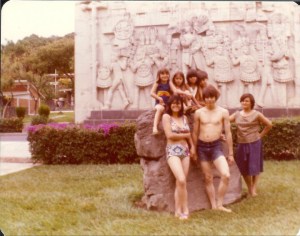
Oaxtepec, México, 1978

Once when I went to México, I heard an interesting story from my cousin Becky. Her father didn’t like her boyfriend, so she had to see him secretly. He eventually gave her an engagement ring that she only wore around the house when her father wasn’t home.

One day, she forgot to take it off and her father saw the ring. He was so angry with her. And he forbade her from seeing her boyfriend again. Of course, she kept seeing him. And she wore her engagement ring around the house while doing chores provided her father wasn’t home.

Well, one day, she’s wearing her ring and peeling potatoes for the dinner soup. Later, while she cooking, her father comes into the kitchen and immediately looks at Becky’s hand to see if she’s wearing the ring. Becky looks at her hand and panics. Her ring isn’t on her finger. She has no idea where it is! But her father leaves the kitchen without saying a word.That night at dinner, everyone is eating soup. Her father is very quite while eating his soup. That is, until, just by coincidence, he sees Becky’s engagement ring on his spoon. He starts yelling at his daughter and he keeps the ring.

As soon as I get to México, all my relatives come to visit me no matter whose house I visit. A few childhood friends came to visit me as soon as I arrived, among them a certain girl named Flor who remembered me as a boy when we played together. My cousin Becky was dating Flor’s cousin even though Becky’s father totally disapproved of her boyfriend and his engagement ring. So, when I arrived in México, two people immediately looked for me. Becky and Flor. Becky contrives this plan to meet her boyfriend by taking me with her as her chaperone. Apparently, her parents let her go out with me. Becky had set me up with Flor who gets permission to go out only if she goes out with her cousin, Becky’s boyfriend.

So, we’re actually going out a on double date without permission, but no one really knows the actual circumstances. It turns out Flor is really interested in me, but I lose a precious opportunity when I go back to Chicago and only write letters to her telling her how I’m not really interested in her. Becky eventually married her boyfriend and they lived unhappily ever after. As they say in México, “C’est la vie!”

DDR

Mexican sense of humor


Exhibit A: Mexican sense of humor

Mexicans have the best sense of humor in the world. No one laughs more than a Mexican. They’re always joking around, and they are always laughing. Just watch them and see. Many people often ask me why I’m always laughing. I never actually have an answer because I don’t know why I’m always laughing. Sometimes, I laugh for no apparent reason, which makes it easy for me to find a seat on the train.

When I was in México, I noticed my cousin David Rodríguez laughed just as much as me and just as loud. My sons always complain that I laugh louder than everyone else in the theater whenever we see a movie. I can’t help it. My mother and I always told jokes and we weren’t afraid to laugh. My abuelita was also quite funny. Our whole family is always laughing. If you ever go to a Mexican party, you will hear continuous laughter. It’s just our nature. We lead simple uncomplicated lives and enjoy every moment of life. If we have a place to live, food to eat, and drink to drink, we’re happy as a tamal in a corn husk. And no matter what tragedy occurs in our lives, we’ll just laugh it off.

I’ve heard Mexicans tell how they lost their job, their house, their car, etc., and make everyone listening laugh while they told their sad tale. I admit it. I’ve laughed, too. My friend José was a carpenter who had once cut off his index finger with an electric saw. One day, I saw he had two fingers bandaged and I asked him what had happened. He told me how he was cutting wood with an electric band saw and his mind drifted a little. Right from the beginning he slipped into the typical Mexican joke-telling mode. “Remember how I told you how I cut off my index finger the last time,” José said, and I remembered how he had made me laugh then. “Well, this time, I cut off my index finger AND my middle finger!” He started laughing with his contagious laughter, and I couldn’t help but laugh, too. “¡Chingado! I did it again!” he said to me. “Then I couldn’t find my fingers right away because they went flying across the room!” I regret to say that we both laughed hysterically during his recounting of this catastrophe. Of course, he never did finish telling me the story because he was laughing too hard. But even in a crisis, a Mexican will find humor.

Helen Hicks


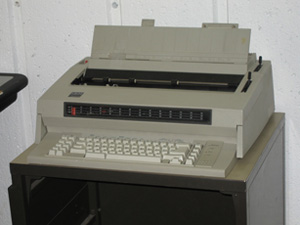
I used to type on a manual typewriter, but then I bought an electric typewriter.

When I was in the Marines, I was stationed in California for my entire three-year enlistment. I wanted to get an education, so I started reading all kinds of books from the base library at Twenty-Nine Palms and Camp Pendleton. I spent every free moment reading. I even bought the Great Books collection and eventually read them all.

Since I had dropped out of high school, I always felt that I needed a formal education, a college degree, to validate my writing. While at Camp Pendleton, I enrolled at the Fallbrook Community College and took an English composition course that the college offered on base. I really thought I was a great writer and I truly believed that the instructor would absolutely love everything that I wrote.

Looking back, my writing was mediocre and forced. Well, I’ll be honest, it hasn’t really changed all that much. When I turned in my first composition, I was disappointed to get a B-. I was really expecting an A+++! Every time I see A Christmas Story and I see Ralph turning in his composition asking for the Red Rider BB Gun for Christmas, I remember feeling similar feelings of elation and expecting A when I turned in my first composition. Well, I guess I hadn’t developed as a writer because I couldn’t take the constructive criticism that my instructor gave me. I eventually stopped showing up to class.

But because of the college catalog, I learned that there was a writer’s group that met in Fallbrook, just west of Camp Pendleton. I would drive past the bombing range to exit out of one of the lesser used gates. As I entered Fallbrook, I always enjoyed reading the sign, “Welcome to Fallbrook. Avocado Capital of the World.” Nothing inspires me to write more than avocados! I always looked forward to these writer’s club meetings because I knew I would be surrounded by avocados. Maybe I’m just too Mexican.

Anyway, Helen Hicks ran this writer’s club in Fallbrook. She was a published writer who had written a few TV scripts for Bonanza and Little House on the Prairie. She really knew how to inspire writers by example. She was writing Gothic novels when I was a member. What I really learned from her was how to take constructive criticism. She could really dish it out, but I respected her opinion and I always tried to follow her suggestions.

Of course, she wasn’t always right, but she was a published writer and that counts for something. I remember one woman wrote an essay that began as one of our writing exercises. This woman was a flight attendant, but she had always wanted to be a published writer. Well, this woman read the essay to us and some writers really liked the piece. Helen offered her usual constructive criticism. But then she said she wasn’t sure who would publish it just as it was written. Undaunted, this woman kept writing and kept reading to our group. About two months later, she came in with a magazine that had published her piece almost as originally written. She was so proud of her accomplishment and wanted Helen to know it. Helen congratulated her and we all applauded her. And the moral of the story? Well, just keep plugging away and someday you’ll succeed.

When I returned to Chicago after my honorable discharge, I wrote to Helen to tell her that I missed her writer’s club. She wrote back and told me to start my own club in Chicago. She also told me to keep on writing.

DDR

Writer’s Desk


IBM Selectric

Back in the 1980s, my brother Jerry told me about a writer’s group that met every third Tuesday in the Beverly neighborhood at 107th and Hale. So I joined the group because I really enjoyed writing, and reading my works for this group motivated me to write. I met a lot of interesting people and I always looked forward to every meeting.

One of the poets, introduced me to her sister who just by chance had married a Mexican whose last name was Navarrete, just like one of my aunts in Mexico. The poet’s sister just happened to be a commercial artist. Eventually, she drew a caricature of me for my comedian’s business card. (It’s the caricature you see below.) I remember that she was afraid to show it to me because I might think that she was making fun of me. I really loved it! It was exactly what I wanted. I was always proud of my business card.

Elizabeth-Anne Vanek was the president of the group and she was a published poet. She was the heart, soul, and muse of the group. Without her, the group would have disintegrated. I also met Marc Smith before he became famous for his poetry slams at the Green Mill. He came to many meetings and would read his latest poetry for us.

I also remember Frida who came to every meeting religiously and listened to everyone’s work patiently and then commented with objective criticism. She was a writer who didn’t actually write anything. She couldn’t write anymore. Her muse had abandoned her.

I also brought my friend Tony Trendl from the Marquette Park Track Club for a couple of meetings. I must admit that I did the most writing in my life while I belonged to this group. It was then that I started writing for The Finish Line and the Illinois Runner. However,  I never published any of my short stories that I read to the group. My writing improved immensely while I was a member of the Writer’s Desk.

And in another one of those cosmic coincidences that frequently occur to me. I now live right down the block from where the Writer’s Desk used to meet!

DDR