Al


On the road somewhere in the USA.

In the 1960s, Chicago was very much a segregated city. Neighborhoods were categorized by race and/or ethnicity. When people moved to Chicago, they pretty much stuck to their own kind. This was in an era before anyone could foretell the coming of Political Correctness and everyone called every race and ethnic group by their corresponding slur.

Sometimes, people would be offended by such name calling, but oftentimes, most people merely accepted it as part of life in Chicago. Those neighborhood boundaries could only be crossed when going to work or when shopping, as long as no one over-stayed their time where they didn’t belong. No one ever commented on these inequities back then. That was Chicago.

When I lived in Back of the Yards, no blacks ventured there except to go shopping at the stores on Ashland Avenue between 45th Street and 51st Street. There was name calling and such, but basically there was never any trouble.

Al at the Sinclair gas station.

When I lived at 4546 S. Marshfield Avenue, there was a Sinclair gas station, whose logo was a green dinosaur, on the corner across the street. It had one gas pump that was directly in front of the building on the sidewalk. Whenever I needed air for my bicycle tires, I went across the street for it. As a ten year old, I often needed help fixing my bicycle when my father wasn’t home, so I would go to the gas station where Al would help me.

Al had the reputation for being the very best mechanic around, not just in our neighborhood, but anywhere. Everyone respected him for his mechanical skills and brought their cars to him if they needed repairs. Al also dispensed free mechanical advice to anyone who asked for it. After a while, no one even noticed that he was black. That’s right, a black man was working at our gas station beyond the allowable shopping district boundaries. But it was acceptable because he was at work. However, Al was accepted amicably by all the neighborhood residents. He was a hero to all my friends and me because he could fix our bikes no matter what was wrong with them. And he never charged us anything.
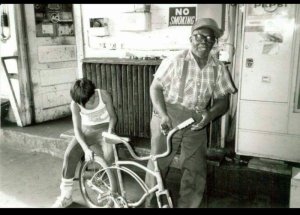
Al in action!

I used to like to hang out with him when I had nothing to do. He just seemed like the wisest man on earth because he could fix just about anything anyone brought in. I would ride my bike over and sit on his bench and watch him fix flat tires. He explained everything he did to me every step of the way. I was always fascinated by the machine that removed the tires from the rim. It was loud and menacing, but Al had tamed it to obey his every command. When business was slow, which was rarely, he would sit next to me on the bench and we would talk small talk. “How’s it going, buddy?” “Great! How are you, Max?” We were buddies. Then all Sinclair gas stations started giving out free passes to the Riverview amusement park with a gas fill-up. Since we were buddies, Al gave me enough passes for my entire family and my father took us to Riverview several times. Al was really popular with all the boys after that.

There was an older boy on the block that I often avoided. I always afraid of this boy because he was rotten to the core and he often scared me. He had that look that threatened physical violence to anyone who returned it. Then one day, he told me that Al was black. Looking back, I’m not even sure if I ever even noticed. He was just Al the mechanic at Sinclair to me. He was a very nice guy and he was always very helpful to me.

Anyway, this boy told me that Al was a “nigger.” I didn’t understand what he was talking about. He explained to me that Al was inferior to us because of his skin color. We rode our bikes to the corner and Al was standing in front of the gas station. The boy told me to call Al a “nigger.” I refused because Al was my friend. We stopped our bikes directly across the street from Al and the boy insisted that I shout “nigger” to Al. I just couldn’t. I knew that Al could hear our conversation, but he acted as if he were oblivious to us. Then the boy said he would beat me up if I didn’t call Al “nigger.” He punched me in the arm really hard, he gave me his patented menacing look, and said, “Then call him a Fudgecicle!” I refused at first, but then I was so afraid to get beat up. So I half-heartedly said, “Fudgecicle.” Al didn’t betray any form of acknowledgement that he had heard me. I felt so bad. I was sure my friendship with Al was over. But I didn’t get beat up.

The next day, I felt too guilty to visit Al as I usually did. After a few more days, I went back to the gas station and I tried to act as if nothing had happened. Al greeted me as he usually did. And we had our normal conversation of small talk. As if nothing had ever happened! Al was such a great friend!

DDR

Melanie


Melanie

After my first divorce, I moved back home with my mother to 2509 W. Marquette Road. At first, she didn’t even know I was living with her. She lived on the second floor, and I moved back into my bedroom in the basement.

After I had separated from my wife, I lived in the basement for about two months before I finally told my mother I had moved back home. I needed to feel comfortable about telling her. Plus, I thought that the possibility of a reconciliation still existed. I didn’t want to tell everyone I was getting divorced if we got back together again! The reason she didn’t know I moved back home was that she worked the day shift, and I worked the midnight shift.

We hardly ever crossed paths, and not just physically, but also ideologically and morally. Anyway, when I told her I was getting divorced, she said I was making a big mistake and that I would never find another wife as good as her. You know, the usual speech a Mexicana gives her oldest son upon discovering that he’s getting divorced. A speech filled with sentiments that would make any Mexican son feel guilty for breaking his mother’s heart by not giving her grandchildren. I was hoping to get a reception like the prodigal son, but I got The Mexicana Mother Speech! I got over it in about two days.

Once I could freely go upstairs to my mother’s apartment on the second floor–she rented out the first floor to paying tenants–I used to see my mother staring out the window a lot. Our house faced north on Marquette Road, just west of Western Avenue, so there was always plenty of activity to observe.

One day, as I was trying to sneak downstairs behind her back–she always knew when I was in the room–she called me over to look out the window. A young Mexicana holding the hand of a little girl was was walking past our house. They lived in a basement apartment across the street. My mother had noticed her walking past our house previously. I don’t think that my mother would have taken such an interest in them if they hadn’t been Mexicanas.

The next day, my mother saw them again. “They always walk by at the same time,” my mother said to me. “She needs a babysitter. I’ll talk to her tomorrow.” I told my mother to be careful because she might not trust her daughter to a complete stranger, especially one who is waiting for her on the street.

The next day, when I went to my mother’s apartment, the young Mexicana and her daughter were in the living room. The mother was a very pretty Mexicana who was completely bilingual. In fact, when I heard her speak English so fluently, I didn’t think that she could speak Spanish at all, but she was just as fluent in both languages. It turns out that Chayo, her actual name was Rosario, took her daughter Melanie to daycare every morning before going to work. Somehow, my mother talked her into dropping off Melanie at our house before going to work.

How did my mother convince Chayo to trust her with her only child? Well, my mother was waiting outside about the time that Chayo and Melanie walked back home from the daycare and my mother greeted her in Spanish. One thing led to another and they were talking on the corner for about an hour before they went into my mother’s house. Apparently, they both knew some of the same people. So that was the connection! Mexicans always try to find a common bond, whether it be friends, family, or the same place of origin in Mexico. So my mother had a babysitting job now.

So, the next day, Melanie was upstairs when I woke up in the afternoon after working the midnight shift. I love children, so it was nice to have a little girl in the house again. She was like my mother’s daughter and my little sister. We both pampered her.

Melanie looked much happier now than when she walked home from the daycare. Melanie’s first day at our house was very exciting for Melanie and us. Then Chayo, who was about my age, came to pick up her daughter.

We talked for a while and when it was time for Chayo, and Melanie to leave, Chayo asked my mother how much she charged for babysitting. I knew mother didn’t want any money, but she had to name a price, so she said, “One-hundred dollars! Cash!” Chayo’s mouth dropped open. And then my mother laughed. She said that she would babysit for free. Chayo said that she had to pay her something because she was saving so much by not taking her daughter to the daycare. Chayo tried to slip some folded dollar bills into my mother’s hand but she wouldn’t accept them. As far as I knew, my mother never charged her for babysitting.

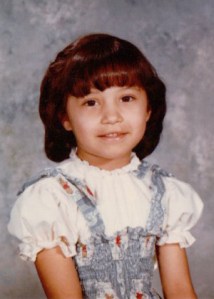
Melanie took quite a liking to me. She had just turned four and she was at that age where she was so much fun. She had long, deep brown hair, brown eyes, and olive skin. She looked like the cutest Mexican girl ever. She would always anxiously wait for me to go upstairs when I woke up in the afternoon. We played games together and she always sat next to me at the dinner table. When I started working the day shift, she would look out the window waiting for me to come home. She was always happy to see me.

Soon, she wanted to go with me whenever I went out. At first, I didn’t want to take her with me, but my mother said it would be okay. Melanie and I walked to my car hand in hand. I was going to the store to buy some groceries for my mother. Melanie sat in the front seat with me. Actually, she kept standing up and putting her arms around my neck, holding on for dear life. This was in the early 1970s before it was mandatory to have small children in safety seats. Well, I almost got into an accident because Melanie obscured my vision, so I had to swerve and slam on the brakes. Melanie lost her grip around my neck and slid across the front seat until her head hit the passenger door. Luckily, she didn’t even get a bruise. I learned my lesson and from then on Melanie wore a seatbelt. After that, I felt more comfortable driving, too.

Then, my mother started talking to me about Chayo. She was available. I should ask her out. But what about Melanie’s father? He was in jail. I didn’t even want to know what crime he had committed to wind up in jail soon after Melanie’s birth and I didn’t want to know. Besides, he never married Chayo.

No, I never asked Chayo out and she soon met someone else, something I have never regretted. One day, Melanie, out of the blue, started telling me, “I love you.” Somehow, she had become like my daughter. I didn’t mind, either. I like having Melanie around. Then, it all ended when I enlisted in the Marines. My mother told me to look for Chayo’s brother who was also in the Marines.

In one of those unbelievable coincidences that you’re not supposed to write about because no one would believe it anyway, I actually met Chayo’s brother at Camp Pendleton. I wrote about this accidental meeting in a previous blog entry. And in yet another one of those unbelievable coincidences, I met one of Chayo’s sisters at the University of Chicago Track Club. But wait! Here’s another coincidence. When I was a member of the Marquette Park Track Club, Joe Gregory, one of our runners, announced the he was getting married. To whom? To another one of Chayo’s sisters.

After I was honorable discharged from the Marine Corps and I had my own apartment near Marquette Park, Chayo called me. We talked awhile. My mother had previously told me that she would try to set me up with Chayo. So Chayo called me, but I wasn’t really interested. She called me a few more times, but that was the end of it.

My only regret? That I didn’t ask her about Melanie!

DDR

Cinco de Mayo


Catering to Gringolandia.

Cinco de Mayo is another Mexican holiday that our Mexican family never celebrated. I never even heard of it until I was old enough to drink alcoholic beverages. I think that it has become a beer company holiday in America, just as Hallmark converted Valentine’s Day into a lovers’ holiday in order to sell Valentine’s Day cards. Beer companies would love to see Cinco de Mayo become a Mexican St. Patrick’s Day! Lately, I’ve been seeing a lot of publicity about the celebration for it. Chicago had a Cinco de Mayo parade downtown on the same day as the Polish Constitution Day parade. Personally, I don’t understand why anyone would celebrate Cinco de Mayo. On May 5, 1862, Mexicans defeated the French at Puebla, just west of Mexico City. However, the Mexicans then went on to lose the war and were ruled by the French until 1867. Is this cause for celebration?

DDR

Fugitive


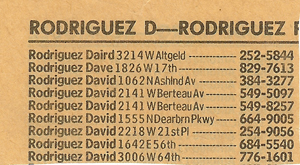
Chicago Telephone Directory

I recently talked to Joey, one of my brothers, who told me that my Uncle Meño thought I was in trouble with the law last December. Once again, my name, David Rodriguez, came up in the news as the triggerman in a shooting. My name is so common in Chicago that I’ve seen it in the news very often and they were never talking about me personally.

My uncle had heard about the shooting, and he immediately thought I was the shooter. Just by chance, this occurred in December right before I went to Mexico, so my uncle thought I was escaping to Mexico to avoid the police. I had e-mailed my uncle Meño for his brother’s address in Celaya about the same time as the shooting, which led to him to think that I was the shooter, and I was escaping to Mexico in the first place.

That explained why he called me right before I left for Mexico. He asked me if I had heard about the shooting. I said I did because several other people had called me asking me if I had been involved in a shooting. I assured him that it wasn’t me.

Well, my brother Joey told me that our uncle didn’t believe me and called Joey to confirm that I wasn’t involved in the shooting. I have written a few blog entries already about how common my name is. I suppose I’ll write many more in the future as more cases of mistaken identity occur!

DDR

Rogelia


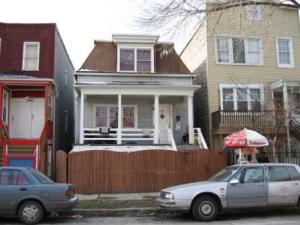
4546 S. Marshfield Avenue, Chicago, Illinois

Rogelia was a pleasingly plump Mexicana who lived next door to us when we lived at 4546 S. Marshfield Avenue. Whenever she saw me, she would call me by name and say hello to me.

I always appreciated her personal attention since I was only ten. She had brown eyes, naturally wavy dark brown hair and olive skin. Judging by her clothing, her favorite color was blue. She was married and had two daughters who were older than me. Her younger daughter Estela looked just like her mother, but she was a little plumper and a little more naturally tanned. Rogelia and my mother were good friends so I saw Rogelia at our house a lot.

In the summer, we all sat on the front stairs and just talked and talked and talked even though every one, except the children, had to get up early in the morning. Neighbors walking by would stop to talk a while, too. Amazingly enough, no one drank beverages of any kind. The rambling conversation was enough to intoxicate everyone.

Whenever Rogelia sat on our stairs, she always asked me to sit next to her. I was like her date. My mother used to get jealous. I loved it! Sometimes Rogelia would run her fingers through my hair to comb it out of my eyes–and my mother would stare daggers at me. She would scold me later and tell me not to let Rogelia touch me. But my mother was never that affectionate with me, so I enjoyed the attention.

Rogelia looked very dainty, but was very physically tough when necessary. Sometimes her husband would home drunk, try to start a fight with anyone sitting on the stairs, and then go home. He would yell for Rogelia to open the door for him, but she wouldn’t. Finally, he’d get tired of yelling, then he’d pull out his keys from his pocket, and open the door himself.

He’d slam the door the door behind him. Most of the time there was yelling and the sound of objects crashing against the wall or floor. Even my mother had to say, “¡Pobrecita Rogelia!” One day, there was more yelling and more crashing noises than usual. Suddenly their apartment door slammed open and her husband, who was drunker than usual when he walked home, came running out with Rogelia chasing him waving her fists at him. He had a black eye and his face was all bloody. Rogelia was furious, but when she saw everyone staring at them, she stopped and told her husband if he ever did it again she would kill him.

We never found out what he did, but there was much speculation for months. Chismes, rumors, spread rapidly and became more elaborate with each retelling. One day, the police came and arrested him. They went to his car and conviscated some rope and a knife from the backseat. Apparently, Rogelia’s husband had raped and killed a woman. He was gone for a few days before he returned. It was a case of mistaken identity and he had happened to be in the wrong place at the wrong time. Rogelia and her husband never had another argument after that.

As strong as Rogelia was, she would feign to be dainty on occasion. For example, when she returned from grocery shopping with her cart filled over the top with groceries, she would ask me to help her carry in the groceries. I was young enough and naive enough back then to think she really needed my help. When I was done, she would ask me questions about how I was doing in school and if I had a girlfriend. She was genuinely interested in me. Then she would give me fifty cents and I would leave.

Sometimes Rogelia would cook dinner for me. She would stick her head out the door and yell my name. The first time she did, I didn’t know why she called me. I soon enjoyed every time time she called me to her apartment. She liked talking to me while I ate alone. And Rogelia was a much better cook than my mother.

The only thing I regret to this day about the whole situation is how I behaved toward her daughter Estela. All the boys made fun of her because she was overweight. Well, I must confess that I, too, joined in on the ridicule. One day, as Estela was walking home, my friends and I were sitting on our front stairs. Alfonso called her a hippo. Fernando corrected him and said she was an elephant. Of course, me being me, I had to top everyone else. I started making earthquake noises and pretended that the ground was trembling. I pointed to crack on the sidewalk and said that Estela broke the sidewalk by walking on it. She ignored us as she continued walking home. Then my earthquake sounds became louder and my body trembled even more. The “earthquake” was so strong that I fell all the way down the stairs.

Estela started crying! I looked next door and saw Rogelia standing outside her door waiting for her daughter. Rogelia had seen everything. I was caught in the act of making fun of her daughter! I was so embarrassed! I knew that Rogelia would be mad at me forever. She would never cook dinner for me again. I looked at her face to study her reaction. She was actually attempting, unsuccessfully, to repress laughter. She put a consoling arm around her daughter and they quickly went into the house.

Well, I did not fall from Rogelia’s good graces because of my incident with Estela. In fact, later that day, she invited me in to dinner. Her husband found me a babysitting job across the street that paid a dollar a week. And everything was fine between Rogelia and me until we moved to another house in the neighborhood.

DDR