XX


Stay thirsty, my friends!

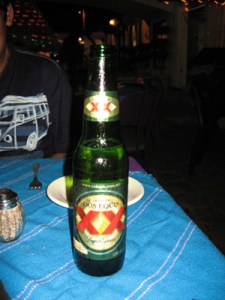
Sometimes we read Spanish texts in Spanish class. Often, the historical time period is referred to as siglo XX, pronounced siglo veinte in Spanish, which means twentieth century. Usually, they read, “siglo dos equis.” Some students actually think the text is referring to Dos Equis the Mexican beer! Thus, I learn about their weekend extra-curricular activities. Rarely do the students read the phrase correctly. Maybe I’m too literal when I read a text, but I never even thought of Dos Equis beer whenever I saw siglo XX. I really read it as the Roman numeral 20. And I love beer!

Anyway, this got me to thinking about Dos Equis beer a lot. But I managed to refrain myself from drinking any. And now they have a Dos Equis commercial that they play during the Ten O’clock News that always makes me laugh. They show an obviously macho machísimo man who I like to think is obviously Mexican. They show him walking into a pool hall, surfing under a huge wave, and surrounded, of course, by several señoritas, implying that he’s a lady’s man. Then the narrator says: “He’s been known to cure narcolepsy just by walking into a room. His donor donation card also lists his beard. He’s a lover not a fighter. But he’s also a fighter so don’t get any ideas. He is … the World’s Most Interesting Man.

The World’s Most Interesting Man

Then this macho machísimo man says with a thick, yet virulent, Mexican accent, “I rarely drink beer. But when I do, I drink Dos Equis. Stay thirsty, my friends.” I mean this guy makes being Mexican look cool! Some of my Spanish students mentioned this commercial to me because they also thought this guy was really cool. I can only hope to someday be half as cool as his beard!

DDR

Garcia Girls


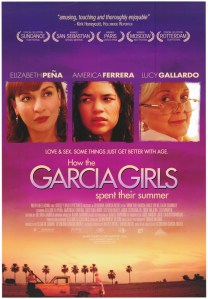
So, I just got back from the show after seeing How the Garcia Girls Spent Their Summer. I always try to see all movies with a Latino or Hispanic theme, or whatever else they claim to be. If the movie is good enough, I occasionally show it to my Spanish classes. The movie looked promising because it starred America Ferrera (Blanca) and Elizabeth Peña (Lolita), but it dragged on a little when they accurately depicted the small-town boredom of Somerton, Arizona.

The scenes could have quickly summarized the boredom and then moved on to the next scene, but no, we, too, had to suffer as much boredom as the protagonists. However, I did like what we learned about the characters when camera focused on one character at a time in what appears to be a soliloquy without words.

When we see Lolita as she drinks at home alone on a Saturday night, we learn a lot about her loneliness and we understand her a little better. These scenes revealed so much about Lolita as a person and other characters without any dialogue. The movie is about three generations of women, grandmother, mother, daughter, who happen to be Mexicanas and how they react to each other’s behavior. Doña Genoveva, the matriarch of the family, finally learns to enjoy life in her advanced years, much to the shock of her daughter and granddaughter.

The movie begins with some retired Mexican men discussing former cars and lovers. Throughout the movie, cars, SUVs, and pickups serve as vehicles that transport the protagonists toward romantic passion. After the opening scene, we see Doña Genoveva gathering her hidden savings throughout the house so she can buy a car. She wants to learn to drive even though she’s seventy years old, causing conflict with her daughter and creating a new friendship with her gardener, Don Pedro (played by Jorge Cervera, Jr., who played the father in Real Women Have Curves (also with America Ferrera). Coincidentally, he plays a Mexican landscaper in both movies, dooming himself to be forever stereotyped as the Mexican landscaper!).

Overall, the movie was exceptionally good in that all the characters learned something about themselves, but the action seemed to drag on much too long. For a movie with a Latino or Hispanic theme, it didn’t feel very Latino, Hispanic, or Mexican. Take away the occasional Spanish dialogue, the Mexican accents, and the Mexican-looking actors, and this movie could have been another non-descript American movie. Neither the characters nor the plot revealed or taught us much about cultural differences. I wouldn’t show this movie to my Spanish classes because it’s not as culturally educational, as, say, Real Women Have Curves.

DDR

Movies


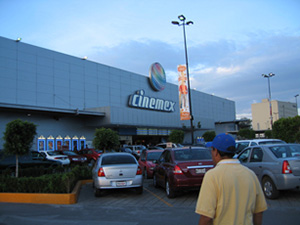
Cinemex, Mexico D.F.

My twin sons and I have been talking a lot about movies lately even though they’re only twelve. They’re curious about my favorite movies and about classic movies in general. We try to watch some classic films together occasionally. The last one we saw was Pride of the Yankees, the Lou Gehrig story with Gary Cooper and Babe Ruth himself. I picked this movie for my sons since they love baseball, and it was one of my favorite movies when I was a kid. Well, we all loved the movie. It was much better than I remembered it.

Last summer, we watched all the Star Wars movies together, one per day, and we really enjoyed them. They wanted to know which one was my favorite. I told them that Episode IV was my favorite because it was the first one I saw. I still remember all the excitement and the hype that preceded the premier. I saw it at the show with my friends Vito and Jim.

Of course, everyone was amazed by the special effects right from the beginning when the words floated in outer space across the silver screen. However, we were all dumbfounded to read, “Episode IV.” When I told my sons about this, they wanted to know why Star Wars didn’t begin with Episode I. Well, I explained my theory to them. Novels, epics, plays, and movies are always more interesting if they start in the middle of the action. If the Star Wars series had started with Episode I, Star Wars wouldn’t have been as popular. I told them how movies usually start in the middle of the story and then flashback to fill in the missing information. This is called starting the story in media res, in the middle of things, and it creates suspense and keeps the viewer watching the movie with great interest. Aristotle explained all this about two-thousand years ago in Poetics, but I didn’t tell that to my sons so I wouldn’t lose their interest. But I did get my point across to them. I was so proud that they understood my point. So now we analyze movies together.

They want to see the new Chronicles of Narnia movie, but I hadn’t see the first one yet. Not that I would deprive them of a movie even if I didn’t see the first one, but I would prefer to see the first one before seeing the sequel. So we were at home, watching the DVD of the first movie. Both Adam and Alex loved watching the movie and seemed to know the plot from watching it so much. Adam had to read the book for school, so he’s really into the movie. So, we were watching it, and my sons are concerned that I didn’t get the movie. They asked me if I wanted them to explain it to me. What I didn’t know about the plot was the intentional effect of the director. But my sons insisted that they explain the plot to me, and they were so excited that they understood the movie better than me that I paused the movie and listened to their explanation. (Spoiler alert! There is no plot spoiling here in case you haven’t seen the movie yet. I’m always impressed when someone writes “Spoilier Alert” when describing movies.) They explained the prophecy to me that would eventually be revealed at the correct time in the movie. But I loved hearing their explanation of the movie. Now, I can’t wait to see the sequel!

DDR

Moving to Mexico


Could I actually live in a condo in a tourist area? I don’t think so.

Over the years, I have had one identity crisis after another. The identity crisis recurs most often is the one in which I can’t decide if I should live in Chicago or Mexico because I’m not sure if I’m Mexican or American.

Sometimes I feel as if I don’t belong here in the U.S. because I feel so Mexican and like a foreigner here. When I’m Mexico, I feel very comfortable there. Of course, that could be merely because I’m a guest there and the excitement and the newness of my being there hasn’t worn off yet. If I stayed much longer, everyone might not be as friendly toward me. I’ve mentioned to some of my friends that I was thinking of moving to Mexico and they immediately offered to help me pack! Wow! What friends!

I went to Mexico when I was 22 and I seriously considered staying there. But then I realized that I would have to get a job in order to support myself. But Mexicans don’t really want foreigners coming in and taking away their jobs. Besides, I didn’t really want to work a back-breaking job in Mexico when I already had a back-breaking job in Chicago. So I went back home to Chicago. However, I often daydreamed about living in Mexico.

Now, I am actually in a position where I can afford to move to Mexico since I have a small pension. I now have to work a job in order to live comfortably in Chicago, but I could live more than comfortably if I moved to Mexico. And I won’t have to work at all if I lived in Mexico. I could sit at home all day writing blog entry after blog entry. Wait, that’s what I’m doing now! But I have to teach in order to supplement my pension.

In Mexico, I would always find something to keep me busy since they do have the Internet down there. And I wouldn’t be lonely because I have a lot of family in Mexico in several cities. Our family, both on my father’s and mother’s side, was very prolific. That’s why Rodriguez and Martinez are some of the most common Spanish last names in the world. So I wouldn’t be lonely.

And even though I’m American, Mexicans–my family in particular–consider me Mexican, sort of. Since I’m American, everyone in Mexico was surprised that I spoke Spanish and ate tortillas. I’m glad that Mexicans thought of me as a Mexican, at least most of the time.

When I go back to Mexico in July, I’ll take another look at where I could possibly live in Mexico. I really love Celaya, Guanajuato, the home of my father’s family. It’s a fairly big city with a small-town feel to it. And, I have an uncle, two aunts, and fifteen cousins who live there! Plus, there’s a university in the city where I could possibly find a teaching position if I ever have the urge to teach again. That would be quite an adventure for me. So now I’m struggling to redefine myself and resolve my latest identity crisis. I’m sure that this time I’ll find myself. Or, maybe not.

DDR

Going to Mexico


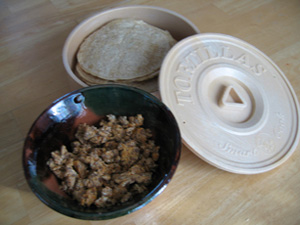
Some of my home cooking.

Okay, I’ve been preparing my sons to go to Mexico. They’re still excited about going even though I told them that everyone in Mexico speaks Spanish. My oldest son used to speak Spanish when he was little because I always talked to him in Spanish, and he went to Cordi Marian and was taught by Mexican nuns. The twins are learning Spanish in school now.

For the past few years, I’ve tried to get them to speak Spanish at home, but they won’t. If they sneezed, I said, “Salud” and they were supposed to respond, “Gracias.” But they wouldn’t. Ever since I told them that we were going to Mexico, they speak a little Spanish with me. I’m glad their attitude has changed a little bit. If I’m writing something in Spanish, Adam will read it aloud and ask me if he pronounced it correctly. I’m happy that they’re trying because now I know they really want to go to Mexico.

I’ve also tried to explain some of the cultural differences between our two countries. They shouldn’t have any problems, but I want them to know in advance that they shoul expect some differences. They probably won’t play any video games while we’re in Mexico. But my sons are very adaptable. They’ll manage somehow. We’ve taken driving vacations before, and we always adapt to every situation. I’m really not worried about much. Well, except maybe Montezuma’s Revenge. If they get it, I hope they get it right away and they won’t get too ill. After that, they’ll build up their immune system.

I warned them about how the food will be different, too. We won’t be going to McDonald’s or Burger King once we cross the border. They won’t see a burger or chicken nugget until we get back to the U.S. And all the food will be spicy. In Mexico, even the candy is spicy.

On Sunday mornings, I make huevos con chorizo and tell them to eat them with tortillas because that’s how Mexicans eat–without silverware. So far, they’re still excited about going to Mexico.

DDR