I had some unusual table conversations while I was in Mexico. I guess I learned a lot about Mexicans in my previous three visits to Mexico. I always felt that I could speak honestly about anything whenever my relatives asked me personal questions. And everyone else was also very honest in these conversations. But not in such a way as to hear more information than I wanted to hear.
One of the most unusual conversations turned from gossip about a woman’s breast implants to an impromptu questionnaire about breast implant preferences. Someone mentioned a certain woman who had unusually large breasts. Someone else who knew her said that she had had breast implants, but that she didn’t like them because they hurt her whenever someone touched them.
Suddenly, my cousin asked me if I liked breast implants. I felt uncomfortable answering this in mixed company, especially since I was asked by a female cousin. Well, I paused to think awhile, but my cousin’s husband immediately volunteered his opinion and said that he preferred natural breasts. He wouldn’t like breasts with implants if he couldn’t touch them and massage them during sex. The females also stated that they liked to have their breasts touched, so they would never get breast implants. All the while, I was surprised that I was participating in such a conversation in Mexico.
Driving on the streets of México City requires excellent driving skills, a good memory to remember all the major street names, great intestinal fortitude, and at least a couple of loose screws in the brain housing group. Because, who, in their right mind, would want to drive someplace where the drivers view the rules of the road as mere suggestions to be ignored whenever possible? I mean, besides me. Red lights mean stop if you think you’ll get into accident. Otherwise, don’t stop too long or the drivers behind you will start beeping at you to make you drive through the red light. Amazingly, you don’t see very many traffic accidents in Mexico City considering the congestion.
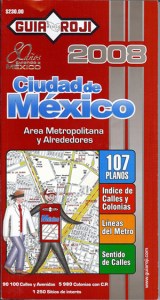
I felt embarrassed that I needed a map to get around México City. Until I found out that anyone who drives all over the city also has a map, like the one above by Roji. It’s a geographically large city, so there are way too many streets to memorize all their names. In fact, many Mexicans know the routes to various places such as their workplace and the homes of family members. But ask them to give you directions to a place they travel to daily, and they’ll be hard pressed to be able to give you accurate directions. Mainly because the don’t know the street names of all the streets on which they drive. My cousin drove me from her house to our aunt’s house. As we were driving, I took out my little notebook with everyone’s address. I asked my cousin the name of the street on which she was driving. She didn’t know its name. Or the names of half the streets we took.
When I drove to the house of another cousin, I followed the directions I was given. They were easy enough to follow. When I arrived at my cousin’s house, I got there way too early and I didn’t feel like waiting around for a few hours for her to get back. So I looked at my Roji and tried to drive to my aunt’s house following a new route that I plotted out, against the advice of my cousin. How hard could it be? Besides, I have been lost in Mexico City many times before. I started to miss driving on my own and getting lost on my own and then trying to find my way to my destination. The other thing about driving in Mexico City is that the street signs are so small, posted on the sides of buildings, making them difficult to locate so that they are rarely helpful. And sometimes when you do find them, they’re covered with graffiti and therefore unreadable.
Anyway, I’m driving to my aunt’s house, but the main street that I wanted to take is a one-way street in the opposite direction of my destination. So I figure I’ll take a parallel side street. However, the streets do not follow a regular grid system because Mexico is such an old city. So all side streets radiate out from the main strip of any given colonia, or neighborhood. Well, if I wanted to drive in a more or less parallel course to the main street, I had to zigzag my way from a couple of blocks away. It was easy to lose my sense of direction because very few streets ran in straight lines. Luckily, I thought to use the GPS feature of my iPhone and I could tell I was more or less on course.
Well, this was quite an adventure! And even though I swear I’ll never drive the streets of México City again (mainly when I’m completely lost while driving), I now miss that roller coaster ride of emotions ranging from fear to sheer terror while driving. I can’t wait to drive back to México City!
A long time ago, my cousin Gary from México came to visit me in Chicago with his friend Gustavo, also from México. It was a cold, snowy February day. Being the considerate host that I am (most of the time), I asked to take their coats. They said they wanted to keep them on. We talked for a while and finally they took off their coats because they got hot. I took their coats and hung them up in the closet. I asked them why they kept their coats on and they said that in México most houses didn’t have heating, so everyone keeps their coat on to stay warm. The weather is much more temperate in Mexico than in Chicago where we have extreme cold in the winter and extreme heat and humidity in the summer and so our homes have heating and air conditioning.
When I was in Mexico, not one home I visited had heating or air conditioning because they don’t really need it. In the winter, the temperatures drop, but everyone sleeps under blankets and when they are awake they wear coats or jackets in the house if they feel cold. Of course, everyone worries that I’m cold because I don’t wear a jacket along with everyone else. In fact, I wore short-sleeved shirts. People got cold watching me walk around sans jacket or sweater. When I look at some of the pictures I’ve taken, I see people wearing winter coats even though I recall the temperature hovering around sixty degrees. On the plus side, Mexicans have two less utility expenses since they don’t have or need heating nor air conditioning. I wish I could do without heating and air conditioning in Chicago!
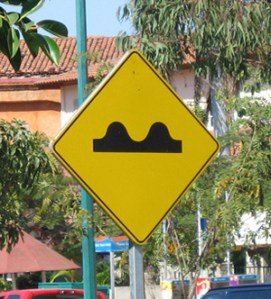
When driving in Mexico, you will encounter el tope. It’s a speed bump that is very unique to Mexico. They come in all shapes and sizes. They actually resemble a speed hump, but they’re actually taller and wider so it takes longer to drive over them. My cousin Mara’s neighborhood has so many topes, that she calls it Topelandia. In America, we also have speed bumps or speed humps. Usually their existence is often linked to petitions. About half of all Americans will petition to have speed humps placed in their residential neighborhoods in order to slow down traffic and make the streets safer for their children. After the construction of said speed bumps, the other half of the residents will petition to have those speed humps removed in order to speed up traffic. Besides, parents should be watching their children so they don’t play in the streets! You either love them or you hate them. I mean the speed humps, not the children.
Most of the time the topes are clearly visible and you must slow down before approaching them to avoid totaling your car. Occasionally, you don’t see one because it hasn’t been painted and you are driving too fast. Your car bottoms out and all your passengers hit their heads on the car roof. It happens to the best of Mexican drivers every so often. It even happened to me. Everyone complains about the topes, but they’re there here to stay. You just have to accept them. Driving over topes would makes for great astronaut training. The only place they don’t have them is on the toll roads that lead to America, otherwise no one would pay to use these toll roads that closely resemble American highways. Without those topes, Mexican drivers would drive even more recklessly, if you can even imagine that! I absolutely hated driving over them. The topes, not the Mexican drivers. But I did have a few close calls. With Mexican drivers.
When I was younger, I never slowed down when driving over speed bumps or speed humps. In fact, if I drove over them at regular speed, the speed bumps felt less bumpy the faster you drove over them. And they never damaged any of my cars, all of which I drove until they were totaled in accidents, none of which were my fault–I swear. I remember always driving full-speed ahead over the fourteen railroad tracks at 55th Street and St. Louis Avenue on Chicago’s south side and feeling less jolts than when I drove over the tracks slowly. I don’t know who said you should slow down over tracks, speed bumps, or speed humps. You should go over them as fast as possible to feel less bumps. That’s why cars have shock absorbers! I now have a car, a 2005 Pontiac Vibe, with a wheelbase so short that I can ride over speed humps or topes without actually having to slow down! It’s actually kind of thrilling! You go up and down rather quickly, much like an amusement park ride!
Sometimes accidents happen unexpectedly. It’s at moments like these that I truly appreciate the life I have. While in Ixtapa-Zihuatanejo with my cousin Mara, her husband Enrique, and their children Daniel and Rebeca, we were enjoying ourselves until Becky was involved in a swimming accident with a boat’s outboard motor. We were there for a whole week. The accident became our reference point. Before Becky’s accident and after Becky’s accident. Everything happened so quickly!
We were sightseeing like typical tourists. We were having a lot of fun. We liked to talk and joke about whatever we were doing. As we walked down the main street, people were trying to sell us trips to beaches where we could snorkel, swim with dolphins, see alligators, and swim on the beach. We eventually found a good deal and went to Ixtapa Island where we snorkeled and then went to swim and tan at the beach. I was in the water a short while–I’m not much of a water person–and then went to talk to my cousin Mara while Enrique, Becky, and Daniel continued swimming. Becky had actually swum competitively so she was really swimming, unlike me who merely dog paddled awhile. I watched her swim and envied her swimming skills. How I wished I could swim like her.
Mara was asking me why I had come out of the water so soon and I told her that I been in the water long enough. We talked awhile when suddenly I heard someone yelling in the water. I walked toward the water where I saw some people near a boat with an outboard motor. I could hear a female voice screaming for help, but I could barely see her head. A few men swam toward her to help her. She appeared to be caught up in the propeller of the outboard motor. One of the men asked for a knife–I assumed so he could cut of her clothing. One woman who was lying on the beach swam toward the boat yelling, “I’m a doctor!” Another woman went to the jet ski stand and told the man to call an ambulance on his cell phone. When they finally released the woman from the boat, I saw that it was Becky! She was holding the propeller against her abdomen, so I thought it was embedded into her body. She had blood on her shirt and I could see a gash on her arm. But she was walking with the help of her father who helped steady her as she walked. The doctor tried to stop the bleeding as Becky walked to another outboard boat that took her and her father to the ambulance.
Our tour guide told Mara, Daniel, and me to get all our things. He would take us to the hospital. When we finally got to the hospital, we learned that Becky had been slashed by the propeller on the wrist, abdomen, and leg. She didn’t have any life threatening injuries. A woman who looked vaguely familiar approached at the hospital and told us she was from the resort where the accident occurred. She had seen everything and she had witnesses, too. She explained that Becky had been swimming in the area where swimming was prohibited because of boat traffic. Becky was swimming underwater when the boat operator started up the boat. He then started moving slowly when he heard a thump near the front of the boat. He shut off the engine immediately, but the propeller kept spinning. He never saw Becky swimming. When he heard her screaming, he tried to free her from the propeller. Others then came to help her. The woman then explained that their company would pay all of Becky’s medical expenses if we agreed not to sue. I said that I was merely a cousin and that she should explain all this to Enrique, Becky’s father. But the woman insisted that I sign. I refused because I’m not familiar with Mexican law. I didn’t want to jeopardize anything to which they were entitled. The woman became more assertive, but I continued to refuse to sign.
I watched as she later tried to convince Enrique to write a statement that he agreed to her terms and sign it. He thought about it long and hard. I pulled him aside with Mara and he explained the situation to us. Yes, he could sue, but in Mexico it would take about eight years to settle the lawsuit and chances were slim to none that they would win any settlement, particularly since there were witnesses who had seen Becky swimming in the no swimming zone. Eventually, he agreed to their terms and they did reimburse him with cash for the medical expenses. They even sent a doctor to the hotel room to visit Becky.
After the accident, we were all shaken up. We were mere shadows of our former selves. Becky had to stay in bed the rest of the vacation. Driving in the car caused Becky great pain. We had to drive ten miles the next day to see a doctor to give her a tetanus shot because they didn’t have one at the hospital. That ride was extremely torturous for Becky because of all the bumps. We had to return in three days and we wondered how we would drive Becky home if every little bump caused her so much pain. Finally, Enrique announced that she would fly home with her mother. One of Becky’s friends would take her home from the airport.
However, we were all grateful that Becky was still alive! She was extremely lucky to be alive!



 Chicago USA