La sirena


Lotería, el juego para todas las edades

When teaching Spanish, I always learn something new from my students, or rather mis estudiantes. Sometimes I don’t notice things that are part of our Mexican culture because they are just part of everyday life. For example, we don’t always notice daylight because it’s always there (in the daytime, of course) and we just take it for granted. In my Spanish classes, I just happen to take Spanish for granted. In fact, I’m rarely aware of which language I’m speaking. So, when I’m supposed to be speaking English, I’m speaking Spanish, and vice versa.

So, today, we had a little bit of free class time, so I decided to show a movie that was filmed in Spanish. Students just love watching movies in class. Rather than conversing in Spanish or doing more exercises. Well, I like to show movies in Spanish because this way they can learn something about Hispanic culture that they can’t learn from a textbook. A student had mentioned the Mexican movie Y tú mamá también earlier in the semester. In the culture section of our textbook SueñaGael García Bernal  is profiled and specifically mentions Y tú mamá también in his film credits. I thought this would be a good movie to teach students a little about Mexican culture and Mexican expressions, otherwise known as mexicanismos. Afterwards, the student who had originally mentioned the movie told me she thought the movie was a little racy. I must admit that it is. I saw it at the show when it first came out. I was in a theater full of Mexicans at the Ford City Theaters, and they were all shouting “¡Huy!” at some of the scenes at the end of the movie.

It seems that no matter what movie I show in class, a few students always comment about something in the movie that was offensive to them. All good movies will offend at least some of my students. Most of the other students love seeing the movie regardless of the content, whether deemed offensive or not. I’ve shown movies from México, Spain, Guatemala, Argentina, and the U.S. (in Spanish). They always address some controversial topic such as sex, incest, murder, etc. and they usually have a tragic, depressing ending. But they are always good movies. The advantage of showing these movies is that I know none of my students saw them in their high school Spanish class. No sane high school teacher would dare show such risqué films without taking a chance of getting disciplined and/or fired. I teach at a university, so I have a little more liberty in film selection since all my students are older than eighteen.

Sometimes when students tell me they find a movie offensive because of too much violence or sex, I tell them that they may leave the class without penalty if they find the movie objectionable. No one ever leaves. In fact, they find the movie enthralling. So I just don’t understand why they complained in the first place. Perhaps, to clear their conscience. Besides, everyone loves Penelope Cruz movies, and she hasn’t made a movie without any offensive topics. My favorite movie with her is the one where she plays a pregnant nun with AIDS.

On a couple of occasions, I offended some students unintentionally by playing Lotería. This is a board game like Bingo that I have been playing since I was a little boy. Every student gets a board with pictures of people and things such as La dama, El soldado, La rana, etc. There is a deck of cards with these same pictures. So, I shuffle the cards and call out the names. If your board has the picture that I called out, you mark the picture with an uncooked pinto bean (provided by me, since students don’t happen to walk around carrying pinto beans with them, but I do). When you cover all the pictures with pinto beans, YOU WIN! And you shout ¡Lotería! at the top of your lungs and I give you a little prize like a packet of chiclets or something else that’s Mexican. This is a child’s game that you would think would not offend anyone. Well, if you thought that, you would be wrong!

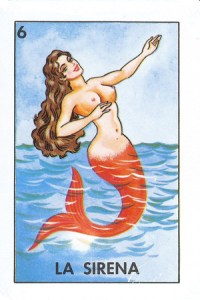
Once, actually, this happened several times, when I called, La sirena, a female student shrieked and said that the mermaid had exposed breasts. She was genuinely offended by the nudity. I didn’t know what to say. So, I looked at the card of La sirena and sure enough she had exposed breasts! I’ve been playing Lotería my whole life and I never even noticed her exposed breasts. To me she was just a mermaid. A cartoon mermaid. All I ever saw was her long hair and her fish tail. I mean, if I saw a real mermaid in person, I wouldn’t be caught staring at her breasts!

Why didn’t I see La sirena‘s breasts before? I’m not sure. Probably because I always saw my mother breast-feeding my younger brothers. And in public, too! I remember my mother taking my brothers and me to the park to play in the playground and she would breast-feed my baby brother right there on the park bench. And she wasn’t alone, either! There were always at least two or three other mothers breast-feeding, too. Maybe I just view breasts differently from everyone else. Breasts were just part of my Mexican culture while growing up and I just never noticed them on La sirena or in movies until students point them out to me! ¡Ay! ¡Ay! ¡Ay!

DDR

T-shirts


UIC student t-shirt

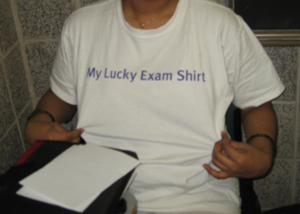
T-shirts with messages always attract my attention, especially if they have an intriguing message. So how does a clothing item that was originally an undergarment come to demand so much attention? Well, I’ll tell you. No one seems to know. If you wear a T-shirt with text, I will read it. If the message is partially obscured by a sweater or jacket, I will ask you to let me read it. If for some reason your message truly intrigues me, I will ask you to let me take a picture of your t-shirt. I hate it when I ask the wearer of a particularly mysterious message to explain the significance of the message and they don’t know. How can they not know? Well, usually the T-shirt was a gift. Well, I wouldn’t wear a t-shirt to disseminate a message that I didn’t understand. Yet, many people do. I just don’t get it!

DDR

Escuela


Mexico D.F.

Be careful when talking about schools in Spanish! If you’re talking about school in the general sense, use escuela. For grade school, elementary school, and grammar school, use escuela primaria. For high school, use escuela preparatoria, escuela secundaria, colegio, or instituto. Unfortunately, there is no term for junior high school. When you graduate high school, you attend la universidad. Do not use colegio because colegio refers to high school. College and colegio are false cognates. If you attended a junior college or a community college, you must use universidad because junior and community colleges do not exist in the Spanish speaking world. 

Students in the general sense are estudiantes. If you are a college or university student, you are either an estudiante, alumno, or alumno subgraduado. Graduate students are alumnos graduados or alumnos de posgrado. 

Be careful what you call the teachers! Grade school and high school teachers are maestros  or maestras. High school teachers may also be profesor or profesora. College and university professors are either profesor(-a) or doctor(-a).

DDR

Confirmation


Most Holy Redeemer Church, Evergreen Park, Illinois

My son Adam was confirmed today. And I recalled many things past and present about being Roman Catholic.

The holy sacrament of Confirmation is usually the fourth sacrament that a Roman Catholic receives. A Christian baby is baptized soon after birth and then around the age of eight makes his or her Confession and receives his or her First Holy Communion. Then around age twelve or thirteen, usually, he or she makes a conscious decision to denounce Satan and become a Christian, unlike Baptism where an innocent baby has no choice but to be baptized a Catholic.

I am a Roman Catholic (or just plain Catholic). There were times in the past when I told people that I was an ex-Catholic or a lapsed Catholic. I was once hospitalized at St. Anthony’s Hospital and when I was asked my religion I said, “Catholic” just out of guilt. A Catholic priest then came to visit me every day. I told him that I wasn’t sure if I was still Catholic, and he told me that it was normal to doubt. Now, whenever someone asks me my religion, I say I’m Catholic. If I think about Catholicism very objectively, I realize that, once you go through all my religious training, I will always be a Catholic and never an ex- or lapsed Catholic. That would be the equivalent of saying, “I used to be Mexican.”

Today, I tried to compare Adam’s confirmation to mine. But I couldn’t remember my confirmation because I was baptized in México when I was about two months old. When it came time for my class to get confirmed at Holy Cross, my mother told me that I was already confirmed. That was news to me! Whenever we had confirmation classes, Sister Cecilia would just look at me with disdain and shake her head. She couldn’t understand how Mexicans could confirm babies. That was so contradictory to the whole concept of confirming that one voluntarily and willingly wanted to be a Catholic. Well, I was an outsider during the whole confirmation process. I had to go to the Confirmation, but I couldn’t sit with the class because I wasn’t getting confirmed. I didn’t feel very Catholic that day. Or today when I tried to compare my confirmation with my son’s.

I was happy for my son, but this was an awkward day for me. Since the divorce, we no longer celebrate anything as a family. But such is life.

DDR

2012


The Spanish perspective of the Mayan calendar

Who actually believes the world will end in 2012? Certainly not the Mayans. Sure, their calendar ends on December 21, 2012. But did they predict the end of the world? Of course, not! The Mayans did not perceive time as linear, as we do, but rather as circular. Their calendar just happens to end on December 21, 2012. Uh oh, that’s 12-21-12. But let’s not read too much into the numerology, right? Because the Maya calendar is way different from ours. Perhaps, two-thousand years ago some Mayan astronomer calculating the calendar decided that he had done enough work and decided to leave some work for future generations of Mayan astronomers. So, who didn’t continue with the calendar? Probably some slacker Maya. And now many people are panicking.

A souvenir from Guatemala

Now that I think of it, our calendar always ends on December 31, but no one ever panics. Why? Because we know it starts all over again. However, we do celebrate the end of the old year and greet the coming of the new year. At least we hope so. In case the world ends at midnight on December 31, we certainly won’t feel too much pain. This tradition started as a fear of the world ending at the end of the calendar year.

But we love to scare ourselves. So, some people subscribe to every “it’s the end of the world theory” that comes along. Remember Y2K? Here, again, there was a lack of calculation and foresight on behalf of computer engineers. Many people feared the end of the world would come on December 31, 1999. Why? Because all the computers in the world calculated the date only until 12-31-99. At midnight of 12-31-99, the calendar “advances” to the next mathematically logical date, 01-01-00! But the computers wouldn’t know that 00 was supposed to mean the year 2000. They would instead “advance” backwards in time to 1900, which is the only logical mathematical step. Hence, the Y2K scare! Many people genuinely believed that at that precise moment there would be power outages, planes falling out of the sky, and nuclear power plants melting down. So many people bought their Y2K water bottles, emergency Y2K food rations to help them survive the imminent disaster, Y2K generators, and Y2K gasoline cans filled with beaucoup gasoline in preparation for the end of the world. But it was all for naught!

And what happened when the year 2000 began? Absolutely nothing! A lot of scared, confused, and drunk people realized they had panicked for nothing. But everyone loved the adrenaline rush of being scared. Why do we love to scare ourselves? Why do we enjoy that sudden rush of adrenalin? Sigmund Freud said we all have this death drive (todestrieb) that makes us want to die. Well, not all of us really want to die, but we don’t mind experiencing death precariously through fictional characters in movies or experiences that simulate near death. We achieve this profound sense of accomplishment at having survived this harrowing pseudo-near-death experience.

That’s why roller coasters are so popular. People ride them, scream their heads off during the whole ride, stagger off the platform, and then run to get back in line. That’s why we like scary movies like Paranormal Activity. Everyone–myself included–went to see it because the buzz was that this was a really scary movie. This was a low budget, no expensive special effects type of movie, like The Blair Witch Project. You could just feel the suspense in the air. The scary part was when the bedroom door mysteriously moved about an inch. All the females in the theater screamed and all the males jumped when they heard all the females screaming. But everyone enjoyed being scared throughout the movie.

And speaking of 2012, I also saw the movie 2012. Since everyone is worrying about the impending end of the world in 2012, why not capitalize on this fear. Give the people what they want. The movie theater was packed when I went to see it with my sons. We were forced to sit in the front row because we got there a few minutes before the movie started, which was great for watching all these buildings fall on top of us. Other than the allusion to the end of the Mayan calendar, this movie had absolutely nothing to do with the Mayas! We witnessed one cataclysmic disaster after the other until the protagonists finally survived in the end. Ironically, the premise of the movie hinges on the total destruction of Planet Earth, but will we see a movie where everyone dies in the end? All the destruction considered, there was a huge adrenalin rush for everyone as they nearly died, followed by a happy ending. We all brushed off the imaginary dust of ourselves and slowly headed back to the real world to anxiously await the real 2012!

DDR