Blog entries


Universidad Nacional Autónoma de México

Okay, so how do I write my blog entries? Well, I’ll tell you. I don’t know. I have no rhyme or reason when I sit down at the computer to write a blog entry. In fact, when I’m at my computer, I’m usually supposed to be doing something else, “important academic work” such as grading online Spanish homework or compositions.

However, I never do what I’m supposed to do in a straight-forward fashion. For example, right now, I sat at the computer to grade online Spanish homework, send an email to my cousin in Mexico, enter student grades on my Excel spreadsheet, and then with time permitting, write a blog entry for the sake of posterity that will better the world in untold ways. Well, I hate correcting online homework online, I can’t think of anything to write my cousin, and I dread the thought of staring at a spreadsheet this early in the morning, so I think I’ll start with a blog entry!

So how do I choose my topics? I don’t know! I have many ideas percolating in my head, some for many years now, that somehow manage to ooze out through my fingertips and out into cyberspace. I can’t always contain them. And so they wind up in a blog entry.

As you’ve probably noticed, I’m rarely topical or current. I’ve reached that age where I’m very fascinated with the past, the nostalgic elements of life. I rarely invent anything that I write. I’m just not that creative. I write about just about everything that I remember because I have a good memory.

How good is my memory? Well, I remember things that most of my friends don’t remember even the slightest detail. But a good memory is like a double-edged sword: it cuts both ways. I also have some painful memories that I would like to forget but can’t. I have issues with my good memory: 1. I remember most things that ever happened to me, and 2. I remember many things that never happened to me. My imagination invents events from my past and I truly believe that they really happened to me. I try to block those out, but I don’t always manage to censor them.

Well, I will end this blog entry rather abruptly today, as I do with most blog entries. I have some things that I really have to do. But first, I’ll go out for my morning run.

DDR

Translations


A Spanish student’s best friend!

Translation from one language to another always poses a problem. Dictionaries alone aren’t enough. They never have the latest technological terms. New products aren’t in there, either. For new products, I looked at the sales inserts of our local Spanish papers and most of the time I found the term I needed.

Now, with the Internet, there are all kinds of translators available. Sometimes students use them for their Spanish compositions. They write the composition in English first and then have the translator translate it for them. I can always tell when they use the translator because the composition looks as if it’s written in Spanish. However, the text is unintelligible. Yes, every word is in Spanish, but the wrong words were chosen, and the syntax is all wrong. The students write a better composition if they write entirely in Spanish. Even when they make mistakes, I can still decipher their intended meaning.

Occasionally, when I need to translate a word that’s not in one of my many dictionaries, I go to the internet and use an online translator for a word or two. Not all the translations are satisfactory. I’ve discovered that Wikipedia.com makes a great translator. A student needed to translate “jigsaw puzzle” into Spanish, and none of my dictionaries had it. So, I looked up jigsaw puzzle on Wikipedia and then I chose to read the article in Spanish got rompecabezas. For years, I’ve meaning to translate Daylight Saving Time into Spanish unsuccessfully. Today I looked it up on Wikipedia and got el horario de verano. This method would work for many languages because most of the Wikipedia articles are translated into many languages.

DDR

Written Spanish


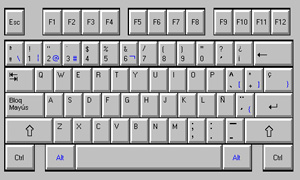
Spanish keyboard map.

I’ve already mentioned how when I went to Mexico everyone seemed to comment on my American accent when I spoke Spanish. Well, my written Spanish is much better than many of my Mexican relatives. I often get letters from Mexico and some relatives just don’t use accent marks that are necessary when writing in Spanish. When I e-mail my cousin in Mexico, she is always amazed that I write much better in Spanish than her, even though she’s a native speaker. Another cousin constantly IMs me. Every so often, she asks me how her Spanish is. I tell her it’s surprisingly good, even though she doesn’t spell very well, doesn’t capitalize at the beginning of sentences, and doesn’t use any punctuation. Some of my Spanish students have seen these types of writings in Spanish and then question why I insist that they use accent marks and ñ and all things Spanish. Well, the main reason is to show that you have been educated. It works for me because my cousins take more seriously when I write proper Spanish.

DDR

Writer’s Desk


IBM Selectric

Back in the 1980s, my brother Jerry told me about a writer’s group that met every third Tuesday in the Beverly neighborhood at 107th and Hale. So I joined the group because I really enjoyed writing, and reading my works for this group motivated me to write. I met a lot of interesting people and I always looked forward to every meeting.

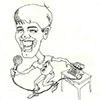
One of the poets, introduced me to her sister who just by chance had married a Mexican whose last name was Navarrete, just like one of my aunts in Mexico. The poet’s sister just happened to be a commercial artist. Eventually, she drew a caricature of me for my comedian’s business card. (It’s the caricature you see below.) I remember that she was afraid to show it to me because I might think that she was making fun of me. I really loved it! It was exactly what I wanted. I was always proud of my business card.

Elizabeth-Anne Vanek was the president of the group and she was a published poet. She was the heart, soul, and muse of the group. Without her, the group would have disintegrated. I also met Marc Smith before he became famous for his poetry slams at the Green Mill. He came to many meetings and would read his latest poetry for us.

I also remember Frida who came to every meeting religiously and listened to everyone’s work patiently and then commented with objective criticism. She was a writer who didn’t actually write anything. She couldn’t write anymore. Her muse had abandoned her.

I also brought my friend Tony Trendl from the Marquette Park Track Club for a couple of meetings. I must admit that I did the most writing in my life while I belonged to this group. It was then that I started writing for The Finish Line and the Illinois Runner. However,  I never published any of my short stories that I read to the group. My writing improved immensely while I was a member of the Writer’s Desk.

And in another one of those cosmic coincidences that frequently occur to me. I now live right down the block from where the Writer’s Desk used to meet!

DDR

Cuentistas de Chicago


Chicago fiction en español

I just finished reading a book of short stories in Spanish that mostly take place in Chicago: Vocesueltas: Cuatro cuentistas de Chicago written by Raúl Dorantes, Bernardo Navia, Fernando Olszanski, and om ulloa (Chicago: Ediciones Vocesueltas, 2007).

You get a real taste of Chicago in the stories of Dorantes and Navia even though they write about their adopted city in Spanish. I really enjoyed reading Dorantes and Navia, the best of the four. Olszanski and ulloa didn’t particularly focus on Chicago as did Dorantes and Navia. My favorite story in the book was “Duelo de sur” by Bernardo Navia. I could truly visuallize the subway stop that he described. The story breathed and smelled of Chicago despite being written in Spanish.

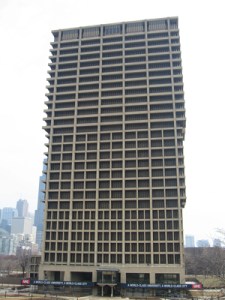
Of course, my enjoyment of this story was based on personal reasons. I personally knew, and still know, Bernardo Navia. I’ve known him for years after first meeting him at the University of Illinois at Chicago. Bernardo was the first graduate student to receive a Ph.D. in Hispanic Studies from UIC. We were enrolled in several classes together, he as a graduate student and I as an undergraduate.

One class in particular that I remember was a 20th century Latin American literature class in which we read Jorge Luis Borges, Alejo Carpentier, Nicanor Parra, Julio Cortázar, among others, with Professor Klaus Müeller-Bergh. I really enjoyed this class thoroughly. I still vividly remember some of the class discussions, particularly the one about “El sur,” a short story by Borges.

Well, in Vocesueltas, Bernardo updates “El sur” by placing the action of “Duelo de sur” in Chicago in the present. The story is even dedicated: A Dahlmann, the protagonist that Borges toys within his story. I enjoyed how Bernardo even notes similarities and differences with “El sur.” For example, instead of someone throwing crumbs, Julián notices that someone has thrown a tooth at his feet. And then he notices another and another before he finally sees a molar. We know that Julián is in a hospital, as was Dahlmann, but in the end he remembers that at least someone gave Dahlmann a knife to defend himself. For me, this was certainly the best story of the anthology.

DDR