I’m not that kind of doctor!


May 9, 2004

I’ve learned that with my Ph.D. and five bucks I can buy a cup of coffee at Starbucks. I’ve also learned research skills that allow me to circumnavigate the Google-verse. I can find anything and everything on the Internet—everything except a job.

I’ve been searching unsuccessfully for a tenure-track position in Spanish for twelve years now. However, I’m not bitter at all. Actually, I’m sure I’m on the verge of finding a job very soon. In 1995, I was awarded a tenure-track position at a community college near my home. This was the ideal job for me. As a community college student myself, I would have been the perfect role model for most community college students. I was supposed to teach some combination of English and Spanish courses because I had one M.A. in English and one in Spanish. I immediately applied to a doctoral program in Hispanic Studies so I could move up another step on the salary scale. Sadly, when the college board of trustees met, they decided that my position wasn’t necessary, and the college couldn’t afford to pay another salary. I had lost my tenure-track position before I even taught my first class! And I have continued my fruitless job search ever since.

Now why did I want a Ph.D. again? Well, since I was in grade school, I wanted to be the most educated person in the world. I remember I once asked my seventh-grade teacher, Sister Laverne, “What’s the highest degree you can get?” And she immediately responded, “Ph.D.” with a sense of awe and reverence. “I’m going to get one of those someday,” I told her. In my heart, it was more like a solemn vow, an eternal quest for knowledge. I would someday be Dr. Rodríguez! However, I never wanted to be a medical doctor. I get squeamish if someone describes medical procedures in too much detail.

There were a few bumps, detours, and stalls on the road to becoming Dr. Rodríguez. My parents groomed me for the life of a manual laborer. As a high school student, I was already a full-time factory worker and couldn’t graduate. Well, it’s hard to get into college if you drop out of high school. Go figure! But I got my GED. I’d hate to think that I wasted six years in high school! Then, I worked in a peanut butter factory for twelve years with a brief three-year stint in the Marines Corps in the middle. I’d say that was a significant detour to becoming Dr. Rodríguez. I must admit that while I was in the Marines, I enrolled in an English composition class at Fallbrook Community College, but ended up dropping out because the composition professor critiqued my writing. Didn’t she know that I would someday be Dr. Rodríguez?

Dr. Rodríguez was ever-present in my thoughts as I continued reading and writing. I always fondly recall my conversation with Sister Laverne. I didn’t even know what a Ph.D. was back then. (And now, I’m not sure what to do with it!) There was no escaping those constant reminders of my becoming a doctor. My initials are DR! Every time I bought a house, I kept initialing DR. My license plate, the same one that I’ve had since the 70s, begins with my initials: DR.

When the peanut butter factory closed, I tried my luck as a standup comedian. I was fairly good, but I couldn’t handle the Bohemian lifestyle of the starving artist. I needed a steady, good-paying job. Okay, I admit it. Over the years, I’ve developed an addiction to food.

So, I became a police officer because the job paid well and offered good benefits. Being a police officer wouldn’t be so bad if there weren’t so many criminals. In 1987, the Chicago Police Department encouraged everyone to go back to college to get a bachelor’s degree in order to qualify for future promotional exams. Well, at first, I resisted going back to school. But the very first time I had to work the midnight shift, with the realization that I would have to work midnights every third month, I made up my mind to finally graduate from college and find another line of work. So, I enrolled at Richard J. Daley College and earned my A.A. in two years while working full-time on the afternoon shift. When I went back to school, I was able to request working the straight afternoons and avoid midnights altogether. I loved the fact that Chicago’s Mayor was Richard M. Daley, and I attended the college that was named after his father Richard J. Daley.

When I transferred to the University of Illinois at Chicago, I also transferred to a police district closer to home. So, I lived and worked in Bridgeport, the home of Mayor Richard M. Daley. As luck would have it, I was the new officer in the district so I would have to work assignments that the seasoned veterans didn’t want. As the new guy, I had to sit in an unmarked car guarding the mayor’s house because most police officers didn’t want to be anchored to one place for the entire shift. I, on the other hand, loved guarding the mayor’s house, sitting there reading the assigned texts for my classes. I was the perfect officer for the post because the mayor didn’t like the officers to watch TV while on duty. I loved to read, and I always studied to get good grades. When the mayor would leave his house, I had plenty of time to put away my book before he saw it. For a while there, I really loved being a police officer! I must admit that I loved the job, but I hated working most of my weekends.

Well, I graduated with a double major in English and Spanish. And since I could study most of my shift, I also graduated Phi Beta Kappa. I applied for a few jobs after graduation, but I was unsuccessful. When the mayor was reelected, I just had to take advantage of my situation. I applied to graduate school for both English and Hispanic Studies at the University of Illinois at Chicago, since they offered many classes that would fit my schedule. I applied for two graduate programs because I desperately wanted to go to graduate school. I wasn’t sure which program would accept me and I really didn’t care as long as I could become a graduate student. I wanted to guard Mayor Daley’s house with a purpose. The mayor’s security detail loved having me in front of the mayor’s house because I was always wide awake and guarding the mayor.

Well, I did get accepted to graduate school! To both programs! I agonized over which program to choose. I loved English and American literature, but I realized it would be more difficult finding a job with an English degree. I made up my mind to choose the Hispanic Studies program because I loved Spanish literature, and I could probably find a job with a Spanish degree since I was bilingual. But why should I be forced to choose between the two programs? Suddenly, one afternoon, while I was guarding the mayor’s house, it occurred to me, like an epiphany. Since I could read all day while I’m at my police job, I could enter both programs! And so, I did.

When I graduated with two MAs in 1995, I was hired by the community college, even though I never actually got the job. But I was still in a doctoral program for Hispanic Studies. Mayor Daley was reelected again, and I was finally on the road to becoming Dr. Rodríguez in earnest.

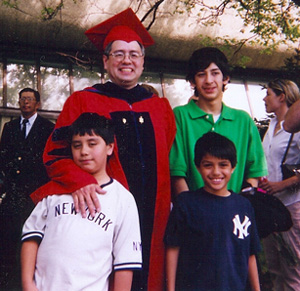
When I earned my Ph.D., one of my police partners bought me a nameplate for my uniform that said, “Dr. D. Rodriguez” as a graduation gift. At first, I was hesitant about wearing it, but then I wore it proudly. The supervisors and top brass who saw the nameplate were impressed. All my police colleagues began calling me “Dr. D.” Whenever someone asked me a question and I knew the answer. Someone would invariably say, “That’s why he’s the Doctor!” Of course, there were playful jokes, too. One police officer would always tell me about his aches and pains, and then ask me for a prescription for painkillers. “I’m not that kind of doctor,” I’d tell him. “But if it’ll make you feel better, I’ll read you some poetry.” No one ever took me up on the poetry reading.

I’ve been teaching for twelve years now. I really love the interaction with the students, even when we argue over silly matters. I’m the greatest teacher in the world! (But aren’t we all?) Most students seem to enjoy my classes and often ask me what I’m teaching next semester. Sometimes, I say things that make the students laugh, so I write them down. I’m thinking of going back on stage. I’m not joking!

Well, I’ve given up looking for a tenure-track position. So if some university or college wants to offer me a position, I may accept it, but only if I don’t have to go through another interview with a search committee. I’ve learned to accept the fact that I’m a retired police officer after a mere twenty years of service: I came, I saw, I retired. I really enjoy teaching so I’ll continue teaching as a lecturer at the University of Illinois at Chicago. However, I am proud to have earned a Ph.D. I once made a pilgrimage to the UIC Library to visit my doctoral dissertation. As I wrote it, I often wondered if anyone would ever read it. Imagine my surprise when I discovered that not only had it been checked out a few times, but someone had also marked some passages! So now, I flaunt my degree whenever possible. I use Dr. or Ph.D. next to my name whenever possible. My PBK newsletter comes addressed to Dr. David Diego Rodríguez. I can’t wait to start getting bulk mail addressed to Dr. Occupant or Dr. Neighbor. I started a blog titled, “David Diego Rodriguez, Ph.D.” at davidrodriguez.us. I love being Googled. If I ever accidently bump into someone on the mean streets of Chicago and they say, “Watch it, asshole!” I’m going to say, “Hey, that’s Dr. Asshole to you!”
DDR

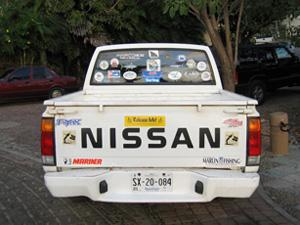
Bumper stickers


Please use bumper stickers responsibly!

I enjoy reading so much that I’m glad someone invented bumper stickers! Now I can also read while I drive. The other day, I saw this bumper sticker as I drove: “Bumper to Bumper / Butt to Butt / Get Off My Ass / You Crazy Nut.” Well, that was a very lame bumper sticker as far as bumper stickers go. I thought back to the glory days, the actual Renaissance of bumper stickers. I remember reading some excellent bumper stickers long ago, in the Golden Age of public expression.

Yes, like many American cultural icons, bumper stickers were born about the same time as t-shirts with messages, way back in the 1960s when everyone seemed to have something important to say. Once, long ago, t-shirts were underwear, something that men wore under their dress shirts with a collar. And there were no bumper stickers then; bumpers were still bare and naked. Their sole purpose was to protect the car and its occupants in case of a collision. In the 1950s, juvenile delinquents, JDs, began wearing white t-shirts as outerwear and car bumpers got bigger and brighter chrome, but alas, neither took advantage of all the possible attention that was showered upon them in the 1960s. Then, someone viewed the white t-shirt as a blank canvas intended for artistic expression. And, Voila! The message t-shirt was born, and riding on its shirttails, was the bumper sticker.

Some of the messages were exclusive to their medium, but most messages expressed themselves equally as well on a t-shirt or a bumper sticker: “If I told you that you had a beautiful body / would you hold it against me?” However, I prefer bumper stickers. T-shirts have long ago reached their saturation point and we’re now seeing the reemergence of plain white T-shirts. I prefer the bumper stickers because I love to read, and they allow me to read while I drive. I wax nostalgic as I recall some of my favorite bumper stickers! I can still see them, like my family and friends gathered round the holiday dinner table! Let me recall a few for you.

I remember there were political messages: “No Nukes,” “Save the Whales.” And there was a religious message: “Jesus Saves.” And then some genius, in a stroke of absolute brilliance, penned this magnificent treasure: “Nuke the Whales for Jesus”! I was amazed that this author didn’t win the Nobel Prize for literature.

When the Born-Again Christians bragged, “I Found It,” National Lampoon offered the rebuttal: “I Lost It!” For a while many station wagons and minivans boasted, “My child is an honor student at …” Suddenly, there were some bumper stickers that read, “Your Kid’s an Honor Student / But You’re a Moron” and “My Kid Beat Up Your Honor Student.” To “If You Can Read This / You’re Too Close,” someone replied, “If You Can Read This / Thank a Teacher.” And for the aggressive tailgater, “Sorry for driving too close in front of you.”

Then there those bumper stickers that expressed a variety of feelings: “Beauty Is In The Eye Of The Beer Holder.” “Insanity Is Hereditary / You Get It From Your Kids.” “Ex-Husband In Trunk.” “Don’t Hit Me / My Lawyer’s In Jail.” “How’s My Driving? / 1-800- EAT SHIT.” “Gas, Grass, Or Ass / No One Rides For Free.” “If This Van’s A Rocking / Don’t Come A Knocking.” I saw an old clunker sporting this bumper sticker: “My Other Car Is A Rolls Royce.” Then I once saw a Roll Royce with this one: “My Other Car Is A Lear Jet.”

As much as I love reading bumper stickers, I have only ever had one bumper sticker on all my cars: “USMC.”

DDR

Accents


On the road in México

Accents are a funny thing. An accent separates or distinguishes you from another person or group when you speak. For as long as I can remember, I have always had an accent. In kindergarten, I spoke broken English since I only spoke Spanish at home. So, I had a Mexican accent. But when I went to Mexico, I had a gringo accent when I spoke Spanish. Then, I met my friend Patrick McDonnell in the second grade, and I spoke with a little bit of an Irish brogue. Since I attended a Lithuanian Catholic grade school, I picked up a few Lithuanian words. In high school, classmates made fun of the way I talked, so I only talked when necessary. I remember reading books aloud to practice my pronunciation. I was trying to eliminate any trace of an accent. Unsuccessfully, I might add.

When I enlisted in the Marines, I met people from all over the United States for the first time in my life. It was the first time someone told me that I had a Chicago accent. I was surprised when I met someone new, and he said he knew I was from Chicago because I had no accent. My accent adapted unconsciously so it would fit in. And I did fit in. During my enlistment, I spoke with the accents of Brooklyn, Texas, Queens, Boston, Virginia, Oklahoma, and California. But I didn’t do this on purpose. I just somehow blended in with everyone around me.

When I began teaching Spanish, I also unconsciously adapted the accent of the people around me. So, depending on to whom I spoke, I would speak like them. I’m not sure what my authentic original voice sounds like anymore. A colleague once said, “I was trying to figure out what dialect you were. Now I know you’re Mexican because you said, “Mande.”

I suppose if I listen to myself carefully, I hear all these different accents in my voice from different places.

DDR

Maxwell Street


I’ll have a Polish sausage with mustard and onions, but hold the cholesterol!

Last night, I watched The Blues Brothers movie again, mainly to show my sons a classic movie about Chicago. I first saw it in 1980 when I was in the Marines. I saw the 25th anniversary edition DVD at my local library and I borrowed it since I always talk about classic movies with my sons.

This is an age of reproductions and sometimes my sons will quote something from a song, a TV show, or a movie they have seen without knowing the source of the imitation, parody, or spoof. So whenever possible, I try to educate my sons by pointing out the original source. Perhaps the most famous scene from The Blues Brothers movie is the one that I’ve seen in many contexts and that is the scene where Jake and Elwood Blues go to the Triple Rock Baptist Church and find God. You know the scene where Jake back flips up and down the aisle. I once saw this scene with my sons at a movie theater during the previews. My sons had seen the scene before, too, but they had never seen the whole movie.

I liked the scene at Maxwell Street because I still remember going to Maxwell Street as a boy with my father and uncles when we lived in Pilsen. When we went to St. Francis of Assisi Church on Roosevelt and Halsted, we were right around the corner from Maxwell Street. Sometimes we went to Maxwell Street after mass. My father always went to Preskill’s hardware store where my father could look at tools for hours. I always remember the little shacks that were built in the middle of the street to sell food such as red hots (hot dogs), Polish sausages, and other appetizing greasy foods, but we never ate there.

When I was old enough to drive, I often returned to Maxwell Street, against my mother’s wishes. This was a wonderful place to buy nice clothing cheap. And tailors would alter it for a perfect fit.

It was then that I was finally attracted to the fine cuisine that Maxwell Street had to offer. Yes, I’m talking about those Polish sausages and pork chop sandwiches, way before they started serving them with French fries. Jim’s Original Maxwell Street Polish Sausage was right on the corner of Maxwell and Halsted. That was my favorite eating establishment.

Sometimes I would stop there on the way home from the comedy clubs because they never closed. I mean never! Not even Christmas or New Year’s Eve. Where else could I buy a Polish sausage and pork chop sandwich at any hour of the day, any day of the year? Sometimes I would drive by just to smell the all the Polish sausages, pork chops, and onions piled high on the ever-grilling grill that was the equivalent of Maxwell Street’s eternal flame.

I would always meet interesting people there, too. I once saw a limo pull up and the passenger in the backseat got out to buy a Polish sausage and then got back into the backseat of the limo and then it drove off. I’ve often wondered about the true story of that purchase. How cool would it be to go to Maxwell Street in limo?

When I became a Chicago police officer, if I drove past Maxwell Street, I just had to stop for a Polish sausage and a pork chop sandwich. No matter what district I worked in, if I somehow found myself going by Maxwell Street on the way back from the Cook County Jail, the Cook County Hospital, or the Cook County Juvenile Detention Center. Of course, I would stop at Jim’s Original Maxwell Street Polish Sausage and partake of their fine cuisine.

DDR

My mother had friends everywhere


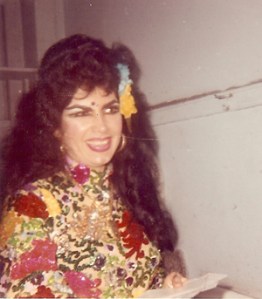
Irma Serrano at the People’s Theater, Chicago, Illinois

When I was a young boy, I was convinced that my mother knew everyone in the neighborhood. Every time I went grocery shopping with my mother, she always met someone she knew, either from the neighborhood, the old neighborhood, or from México.  While talking to someone she met on the street, my mother would ask about other mutual acquaintances. I was amazed at how many people she knew. She could talk for an hour with someone she met on the street because they knew each other very well and I would always be pulling her arm so we could go home before the milk went sour.

Once before my mother went to Mexico for her summer vacation, she asked me to do her a big favor. The Mexican singer Irma Serrano was coming to Chicago to perform at the People’s Theater on 47th Street and Ashland Avenue in Back of the Yards.

Well, my mother wanted me to go to the show and take pictures of Irma Serrano for her. I was nervous because Irma Serrano was incredibly famous in Mexico. Then, my mother told me to go backstage after the show and tell Irma that my mother said hello.

Well, this was just too great a task for me! I told my mother that I didn’t think I could do all this. My mother assured me that I could once I told Irma that I was the son of Carmen Rodríguez. I told my mother that if she wanted to see Irma Serrano so badly maybe she shouldn’t go to Mexico and she herself should see Irma Serrano at the People’s Theater instead. After much convincing and threatening on the part of my mother, I agreed to take pictures of Irma Serrano and then go backstage to talk to Irma and then take even more pictures.

The day of the concert, I watched Irma perform beautifully—I must admit that even I loved the show—and I took plenty of pictures of Irma as promised. It took me a while to build up my courage, but I managed to go backstage and talk to Irma Serrano. When I told her I was the son of Carmen Rodríguez, Irma hugged me and asked me how my mother was doing. I asked her if I could take some pictures of her, and she posed for me. I managed to get a good picture of Irma’s dress that looked like butterfly wings from behind. My mother loved the pictures!

When I joined the Marines, my mother told me to look for somebody she knew. I said, “Chances are I won’t ever meet him. Even you have never met him!” He was the uncle of a little girl, Melanie, for whom my mother would babysit. My mother knew that her uncle was in the Marines but had no other information about him. I promised my mother that I would look for him, but I was sure that I would never run into him since the Marines are stationed all around the globe and I never left California.

However, one day, when I was stationed at Camp Pendleton, California, some arrogant Marine entered our shop shouting, “Anyone here from Chicago?” I didn’t like his cocky attitude, so I didn’t answer him immediately. Then he shouted, “Any south siders here?” Well, I couldn’t resist that invitation to meet and greet a fellow south sider. What a coincidence! He just so happened to be Melanie’s uncle. We even knew some of the same people. We became friends because of my mother!

DDR